
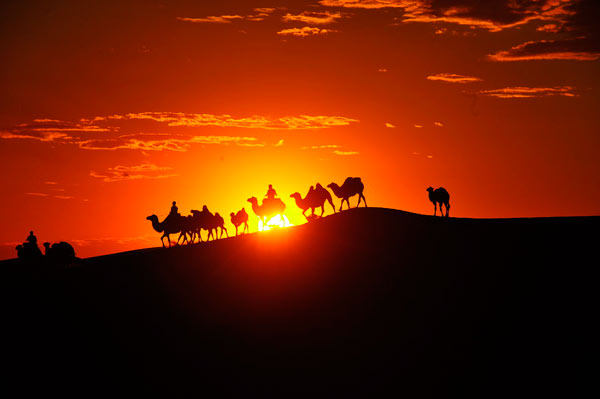
File photo of a desert in Tongliao, Inner Mongolia autonomous region.(Photo/Chinadaily)
It is always a pleasure for me to support and participate in the China Development Forum at the LSE. Since its inception it has gone from strength to strength. I truly see it as a gathering of future leaders.
I have been following China, the events there and the development of the country, all my life. It has been the greatest privilege of my life to be a witness to and, if I may say so, a modest participant in, one of the greatest chapters in human history. I refer to the remarkable transformation and development of China in an unprecedentedly short period of time into the world’s second largest economy and the transition from poverty to the beginnings of moderate prosperity that this has entailed for well over a billion people. Given the majesty of China’s history, culture and civilisation, I prefer to refer to this not as the rise of China but rather as the return of China.
Now that China has returned, the question of what sort of country it will be, what role it will play in the world, is something that naturally concerns the entire international community.
It is against this background that China has advanced the concepts of a global community of common destiny, of shared prosperity, equality and mutual benefit and win win cooperation. China, having suffered from poverty and oppression in the past, understands that a world where only China develops, and its neighbours and the wider world either stagnate or relapse into poverty and conflict, is not only undesirable, it is actually impossible. China itself has prospered by opening its door to the outside world. Sustainable and lasting prosperity has to mean prosperity for all.
This is the thinking behind a whole range of China’s recent initiatives – for example of the development of BRICS, along with Brazil, Russia, India and South Africa, and the creation of their New Development Bank; of the Asian Infrastructure Investment Bank (AIIB), formally launched in Beijing earlier this month; and especially of our topic of the moment, the great vision of jointly building the Silk Road Economic Belt and the 21st Century Maritime Silk Road.
As Minister Zhang has already explained, this is a new idea, but one with an ancient lineage. As the National Development and Reform Commission, the Ministry of Foreign Affairs and the Ministry of Commerce of the People’s Republic of China have jointly observed:
“More than two millennia ago the diligent and courageous people of Eurasia explored and opened up several routes of trade and cultural exchanges that linked the major civilisations of Asia, Europe and Africa, collectively called the Silk Road by later generations. For thousands of years, the Silk Road Spirit – ‘peace and cooperation, openness and inclusiveness, mutual learning and mutual benefit’ - has been passed from generation to generation, promoted the progress of human civilisation, and contributed greatly to the prosperity and development of the countries along the Silk Road. Symbolising communication and cooperation between the East and the West, the Silk Road Spirit is a historic and cultural heritage shared by all countries around the world.”
China’s initiative to jointly build the Belt and Road, embracing the trend towards a multipolar world, economic globalisation, cultural diversity and greater IT application, is designed to uphold global free trade and an open world economy and to enhance regional cooperation. It aims at being highly efficient in terms of the allocation of resources and at achieving a deep integration of markets among the countries along the Belt and Road, thereby jointly creating an open, inclusive and balanced regional economic cooperation architecture that benefits all.
According to the vision of the Chinese government, the Belt and Road Initiative is in line with the purposes and principles of the United Nations Charter. It upholds the Five Principles of Peaceful Coexistence, namely mutual respect for each other's sovereignty and territorial integrity, mutual non-aggression, mutual non-interference in each other's internal affairs, equality and mutual benefit, and peaceful coexistence.
The initiative is an open one. It covers, but is not limited to, the area of the ancient Silk Road. It is open to all countries, and international and regional organisations, so that the results will benefit wider parts of the globe as well.
It is harmonious and inclusive. It advocates tolerance among civilisations, respects the paths of development chosen by different countries, and supports dialogues among different civilisations on the principles of seeking common ground whilst reserving differences and drawing on each other’s strengths, so that all countries can coexist in peace for common prosperity.
The new silk road follows market principles. It will abide by market rules and international norms, will give play to the decisive role of the market in resource allocation and the primary role of enterprises, and will also let governments perform their due functions.
 |
Day|Week

 China releases HD true color images of lunar surface
 To-be flight attendants undergo training at snow-covered field
 Aerial photos taken on J-11 fighter
 'Coldest town in China' — a fairyland you don't want to miss
 Deep love for breathtaking Hainan
 Beautiful Chinese tennis player Wang Qiang goes viral online
 Minus 71 degrees! Coldest village on earth
 Chinese pole dancing master opens class in Tianjin
 The most beautiful town of snow in China
 SWAT members hold romantic wedding in E China


