
 |
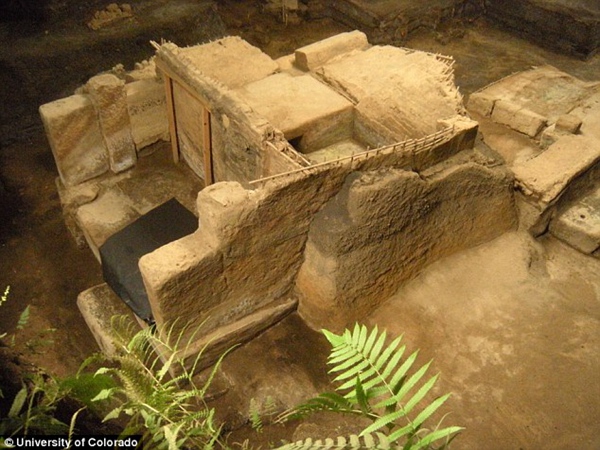
| Scientists at the University of Colorado Boulder have taken a fresh look at a Ceren Maya village in El Salvador, which was frozen in time by a blanket of volcanic ash 1,400 years ago. |
Scientists have taken a fresh look at a Maya village in El Salvador, which was frozen in time by a blanket of volcanic ash 1,400 years ago.
Their study has found that around 200 people who called Ceren their home lived with little influence from elites over their daily lives.
They had full control over their architecture, crops, religion and economics, according to ongoing research by the University of Colorado Boulder.
The village of Ceren was covered in 17ft ash, at 7pm on an August evening, as the Loma Caldera volcano erupted less than a third of a mile away.
Discovered in 1978 by University of Colorado Boulder anthropology Professor Payson Sheets, Ceren has been described as the 'New World Pompeii'.
The ash has preserved the village so well that researchers can see the marks of finger swipes in ceramic bowls and human footprints in gardens.
But exactly how the villagers lived has long been a subject of speculation.
Some Mayan archaeological records document 'top-down' societies where the elite living among palaces, pyramids, temples and tombs.
The documents suggest they made most political and economic decisions in a particular region, at times exacting tribute or labour from villages.
But at Ceren, the villagers appear to have had free reign regarding their architecture, crop selections, religious activities and economics.
'This is the first clear window anyone has had on the daily activities and the quality of life of Maya commoners back then,' said Sheets, who is directing the excavation.
'At Ceren we found virtually no influence and certainly no control by the elites.'
A paper on the subject appears in the current issue of Latin American Antiquity published by the Society for American Archaeology.
The 10-acre Ceren research area was declared a UNESCO World Heritage Site in 1993.
Ceren is believed to have been home to about 200 people.
So far twelve buildings have been excavated, including living quarters, storehouses, workshops, kitchens, religious buildings and a community sauna.
There are dozens of unexcavated structures, and perhaps even another settlement or two under the Loma Caldera volcanic ash, which covers an area of roughly two square miles, he said.
So far, no bodies have been found, which suggests earthquake may have given residents an early warning before the eruption.
The only relationship Ceren commoners had with Maya elite was indirect, through public marketplace transactions in the Zapotitan Valley.
There, Ceren farmers likely swapped surplus crops or crafts for coveted specialty items like jade axes, obsidian knives and colorful polychrome pots, all of which elites arranged to have brought to market from a distance.
Virtually every Ceren household had a jade axe - which is harder than steel - using it for tree cutting, structure building and general woodworking.
About a quarter of the hundreds of pots found in the village were polychrome, said Sheets.
'The Ceren people could have chosen to do business at about a dozen different marketplaces in the region,' said Sheets.
'If they thought the elites were charging too much at one marketplace, they were free to vote with their feet and go to another.'
One of the excavated community buildings has two large benches in the front room, which Sheets believes were used by village elders when making decisions.
One decision would have regarded organising the annual crop harvest festival, a celebratory eating and drinking ritual that appears to have been underway at Ceren when the Loma Caldera volcano abruptly blew just north of the village, said Sheets.
He believes the villagers would have fled south, perhaps along a white road leading away from the village discovered during the 2011 field season under about 15 feet of ash.
There also is evidence that residents of particular households at Ceren were responsible for the upkeep of certain community structures, said Sheets.
One household, for example, contained an inordinate amount of pots and firewood that the researchers speculated were used during activities in the domed community sauna building.
That sweat bath, which could comfortably seat about a dozen people, had a central firebox where water was poured to create the desired steam and heat, Sheets said.
In 2009 Sheets and his team discovered intensively cultivated manioc fields at Ceren that yielded at least 10 tons of manioc shortly before the eruption 1,400 years ago.
It was the first and only evidence of intense manioc cultivation at any New World archaeology site. Sheets and others believe such large manioc crops could have played a vital role in feeding indigenous societies living throughout tropical Latin America.
Powder from dried manioc is used today in the region to make tortillas and tamales, and fermented manioc is used to make alcoholic beverages.
 |
 When a Chinese woman marries an Indian man
 Love beyond limit of heights in the world
 Photos of beautiful teacher hit the Internet
 Transparent Over-cliff Path Cracked Suddenly
 Bride-to-be tries to save drowned man
 Russian helicopter lands safely after being attacked in Syria
 Models change clothes on street in Hangzhou
 Winding mountain road
in China
Winding mountain road
in China In pics: army beauties across world
 Top 20 hottest women in the world in 2014
 Top 10 hardest languages to learn
 10 Chinese female stars with most beautiful faces
 China’s Top 10 Unique Bridges, Highways and Roads
 Aging gracefully
 Alternative education
 China’s domestic airliner deserves salute
 Confucius Peace Prize will go on despite ridicule
Day|Week


