
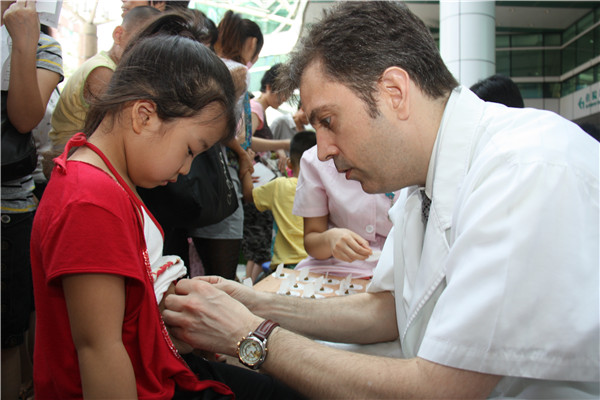
Paul Ryan, a US doctor studying traditional Chinese medicine in Guangzhou, capital of Guangdong province, treats a girl with sanfutie plaster, in July, 2012. [Photo provided to China Daily]
Traditional Chinese medicine has won more recognition in Western countries in recent years, but the 5,000-year-old medical science still needs a modern interpretation to break into the mainstream Western market.
According to the Beijing-based World Federation of Chinese Medicine Societies, more TCM clinics have opened in the West and more colleges are starting to offer TCM education, but TCM has not attained legal status in many countries.
In some countries, TCM is considered a food supplement rather than having medicinal effects, it added.
A major reason that TCM is not widely acknowledged in these countries is a lack of research on TCM such as its pharmaceutical details and its interaction with other medicines, according to the federation.
The number of registered TCM practitioners worldwide is estimated at about 500,000.
A cooperative project between the Guangdong Provincial Hospital of Chinese Medicine and Royal Melbourne Institute of Technology in Australia is trying to combine TCM with modern interpretations of ancient documents and high-level clinical research.
 |
 Top 10 nominated designs at BJDW
 Fashion show staged in Forbidden City at night
 Construction of HK-Zhuhai-Macao Bridge enters final stage
 Model of heavy-lift copter makes debuts at Tianjin expo
 Art photos of Chinese beauty in Han Chinese clothing
 Stunning photos of air show in China’s V-Day parade
 Models change clothes on street in Hangzhou
 Charming Chinese female soldiers
 Beauty vs. muscular man
 Rising to the challenge
 Rand report echoes Cold War mind-set, overstates threats
 Inland nuke plants crucial to energy future
 Communist confrontation
Day|Week