Sat,Aug 2,2014
 The 4th Chinese National Pole Dance Championship held in Tianjin
 Chinese navy commandos debut at 2014 RIMPAC
 Guangxi impression: scenic countryside
 World's largest aquatic insect found in Sichuan
 Ceremony volunteers for Youth Olympics make public appearance
 A glimpse of female crew of Liaoning aircraft carrier
 Stills from "Dad, where are we going?"
 Legless man's happy life
 Top ten most beautiful islands in China
 Aerial view of Hong Kong
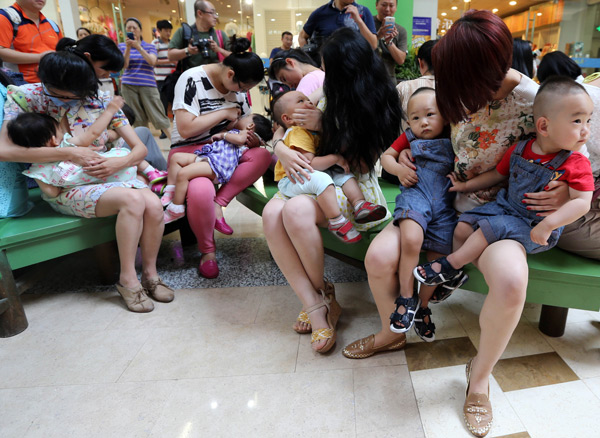 |
| Activist mothers breast-feed their babies for five minutes in a shopping mall in Qingdao, Shandong province, on June 28 to promote the importance of breast-feeding. Provided to china daily |
Though it received 240 liters of breast milk in one year, China's second breast milk bank, in Nanjing, Jiangsu province, has far from enough to feed hospitalized premature and sick babies.
The breast milk bank, established at the Nanjing Maternity and Child Health Care Hospital in August 2013, has received 205 donors.
"We have about 800 milliliters of milk at our disposal every day," said Zhou Juan, a nurse at the milk bank. "But, generally, we have more than 10 sick babies who need to be fed with breast milk. A newborn needs to have eight meals a day, sometimes several milliliters, sometimes more than 40."
"Now half of the hospitalized babies that need breast milk can only receive formula milk powder," Zhou said. "The donated breast milk is given to ultra low-weight premature and seriously ill babies."
Han Shuping, director of the hospital's neonatal department, said breast milk provides the best nutrition to newborns and helps those with diseases recover better.
She said a lack of door-to-door service and a shortage of funds have contributed to the current problem.
"To guarantee the safety of the breast milk, it's required that all donors go to the bank where the milk can be disinfected and frozen immediately," Han said. "But generally that will take the moms half a day. Many of them also need to go to work or take care of their own babies.
"Unlike breast milk banks in countries where donors are allowed to pump milk at home before the bank workers visit to collect them, the bank in Nanjing can only send cars to drive the donors to the hospital."
To prevent possible diseases that can be transmitted through breast milk — such as some skin diseases and the HIV/AIDS — donors must pass strict physical examinations.
"The donors also need to feed their babies for no more than 10 months to guarantee the quality of the breast milk, and have good nutrition and an optimistic mood during the breast-feeding period," said Zhou.
Pan Hui, a new mom who has donated more than 10,000 milliliters of breast milk, goes to the hospital once a week to donate.
"I have extra breast milk and it can help babies in need," said Pan. "But it's time consuming and sometimes inconvenient."
According to Han, though the hospital pays to disinfect and store the donated milk, and pay for the donors' health examinations, the milk is provided to the babies for free.
"Currently, there's no regulation that allows us to charge fees to maintain the function of the bank," Han said. "In the US, users will be charged, and the breast milk is much more expensive than formula."
"We have suggested that all breast-feeding medical workers at the hospital should donate to the bank, and we're trying to solve the current problems to meet the huge demand for breast milk."
 Blockbuster? No, it’s firefighters’ posters
 Special 'gifts' for IT men for Chinese Qixi Festival
 Foreign students' colorful life in China
 French photographer‘s work 'China 2050' goes viral online
 A bite of Halal Food
 Dressed in uniforms to marry you
 Female soldier in Chinese special force
 Zhujiang ambassadors attend lotus lanterns activity
 From girly girl to tough special police officer
 22-year-old veteran travels around China
 Night scenery of pagoda forests
 China suffers from hot summer
 48 hours after super Typhoon Rammasun
 German pianist plays mid-air ‘magic carpet’ show over Munich Airport
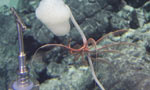 China's manned deep-sea submersible conducts dive in Pacific Ocean
Day|Week|Month