



LineShine's repeat TOP500 win highlights China's homegrown tech strength
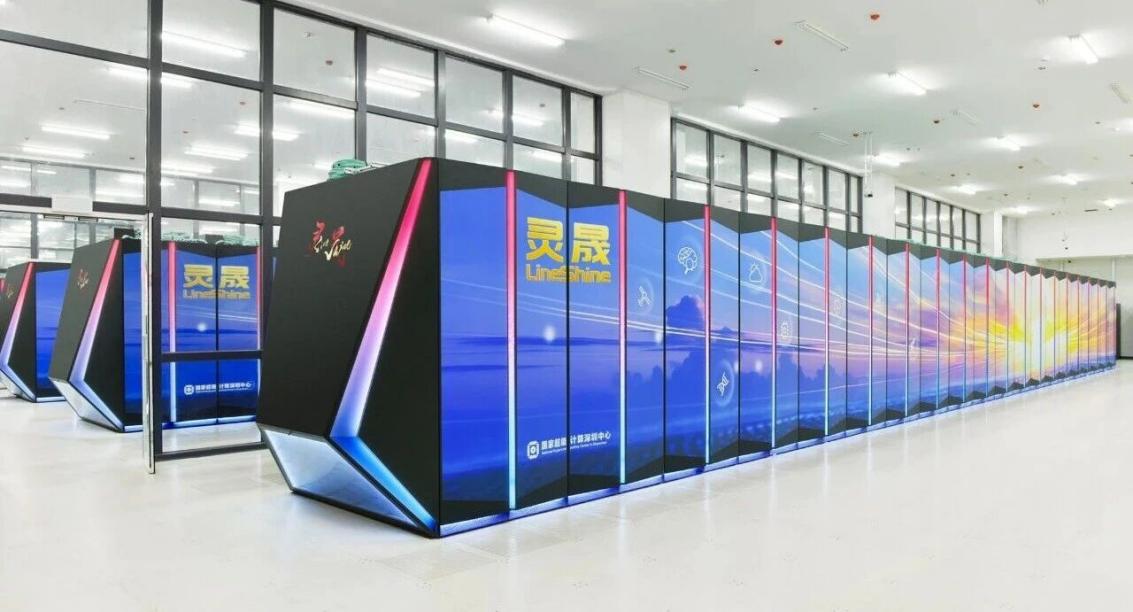
Photo shows the LineShine supercomputer. (Photo courtesy of the National Supercomputing Center in Shenzhen)
China's homegrown supercomputer LineShine has retained its title as the world's most powerful supercomputer in the latest TOP500 ranking, following its debut at No. 1 in June 2026.
The repeat win further underscores the leading edge of Chinese supercomputing, with LineShine outperforming the U.S. runner-up, El Capitan, by roughly 21 percent in sustained double-precision performance.
Hailed as the "crown jewel" of computing and an "engine" of sci-tech breakthroughs, supercomputing is widely applied in weather forecasting, engineering simulation, materials science, and drug discovery, among other fields. As a result, it has become one of the fiercest arenas of international technological competition.
In the 1980s, high-performance computers imported into China had to be housed inside transparent glass rooms, with foreign personnel holding the keys and vetting all computing data. This episode has long served as a driving force behind China's homegrown supercomputing sector.
Over the following decades, China's homegrown supercomputers made rapid strides.
With the successive debuts of the Sugon, Tianhe, and Sunway series, China joined the small group of nations capable of developing high-end computing systems.
Supercomputers such as Tianhe-2 and Sunway TaihuLight have repeatedly topped the TOP500 ranking. Yet as the external environment changed, China's supercomputing sector was hit with severe technological blockades, becoming one of the most heavily restricted fields.
Despite these challenges, China's progress in supercomputing never stalled.
Lu Yutong, chief designer of LineShine, said in an article that the team rebuilt an independent, controllable, secure, reliable, and sustainably evolving technological roadmap for supercomputing through long-term investment and sustained breakthroughs.
LineShine's systemic innovation spans the entire chain, including chips, networking, storage, system software, and the application ecosystem.
By integrating matrix acceleration units directly into the CPU, the architecture gives processors built-in acceleration capabilities. The design achieved a leapfrog breakthrough without using a single GPU, while offering a new paradigm for next-generation platforms that integrate supercomputing with intelligent computing.
In addition, by combining homegrown high-bandwidth memory, proprietary high-speed networking, and a fully self-developed software system, LineShine has moved beyond isolated breakthroughs into a complete, self-reliant system. Retaining its global No. 1 title once again proves the machine's real-world performance and stability.
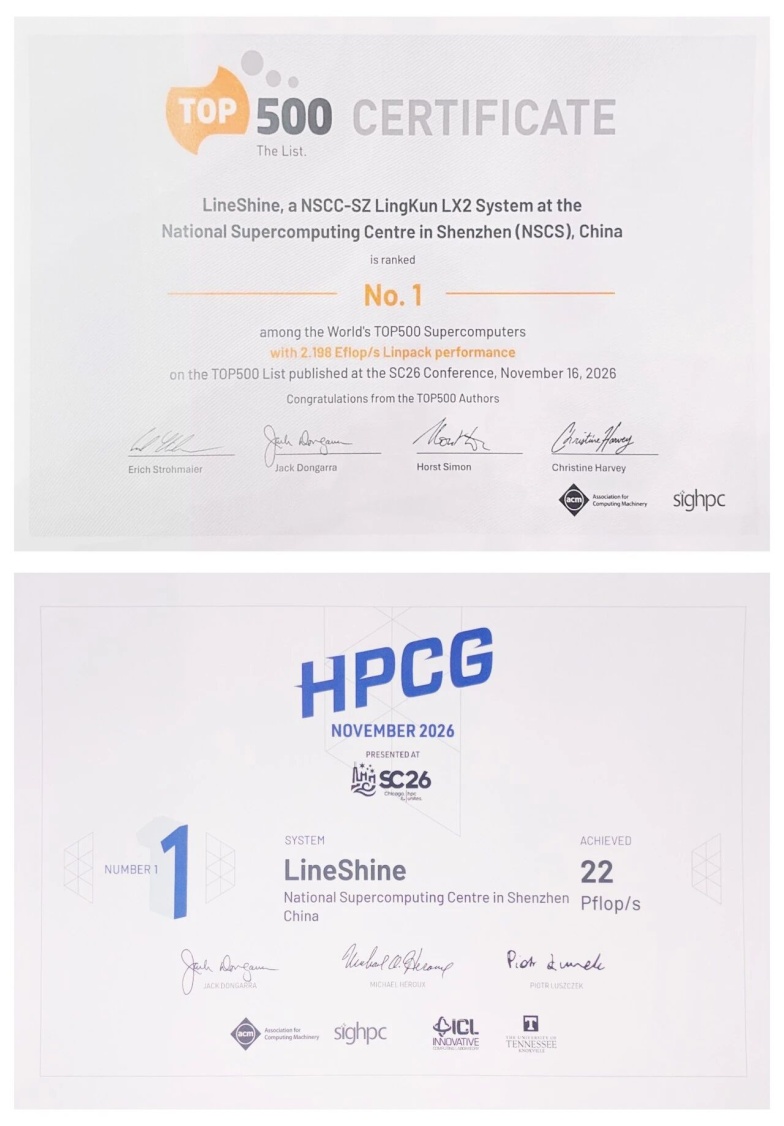
China's homegrown supercomputer LineShine ranks first on the latest TOP500 ranking at the International Conference for High Performance Computing, Networking, Storage, and Analysis (SC26) in Chicago, the U.S., on Nov. 17, 2026. (Photo courtesy of the National Supercomputing Center in Shenzhen)
Beyond retaining its title as the world's most powerful supercomputer, LineShine stands out in other ways.
A homegrown supercomputer's true strength lies not just in its performance, but also in practical use. LineShine has supported 22 large-scale applications involving more than 10 million processor cores each and has been adapted to run more than 220 specialized software applications.
Looking ahead, efforts will focus on extending the industrial chain, weaving digital technology more deeply into the real economy, and steadily turning the computing strengths into development advantages.
Photos




Related Stories
- China's intelligent computing expected to top 90 pct of total computing capacity
- Grassland city in N China's Inner Mongolia transforms into an AI computing hub
- China's integrated computing network spurs new industrial opportunities
- China advances coordinated development of intelligent computing, advanced storage capacity
- China builds national computing network as key pillar of new infrastructure
- China's space-based computing cloud starts regular in-orbit services
- In the AI era, Changzhou 'transforms' into a global computing power hub
- China to advance forward-looking research in space computing power technologies, support related industry: MIIT official
- Chinese scientists develop high-efficiency computing-in-memory device
- China's tech firm deploys AI model in orbit, unveils massive space computing plan
Copyright © 2026 People's Daily Online. All Rights Reserved.
