



How China's second Jiaozhou Bay undersea tunnel achieves green construction
Located in Qingdao, east China's Shandong province, Jiaozhou Bay boasts wide, deep waters. Far beneath the surface, construction is underway on the second Jiaozhou Bay undersea tunnel, a massive engineering project.
The tunnel's main line is 17.48 kilometers long, while the tunnel itself extends for 14.37 kilometers. It consists of two parallel main tunnels for traffic, with a service tunnel running between them. Designed to operate entirely underground, the project leaves no visible footprint on the surface while ensuring uninterrupted maritime activity above.
Li Xiang, head of the company responsible for constructing the project, said the team planned from the start to minimize the project's impact on Jiaozhou Bay's marine environment, which is why the entire tunnel is deeply embedded beneath the seabed.
How did the builders lay a tunnel deep beneath the seabed?
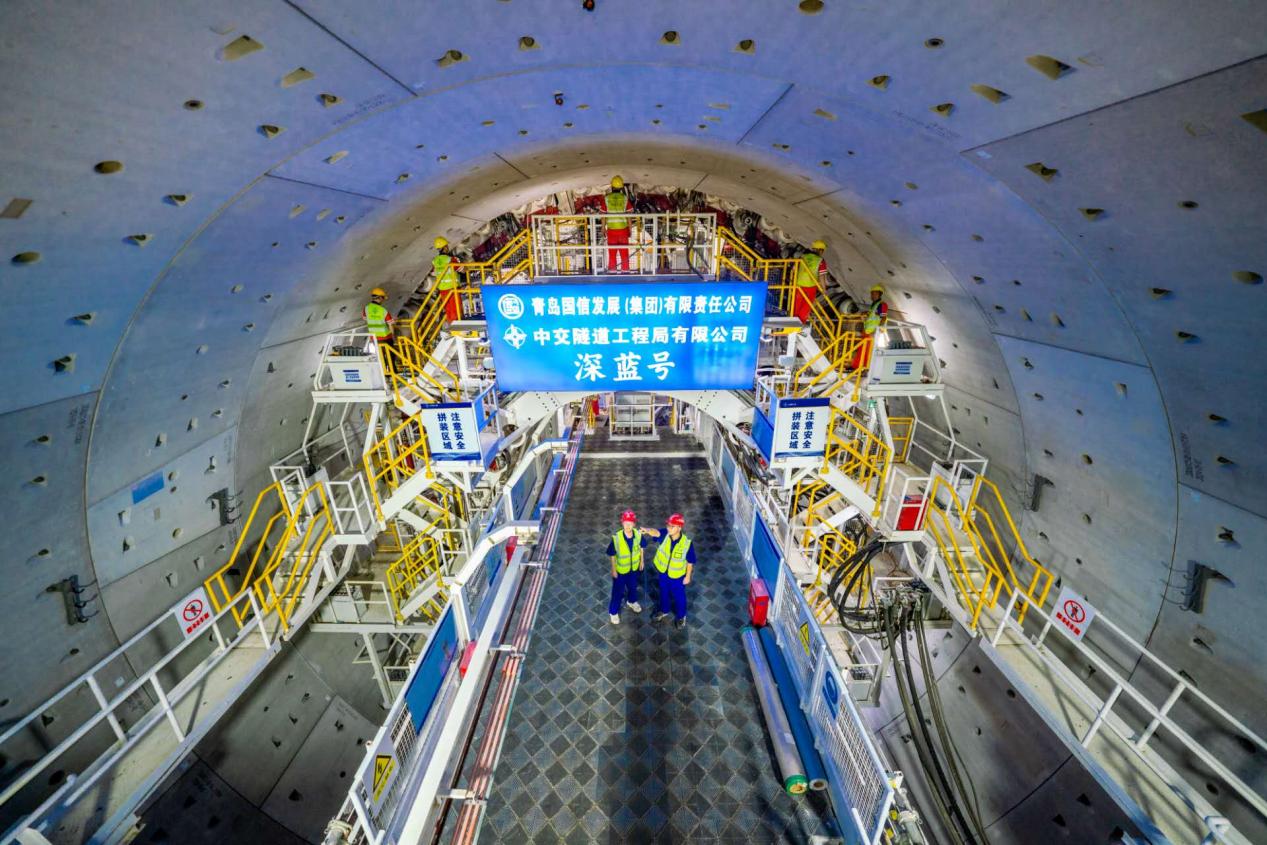
Photo shows the construction site of the second Jiaozhou Bay undersea tunnel in Qingdao, east China's Shandong province. (Photo courtesy of Beijing Daily)
Situated beneath the seabed, the tunnel traverses locations with water depths ranging from 20 to 46 meters. It runs beneath 11 meters of soil and rock at its shallowest point and more than 70 meters at its deepest.
At its lowest point, the tunnel's roadway sits 115 meters below sea level -- beneath 46 meters of water and more than 60 meters of seabed rock.
Therefore, compared to cross-sea bridges and immersed tube tunnels, a tunnel buried deep in seabed rock causes virtually zero disruption to maritime traffic or marine life in Jiaozhou Bay.
This design concept, however, brought about a world-class challenge: ventilation.
For most road tunnels, a tall ventilation tower must be erected every 3 to 5 kilometers to refresh the air inside. The offshore section of the second Jiaozhou Bay undersea tunnel spans 9.95 kilometers.
With traditional designs, this would mean building an artificial island in the middle of the sea and reclaiming land just to erect ventilation towers. This would have contradicted the initial objective of protecting Jiaozhou Bay's marine environment.
To solve the ventilation challenge, the designers turned to the service tunnel.
Carrying no regular traffic, the service tunnel serves mainly for maintenance and as an emergency route once the tunnel opens to traffic.
"We turned the service tunnel into a 'laid-down' ventilation tower, using fans to pump fresh air directly into the main tunnel," said Sun Wenhao, head of design for the second Jiaozhou Bay undersea tunnel at China Railway Siyuan Survey and Design Group Co., Ltd.
Working alongside ventilation shafts on both ends of the tunnel, the service tunnel has helped overcome the ventilation bottleneck caused by the ultra-long distance.
On Oct. 2, shield tunneling for the project wrapped up 105 meters beneath the surface of Jiaozhou Bay.
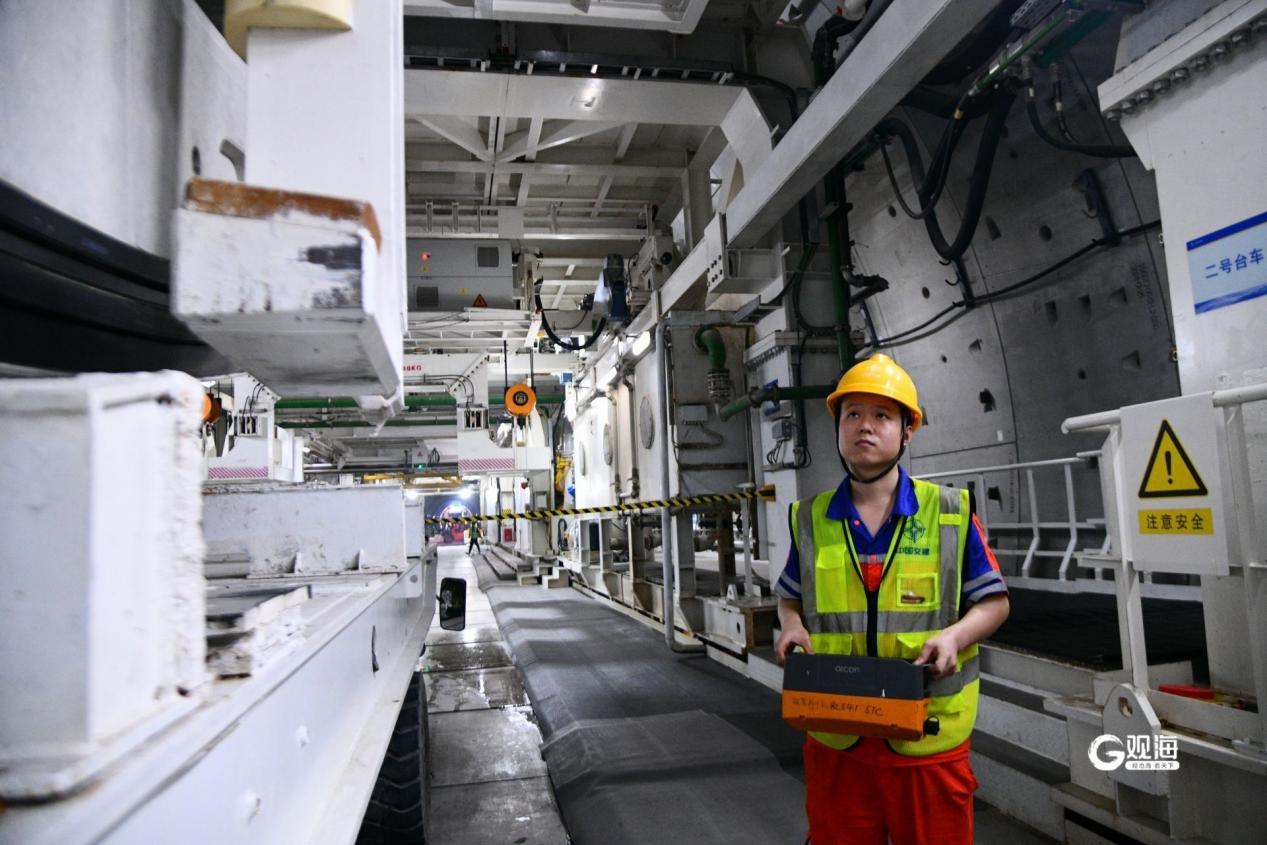
A builder operates machinery at the construction site of the second Jiaozhou Bay undersea tunnel in Qingdao, east China's Shandong province. (Photo courtesy of Guanhai News)
Data shows that excavating 3,255 meters of the main line by shield tunneling generated more than 1.3 million cubic meters of slurry and over 600,000 cubic meters of muck.
The project uses six filter press treatment systems capable of processing up to 4,000 cubic meters of slurry a day. The equipment compresses millions of cubic meters of separated slurry into mud cakes with less than 30 percent moisture. The resulting mud cakes are then reused as roadbed backfill, maximizing the reuse of excavated waste.
The project has carried out nearly 4,000 safe subsea blasts so far, yet passing ships can barely feel them, thanks to upgraded drilling and blasting techniques.
Using a drilling jumbo, a tunneling machine, builders can drill 260 boreholes across a 160-square-meter excavation face within 3 hours.
"Having more boreholes means we can reduce the explosive charge per hole and minimize disturbance from the blast," said Chen Yao, manager of the project's TJ-04 section under China Railway No. 2 Engineering Group.
Following drilling, technicians load digital electronic detonators into each borehole.
"Digital electronic detonators allow for precise control, reducing the amplitude and decibel levels of blasting vibration to the absolute minimum," Chen noted.
In practice, the vibration is barely perceptible. During blasting in the northbound main tunnel, people just 12 meters away in the service tunnel heard the noise but felt no tremor.
At the safety production dispatch and command center of the project, the command display screen clearly presents metrics such as construction progress and personnel headcounts.
"Using 5G, BeiDou positioning, smart robots, and other technologies, the project has built a digital construction platform for lean management," Li said.
Even 115 meters below sea level, the system accurately tracks each worker's location, movement trajectory, and tunnel entry and exit times, making site management more digitalized, refined, and smarter, he added.
The project incorporates a wide range of green practices during construction. Excavators, loaders, haul trucks, and other main machinery all run on new energy, excavated rock debris is nearly 100 percent recycled, and underground space is fully utilized to save surface land.
Engineers are also working to turn the site into a green tunnel demonstration project and draft evaluation standards, filling a gap in domestic green tunnel guidelines.
Photos


Related Stories
Copyright © 2026 People's Daily Online. All Rights Reserved.
