



New Chinese homegrown brands gain ground
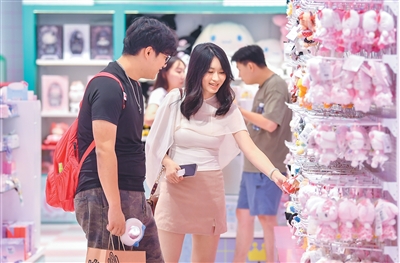
Consumers shop for products at a shopping mall in Haikou, south China's Hainan Province. (Photo/Su Bikun)
Homegrown Chinese brands are turning up in a growing number of product categories — and consumers are noticing.
The trend is even clearer among foreign tourists. Bags by Songmont, shoes by PANE and fragrances by To Summer have become must-buys for many of them.
A growing number of homegrown brands, once known mainly for their low prices, now draw long lines of shoppers and are becoming household names.
On e-commerce platforms, a growing number of homegrown brands now rank among the most-searched names.
Search volume is one measure of a brand's standing: the biggest international luxury names are searched for constantly, which means consumers go looking for them rather than waiting to be shown.
The China Online Consumer Brand Index, now in its seventh edition, is the first online consumer index designed to measure high-quality development. Researchers at Peking University's National School of Development used it to analyze third-quarter search volumes for homegrown brands. Homegrown brands took 67 of the top 100 spots and six of the top 10. And in seven of the 13 industries covered — including home appliances, furniture, jewelry and apparel — they ranked first.
"Brand searches reflect, to a certain extent, consumers' attention to and awareness of a brand," said Ji Yang, a member of the research team and associate professor at the School of Business at Sun Yat-sen University.
Homegrown brands target both budget-conscious and premium consumers, but competing on price alone does not work in many sectors. "In the beauty industry, lower average spending per customer does not translate into higher search volumes. Brands that attract more searches also tend to have higher spending per customer, pointing to competition increasingly driven by quality," Ji said.
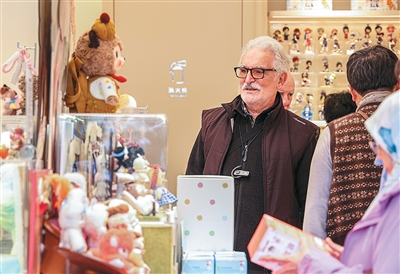
A foreign tourist shops at a Pop Mart store at Yuyuan Garden Mall in Shanghai. (Photo/Wang Chu)
The index scores brands on 12 indicators across four dimensions, among them transaction value and customer ratings. Average scores have risen 8.8 percent since the first quarter of 2023. Ji said search volume correlates strongly with those scores — evidence that brands are increasingly competing on quality.
Lin Jianhao, a business director at Tmall's brand marketing center, said the platform began tracking emerging homegrown brands in 2019. Back then, brands were often well-funded and leaned heavily on marketing, while consumers were choosing them over foreign labels out of national pride.
Consumers are more willing to pay for effectiveness and user experience, and they increasingly weigh the technology and R&D behind a product, Lin said.
Emerging brands are also designing for the specific needs of Chinese consumers. LISSOME, a small-appliance brand, found that most dishwashers on the market are built-in models, while smaller households need portable machines with quick wash cycles. Its "capsule" dishwasher, priced from about 2,000 yuan ($298), quickly gained popularity.
The Singles' Day shopping festival offers a window into the development of Chinese brands and evolving consumption trends. This year, Tmall's event featured 1 million global brands and 72 million products on promotion, both record figures. Among the brands, 182 that have been on Tmall for less than five years ranked in the top 10 of their industries by sales, some within a year of their founding.
Brands are increasingly launching new products to drive spending. In the month before the festival, the number of merchants launching on Taobao and Tmall rose 64 percent year on year. New products topped the best-seller lists in beauty, apparel, sports and outdoor, and consumer electronics.
Photos




Related Stories
- From TikTok to the Alps, outdoor brands blaze new trails
- Rise of domestic brands reeling in 'China haul'
- Three Chinese brands hold joint fashion show at Milan Fashion Week
- International brands like Apple, adidas, L'Oréal, Coca-Cola report robust quarterly earnings in China
- Chinese brands showcase latest products at 20th Bahia Farm Show in Brazil
- Nation's brands eye spotlight at World Cup
- Chinese brands shine at international awards for innovation
- Int'l brands tap into China's thriving county-level markets
- Chinese beauty brands shine during "Double 11" by tapping culture, technology
- Chinese brands make new strides toward high-quality development
Copyright © 2026 People's Daily Online. All Rights Reserved.
