



Fragrance become young Chinese's 'emotional companion'
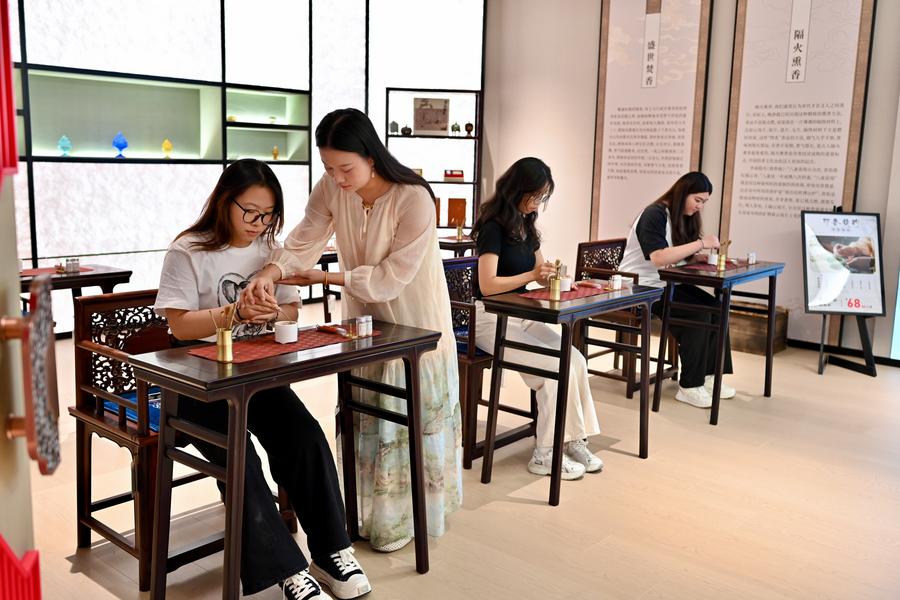
Women try incense-making under the guidance of a staff member at an agarwood museum in Xianyou County, southeast China's Fujian Province, on Sept. 24, 2025. (Xinhua/Jiang Kehong)
Lighting incense before bed has become a nightly ritual for a woman surnamed Chen, a 28-year-old working in the internet industry.
"My brain switches to rest mode, and the house smells nice. I feel good," she said.
She is not alone. On social media, many users share their experiences with fragrance, which is increasingly becoming an "emotional companion" for young Chinese.
Dapu town in Yongchun county, Quanzhou city, southeast China's Fujian Province, is the birthplace of Yongchun incense and a major production hub for the industry. The craft dates back to the late Ming Dynasty (1368-1644) and early Qing Dynasty (1644-1911). In 2021, Fujian incense-making craft, represented by Yongchun incense, was added to China's national intangible cultural heritage list.
The best-known type is bamboo incense. Lin Wenxi, a national-level inheritor of the craft, said it is made with local bamboo as the core, wrapped in natural plant materials that bind the powdered herbs. Craftspeople complete more than 10 steps by hand, producing a mild, lasting scent.
Yongchun incense has grown into an industry spanning the primary, secondary and tertiary sectors. The county has about 300 incense makers employing more than 30,000 people and producing over 1,000 varieties of products. The output value of the incense industrial chain has surpassed 10 billion yuan (about $1.5 billion). Yongchun incense products are sold in many countries and regions.
In the first five months of this year, the gross merchandise volume generated by livestream sales of Yongchun incense sticks and new Chinese-style aromatherapy products rose 461 percent year on year, with young consumers accounting for more than 60 percent of buyers.
One Dapu company uses artificial intelligence to analyze scent trends on e-commerce platforms, then refines the ingredient ratios in traditional formulas to develop fragrances and gift sets that appeal to young consumers.
Another local factory, which started as a family workshop in 1983, has grown into a business spanning research and development, manufacturing, cultural and creative product development, and tourism. Its incense-themed cultural and creative park was named one of Fujian's first sightseeing factories, where visitors can try their hand at making incense.
Local firms are also expanding beyond traditional incense products into portable incense, car and home fragrances, and cultural and creative souvenirs. These categories are gaining market share, while orders from stores, scenic spots and high-end hotels continue to rise.
In recent years, Yongchun has joined forces with Anxi, known for its tea, and Dehua, known for porcelain, to build a national demonstration zone for the integrated development of the tea, porcelain and incense industries.
In Jinxi county, Fuzhou city, east China's Jiangxi Province a fragrance-themed town lets visitors "listen" to scents: put on headphones, choose a fragrance, and hear the music composed for it. The town is also a provincial industrial tourism demonstration base.
In 2025, Jinxi county's flavor and fragrance industrial cluster generated revenue of 11.45 billion yuan, with more than 300 flavor products and nearly 10,000 fragrance products sold in over 30 countries and regions. The county's output of natural linalool and natural camphor powder accounted for 80 percent of the global market.
Camphor trees are a key raw material for the county's flavor and fragrance industry. In 2025, Jinxi had 165,000 mu (11,000 hectares) under large-scale cultivation. Through a cooperation model involving companies, cooperatives and farmers, local growers earn income from planting, employment and contract farming.
A Jinxi company develops essential oils and skincare products and uses livestreaming to reach young buyers. Its livestream sales exceeded 50 million yuan in the first half of this year.
Hu Gang, a flavor and fragrance technology graduate born in the 1990s, joined a Jinxi company in 2020. One product he helped develop is used in pharmaceuticals and personal care products, which are popular among young consumers.
Jinxi now has 126 companies in its flavor and fragrance cluster, 13 of which generate annual revenue above 100 million yuan. The industrial chain employs more than 11,000 people. In the first half of this year, the cluster brought in 6.645 billion yuan, up 16.18 percent year on year.
Photos



Related Stories
- China's consumer prices maintain mild recovery in October
- China issues guidelines to boost consumption, investment through infrastructure upgrades
- Services, smart products fuel new momentum in China's consumer market
- Payments rise as China's major shopping promotion season starts
- China's retail sales strengthen in first three quarters as consumption upgrading continues
Copyright © 2026 People's Daily Online. All Rights Reserved.
