



Commentary: China and Germany should deepen cooperation amid economic uncertainty

People cheers at a beer carnival in Taicang, east China's Jiangsu Province, Aug. 26, 2025. Known as the "hometown of German enterprises" in China, Taicang has gathered over 560 German-funded enterprises so far since the first German company Kern-Liebers settled in 1993, (Photo by Wang Xuzhong/Xinhua)
BERLIN, Oct. 27 (Xinhua) -- As two major economies with close business ties and complementary strengths, China and Germany have much to gain from deeper engagement and collaboration.
German President Frank-Walter Steinmeier's state visit to China, the first in nearly eight years, offers an opportunity to strengthen the foundation of China-Germany economic cooperation and explore new avenues for mutually beneficial development.
For Germany, China is seen as a partner in addressing global challenges and a competitor in economic and trade affairs. Concerns over industrial competition and trade imbalances have fueled calls for a tougher approach toward China. Yet these challenges should not overshadow the broader benefits of bilateral economic ties.
Trade between the two countries reflects their respective strengths, market demands and business choices. Rather than letting competition undermine cooperation, both sides stand to gain by addressing the concerns through dialogue.
Investment figures offer a telling illustration. According to an analysis published by the German Economic Institute, German companies invested around 5.6 billion euros (about 6.5 billion U.S. dollars) in China in the first half of 2026, roughly one-third more than that in the same period a year earlier. A survey by the German Chamber of Commerce in China, cited in the analysis, found that more than 85 percent of German companies operating in China intended to maintain or expand their presence, while more than half planned to increase investment.
For German companies, investing in China offers more than access to a large market. China's fast-evolving industrial landscape and strong innovation capabilities also offer opportunities to test new technologies, improve products and respond more quickly to changing market demands. The expertise gained in China can, in turn, help German companies strengthen competitiveness at home and in global markets. This makes a continued presence in China a strategic business choice, not simply a means of expanding sales.
Steinmeier's planned visit to Volkswagen's technology center in Hefei, east China's Anhui Province, offers a concrete example of this cooperation. The center integrates vehicle development, component R&D, procurement and testing, enabling Volkswagen to develop and validate vehicles locally and shorten time to market by around 30 percent, according to the German carmaker.
These business realities also offer a practical lesson for policymakers: competition need not come at the expense of cooperation. Siemens CEO Roland Busch told German newspaper Welt am Sonntag in August that Chinese companies had become highly capable competitors, citing strong engineering teams, innovative products and rapid adoption of new technologies, including AI. He cautioned against using tariffs to shield industries from competition.
BMW CEO Milan Nedeljkovic likewise opposed heightening trade tensions in an interview published by Frankfurter Allgemeine Zeitung last month, saying, "Nobody is interested in an escalation," and calling for dialogue to resolve trade disputes.
The interests of German companies in China reflect a broader reality: China and Germany's economic ties are deeply embedded in each other's industrial development. China has been Germany's largest trading partner in nine of the past 10 years, and the relationship extends well beyond the exchange of finished goods to manufacturing, research and investment.
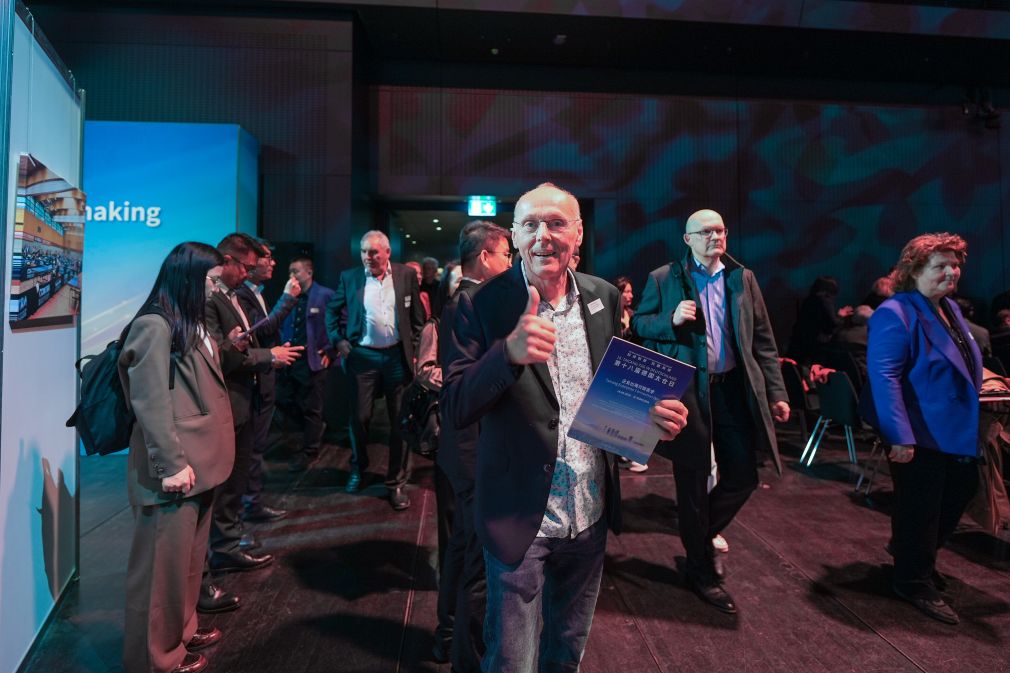
A guest holding a brochure attends the 18th German "Taicang Day" event in Munich, Germany, April 16, 2026. (Photo by Zhao He/Xinhua)
For many businesses in both countries, cooperation across these areas helps them innovate, compete and reach global markets. Preserving and deepening these links is therefore not just about sustaining trade flows, but also about creating new opportunities for both economies to grow.
The stakes extend beyond bilateral trade. As the world's second- and third-largest economies, China and Germany, which are all-around strategic partners, share an interest in global economic stability, climate mitigation and multilateral cooperation.
As protectionism and uncertainty rattle global supply chains, the two countries can ease the strain by keeping economic channels open, addressing trade concerns through dialogue and working under the auspices of the World Trade Organization. A more stable and balanced economic relationship would benefit businesses and consumers in both nations while supporting broader global growth.
Steinmeier's visit offers an opportunity to consolidate mutual trust, strengthen mutual understanding and maintain the momentum of practical cooperation. In a world of growing uncertainty, a stable and constructive China-German relationship can bolster global economic growth and help create a more predictable international environment.
Photos


Related Stories
- China, Germany call for deeper trade, investment ties at Berlin forum
- German investment in China rises by a third in H1: report
- Chinese FM urges China, Germany to boost cooperation, uphold free trade
- German president to visit China
- Chinese vice premier calls on China, Germany to tap cooperation potential in emerging fields
Copyright © 2026 People's Daily Online. All Rights Reserved.
