



Yasukuni Shrine visits and offerings tear away Japan's "country for peace" mask
Japanese Prime Minister Sanae Takaichi on Oct. 17 sent a ritual offering, known as "masakaki," to the Yasukuni Shrine, a notorious shrine which honors convicted Japanese Class-A war criminals from World War II, under her title as prime minister, local media reported. She made a monetary offering to the shrine through senior officials of the ruling Liberal Democratic Party on Oct. 19.
During Japan's "autumn festival," several Japanese politicians made offerings, while some cabinet ministers and lawmakers visited the shrine in person.
By pressing ahead with offerings and visits despite repeated opposition from peace advocates at home and abroad, such erroneous acts desecrate historical justice, challenge the bottom line of human civilization, and constitute a provocation to the postwar international order.
The Yasukuni Shrine has never been merely a religious site. It is a spiritual tool and symbol of the Japanese militarism that drove wars of aggression abroad.
Recently, Japanese media released internal meeting records from the shrine for the first time, revealing the full decision-making process behind the enshrinement of 14 Class-A war criminals, including Hideki Tojo.
The documents show that the Japanese government made arrangements on the enshrinement of Class-A war criminals with the shrine as early as the 1960s, but chose to keep the public in the dark until it was revealed in 1979.
This revelation once again confirms that the Yasukuni Shrine is unequivocally a shrine to war criminals. The Japanese government at the time knew full well the disgrace of enshrining Class-A war criminals and, fearful of the consequences, deliberately kept the decision-making process secret.
Fully aware that these war criminals were the chief culprits behind the Japanese militarists' war of aggression with the blood of innumerable war victims on their hands, they nevertheless chose to enshrine them alongside ordinary war dead. The aim was to rehabilitate war criminals, whitewash Japan's wartime atrocities, distort history, and pave the way for Japan's remilitarization.
Takaichi pays lip service to peace while making offerings to war criminals. This pretense of peace is a blatant mockery of historical justice. For years before becoming prime minister, she repeatedly visited the Yasukuni Shrine. Since taking office, she has resorted to the more indirect approach of making ritual and monetary offerings -- a way of paying homage without visiting in person.
She has used such tactics at least four times this year. On the one hand, she claims to champion peace and kneeled in Australia; on the other, she pays homage to the chief culprits behind Japanese militarists' war of aggression, denies the historical facts of the Nanjing Massacre, and upholds a distorted view of history. Her hypocrisy lays bare Japanese right-wing forces' determination to revive militarism and their underlying drive for aggression.
Driven by this distorted view of history, Japan under Takaichi's leadership has continued to push beyond the constraints of the postwar system, with its militarist ambitions becoming increasingly brazen.
In fiscal year 2026, Japan's defense budget exceeded 9 trillion yen (about $58 billion), marking 14 consecutive years of growth, with its expansion rate hitting a postwar record.
Japan has fielded long-range missiles capable of striking enemy bases for the first time, fully relaxed restrictions on lethal weapons exports, and continued to erode its exclusively defense-oriented policy. It has also participated for the first time as a full member in the "Balikatan" joint military exercises by the Philippines and the U.S.
It launched offensive shore-based anti-ship missiles overseas for the first time since World War II and pushed to rename the Air Self-Defense Force into "the Air and Space Self-Defense Force." Step by step, Japan is extending the reach of its so-called "security guarantees" overseas.
No matter what "threats" Japanese politicians invoke as excuses, they cannot conceal their real aim of accelerating remilitarization and advancing its neo-militarism.
This year marks the 80th anniversary of the opening of the Tokyo Trials. In its solemn verdict, the International Military Tribunal for the Far East condemned Hideki Tojo and other Japanese Class-A war criminals to the lasting disgrace of history, upheld international justice, and laid the legal foundation for the postwar international order.
Japanese leaders who visit or make offerings to the Yasukuni Shrine are, in essence, openly repudiating the verdicts of the Tokyo Trials, placing themselves against historical justice and the conscience of humanity, and challenging the victory of World War II and the postwar international order. The international community and people of conscience firmly oppose such actions.
Spokespersons for the Ministry of Foreign Affairs of China and the Chinese Embassy in Japan have strongly condemned Japan's actions, urging the Japanese side to reflect deeply on its history of aggression, face up to its wartime crimes, and make a clean break with militarism.
The South Korean government expressed "deep disappointment and regret," stressing that facing history squarely is a key foundation for building future-oriented relations between South Korea and Japan.
Japanese scholars and intellectuals, including Masahiko Shimizu and Atsushi Koketsu, have pointed out that visits by Japanese politicians to the Yasukuni Shrine are wholly unacceptable from a historical standpoint and risk paving the way for another war of aggression.
These reactions make clear that attempts to whitewash aggression and glorify war criminals are firmly rejected not only by the peoples of Asian countries that suffered under Japanese aggression, but also by peace-loving people within Japan itself.
The evidence of Japanese militarism's crimes of aggression is overwhelming. History shall not be rewritten and justice must not be desecrated. If Japan continues to defy the tide of history and pursue its misguided course, it will once again find itself in the dock of history, condemned by the international community.
(Zhong Sheng is a pen name often used by People's Daily to express its views on foreign policy and international relations.)
Photos
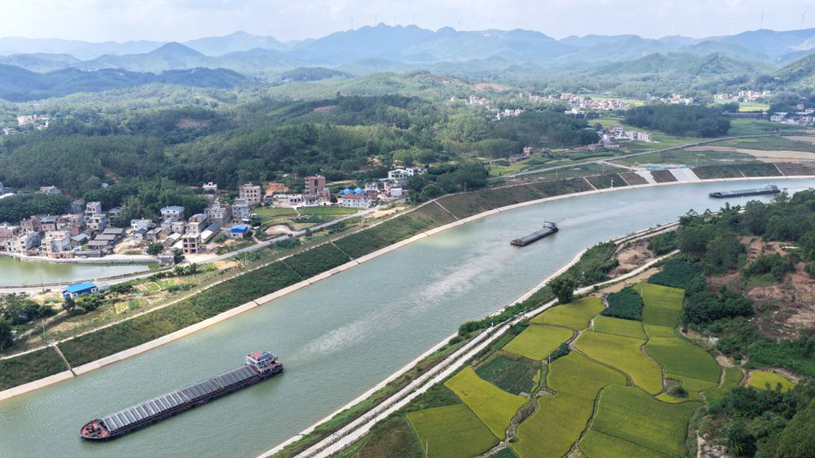 Cargo throughput of Pinglu Canal surpasses 1 mln tonnes in S China's Guangxi
 China's homegrown C919 launches first commercial passenger flight to Yinchuan
 BeiDou Navigation Satellite System drives economic growth and social development
 Overseas buyer attendance at first phase of China's Canton Fair hits record high
Related Stories
- China condemns Japan's negative moves concerning Yasukuni Shrine
- No room for consideration for Japan to follow postwar int'l order, honor obligations: Chinese spokesperson
- China urges Japan to face history as war criminal enshrinement arrangement documents exposed
- Japan urged to severely punish perpetrator of Chinese embassy break-in: spokesperson
- China urges Japan to uphold political documents on 54th anniversary of ties normalization
Copyright © 2026 People's Daily Online. All Rights Reserved.
