



BCI training could help restore fine motor skills
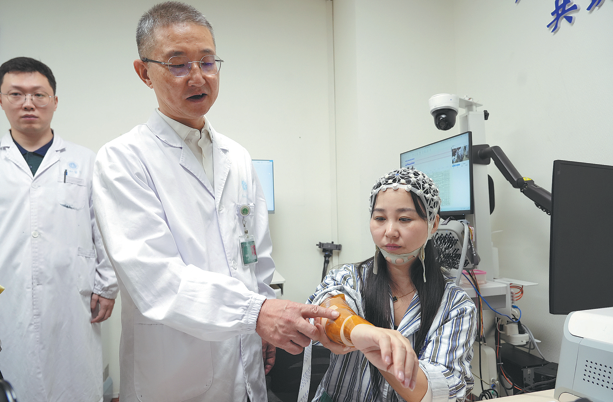
Neurosurgeon Jiang Xiaobing guides Chu Huayan during a rehabilitation session at Union Hospital in Wuhan, Hubei province. CHEN YOUWEI/FOR CHINA DAILY
A woman who was left partly paralyzed after brain tumor surgery can now play simple tunes without assistance from the noninvasive brain-computer interface system she used during rehabilitation, offering an early indication that the technology may help patients regain voluntary hand movement.
The experimental BCI system, developed by researchers at Union Hospital in Wuhan, Hubei province, targets fine motor skills, including individual finger movements and coordination, rather than broader actions such as lifting an arm or grasping objects.
Jiang Xiaobing, director of neurosurgery at the hospital, said these movements require more complex control and remain a major challenge in rehabilitation. He told China Daily on Tuesday that the early-stage study has involved only four patients and has yet to include a controlled trial.
The research is being conducted at Union Hospital, Tongji Medical College, Huazhong University of Science and Technology.
Chu Huayan, 39, was diagnosed with a brain glioma in 2018. After the tumor recurred and affected the brain's motor area, she developed paralysis on her right side following surgery in May 2022, according to the hospital. A year of conventional rehabilitation brought little improvement.
She began BCI training in May and started more demanding finger exercises in August. She can now hold large drink bottles without her hand shaking and reach farther with chopsticks, she said in an interview on Tuesday.
The system uses a cap to record electrical signals from the brain as a patient imagines moving a finger. Software decodes the intended movement and triggers carefully timed electrical pulses delivered through a grid of electrodes to the muscles. The finger moves, providing sensory feedback to the patient, and the cycle is repeated to help retrain movement.
"When I wear the device, it follows what I'm thinking and uses electrical stimulation to move my hand," Chu said. "Even without it, I can still play the keyboard, although my hand is less flexible and gets stiff more easily."
At the beginning of her training, Chu needed electrical stimulation to press the keys. Her subsequent progress suggests that she has regained some voluntary movement, Jiang said, although the extent of her recovery requires further evaluation.
"We hope that repeated decoding of movement intentions and sensory feedback will promote neural plasticity and help patients gradually regain the ability to perform fine movements independently," he said.
Other participants have undergone training for shorter periods. Some have improved their arm and hand control, Jiang said, but larger studies and long-term follow-up are needed to establish the treatment's effectiveness and durability.
Union Hospital has also pursued research into implanted BCIs, testing a domestically developed system in 2024 and implanting locally developed chips in two patients in 2025. The hospital opened a dedicated BCI clinic and ward in 2025 and received approval to establish Hubei province's first provincial BCI clinical research center in April, according to the hospital.
Neurological disorders pose a major health challenge in China. A study published in the journal Med in 2025 estimated that China had 468 million cases of neurological disorders in 2021, with strokes among the leading causes of health loss. Population aging has contributed to the growing burden, the researchers found.
Beyond Wuhan, other Chinese research teams are exploring different approaches to using BCI technology to restore movement in patients with neurological conditions.
The Chinese Institute for Brain Research, Beijing, has developed Beinao-1, a semi-invasive system that records brain signals through electrodes placed outside the dura mater, the brain's outermost protective membrane. A stroke patient who received the implant was able to lift a cup after three months of training, according to neurosurgeon Zhao Jizong in an article published on a Chinese Academy of Sciences platform in June. Zhao said 23 patients had received the implants by then.
Beijing Tiantan Hospital also launched a multicenter trial of a fully invasive BCI system in May, with plans to enroll 32 patients, Xinhua News Agency reported in May.
China is also moving toward wider medical use of BCI technology. In March, the National Medical Products Administration approved an invasive BCI device developed by a Shanghai-based company that enables people with spinal cord injuries to grasp objects using a pneumatic glove.
Guidelines issued by seven government departments, including the Ministry of Industry and Information Technology, call for breakthroughs in key BCI technologies by 2027 and the development of a globally competitive industry by 2030.
Jiang said his team plans to expand the study and assess whether improvements in patients' everyday movements can be sustained.
Photos
 Cargo throughput of Pinglu Canal surpasses 1 mln tonnes in S China's Guangxi
 China's homegrown C919 launches first commercial passenger flight to Yinchuan
 BeiDou Navigation Satellite System drives economic growth and social development
 Overseas buyer attendance at first phase of China's Canton Fair hits record high
Related Stories
- Medical workers stick to posts during National Day holiday
- From spinal implant to cancer therapy, foreign patients seek out China's medical advances
- Chinese-developed cell therapy shows promise for severe heart failure
- Chinese medical team supports Burkina Faso's 1st bronchial sleeve lobectomy
- Chinese researchers treat rare disease via new RNA editing technology
- Experiment on China's space station expected to provide new approach for fatty liver treatment
- Chinese researchers construct "biological pacemaker" to control heartbeat
- China-Sierra Leone medical cooperation saves Guinean heart patient
- Chinese scientists report first clinical success using base editing to treat severe blood disorder
- China to accelerate development of tiered diagnosis, treatment system
Copyright © 2026 People's Daily Online. All Rights Reserved.
