



China's central bank issues statement on RMB exchange rate outlook
As a key financial indicator, the renminbi (RMB) exchange rate has drawn considerable attention from investors, policymakers, and market participants worldwide. On Oct. 8, the People's Bank of China (PBOC) issued a comprehensive statement clarifying its official stance on the currency's trajectory.
The statement reaffirms that China operates under a managed floating exchange rate regime, anchored in market supply and demand while referencing a basket of foreign currencies. Under this framework, market forces play a decisive role in determining the RMB exchange rate.
The system rests on three core principles: first, allowing market dynamics to guide exchange rate movements; second, prioritizing financial stability by mitigating excessive short-term volatility, particularly rapid depreciation; and third, enhancing the transparency of monetary and exchange rate policymaking.
Over the past two decades, the RMB has demonstrated resilience and steady performance relative to other major currencies. Since 2010, it has navigated multiple cycles of appreciation and depreciation, reflecting increased flexibility and more pronounced two-way volatility. Since 2025, the currency has continued to fluctuate within a reasonable equilibrium range, maintaining a stable, two-way movement with an overall trend of orderly appreciation.
Looking forward, the RMB exchange rate will be influenced by a complex mix of economic, monetary, and geopolitical factors, alongside ongoing global uncertainties. The PBOC emphasized that China's trade expansion stems from enhanced industrial competitiveness and supply chain efficiency, not currency manipulation. China has neither the need nor the intention to pursue competitive devaluation, a practice it has never adopted.
Historical data further indicates that past RMB appreciation did not hinder China's trade expansion, while depreciation did not automatically translate into higher export volumes. Notably, Chinese trade flows have grown increasingly insulated from exchange rate swings -- a significant structural shift underscoring the economy's deepening maturity.
As a responsible participant in the global economy, China has consistently rejected the use of competitive currency depreciation to counter external pressures. Moreover, given the sheer size of today's global foreign exchange market, sustained unilateral intervention would be impractical and ineffective.
Exchange rate dynamics are driven by a number of factors including economic growth, monetary policy, financial markets, geopolitical developments, and unforeseen shocks. Crucially, there is no direct or mechanical correlation between exchange rate levels and current account balances.
Global imbalances, the PBOC noted, are deeply intertwined with shifting global division of labor, inherent flaws in the international monetary system, and persistently high fiscal deficit and high consumption in some countries. Addressing global imbalances requires collective actions from all stakeholders.
Blaming trading partners for domestic competitiveness gaps, fiscal mismanagement, or structural weaknesses merely deflects responsibility and delays necessary domestic reforms.
Historically, leading industrial countries have all experienced periods of current account surpluses. The persistence of specific deficit patterns within the current monetary framework reflects systemic characteristics rather than temporary anomalies.
Declining trade competitiveness in some countries, more often than not, reflects their own structural problems. Each country should do its own homework by advancing structural reforms. Deficit countries should consolidate fiscal positions, raise domestic savings rates, and strengthen industrial competitiveness, while surplus countries should boost consumption and investment.
China has long been a contributor to global economic rebalancing. During the 15th Five-Year Plan period (2026-2030), China will stay the course in transforming its economic growth model, expand domestic demand, improve the business environment, deepen high-standard opening-up, and pursue a more open, inclusive and balanced global economy.
Photos
 Redeveloped port opens for easier cross-border travel between China's Shenzhen, Hong Kong
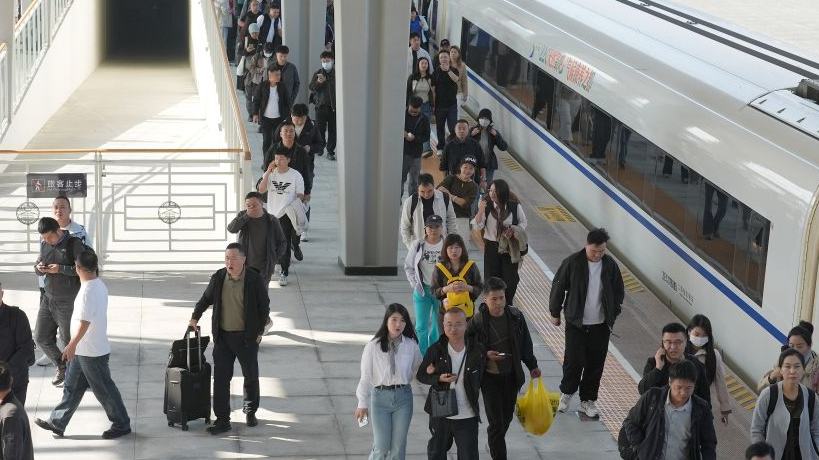 Xi'an-Ankang high-speed railway boosts tourism in Ankang, China's Shaanxi
 Tourists enjoy sunrise at Mount Tai in China's Shandong
 Basha Village in China's Guizhou draws tourists with charming scenery and folk customs
Related Stories
- China remains committed to letting market play decisive role in determining exchange rate: central bank
- Panda bond surge signals China's onshore market appeal
- PBOC to issue 60 bln yuan of RMB bills in Hong Kong
- RMB use expands in Africa amid growing financial connectivity and trade
- China's central bank authorizes Deutsche Bank as RMB clearing bank
Copyright © 2026 People's Daily Online. All Rights Reserved.
