



Nang: Xinjiang's beloved staple gets a creative makeover
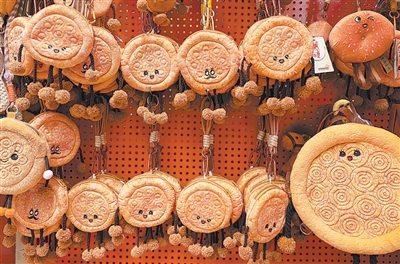
Photo shows pendants inspired by nang, a kind of crusty flatbread, in northwest China's Xinjiang Uygur Autonomous Region. (People's Daily/Shang Rongzheng)
As evening falls, the aroma of freshly baked nang, a kind of crusty flatbread, wafts from bakeries through the streets of Urumqi, northwest China's Xinjiang Uygur Autonomous Region. Picking up a piping-hot nang on the way home from work is a daily habit for many locals, while buying a whole bag to take home has become an increasingly popular choice among tourists leaving Xinjiang.
Nang in Xinjiang comes in all shapes and sizes. The nang from Kuqa city can be as large as a wheel, measuring about 60 centimeters in diameter, while a smaller one is as small as a bagel, making it easy to eat in just a few bites. The Xinjiang Uygur Autonomous Region Museum also houses two nangs from the Tang Dynasty (618-907), one large and one small.
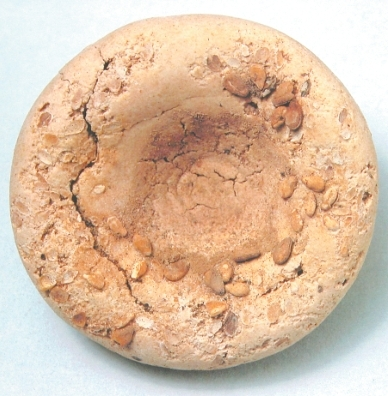
File photo shows Tang Dynasty (618-907) hubing, a baked flatbread topped with sesame, at the Xinjiang Uygur Autonomous Region Museum.
The larger artifact, known as hubing, was unearthed in 1972 from Tomb No. 149 at the Astana ancient cemetery in Turpan. It is 19.5 centimeters in diameter, round and ochre-colored, with a thin center and thicker edges and a decorative pattern stamped in the middle. By the time it was unearthed, it had dried out and broken into 12 pieces. Its shape and method of preparation are virtually identical to those of the nangs eaten today.
The smaller artifact, known as sesame hubing, was unearthed in 1973 from Tomb No. 191 at the Astana ancient cemetery in Turpan. Measuring 3.8 centimeters in diameter, it is sprinkled with sesame seeds and remains relatively intact.
Zhang Shiqi, an associate research curator at the Xinjiang Uygur Autonomous Region Museum, said the dry, rain-scarce climate of Turpan helped preserve the two artifacts to this day, providing valuable physical evidence of the daily lives of Xinjiang's residents at the time. Today, nang is far more than just a flatbread. New ways of enjoying it are constantly emerging, while creative crossovers have won over countless food lovers.
At a cafe in Urumqi, a barista makes nang coffee. The dough is shaped like a coffee cup, its rim coated with sesame seeds, and then baked to set its shape. Freshly brewed coffee is slowly poured into the edible cup to complete the drink. A sip of coffee followed by a bite of nang brings together the coffee's bitterness and the wheaty aroma of nang on the palate, creating a rich, full-bodied and subtly sweet finish.
Seeing nang coffee become a hit, one shop has introduced nang yogurt, pouring yogurt into an edible nang cup and topping it with raisins for a distinctive new flavor.
Nang has also inspired plush toys that can be carried on your back, hung from a bag or stuck to a refrigerator.
"Many tourists told us that after taking nang back to southern China, it quickly went bad in the humid climate. So we turned nang into all kinds of plush products, hoping tourists could take a 'nang' home that would never spoil," said Wen Nana, head of the creative design team behind a series of nang-inspired creative cultural products. The team has given nang a mascot character and built out a product line including crossbody bags, fridge magnets, plush pendants, pillows and storage pouches. The adorable designs have won over countless young consumers.
The team has also taken its creations beyond Xinjiang, opening pop-up stores in major cities such as Beijing and Shanghai. Tools used to make nang, including dough, rolling pins, dough-stamping tools and nang ovens, have also been turned into plush products, allowing consumers to experience the nang-making process through a playful approach.
Nang's creative reach doesn't stop at food and toys. A nang-shaped transit card recently went on sale in Urumqi. Made of polymer clay, it measures about 5 centimeters in diameter and makes for a small, charming accessory to hang from a phone.
Fragrant for a thousand years, nang remains deeply traditional: traditional enough to be a fixture on the dining tables of Xinjiang residents, with nang-making techniques listed as a national-level intangible cultural heritage. Yet it is also endlessly inventive: inventive enough to blend seamlessly into all kinds of dining formats and to charm tourists with playful, creative designs.
Photos
 Xi'an-Ankang high-speed railway boosts tourism in Ankang, China's Shaanxi
 Tourists enjoy sunrise at Mount Tai in China's Shandong
 Basha Village in China's Guizhou draws tourists with charming scenery and folk customs
 Low-altitude tourism programs become growth point in Hongcun Village, China's Anhui
Related Stories
- Xinjiang cotton farmer embraces new opportunities through agricultural modernization
- Starbucks expands China footprint with Xinjiang debut
- Massive cattle, sheep migration begins in Xinjiang
- Two large groundwater reserves found in Taklimakan Desert in China's Xinjiang, shedding light on sustainable water use
- Jiangsu's assistance drives smart tomato farming in Xinjiang
Copyright © 2026 People's Daily Online. All Rights Reserved.
