



China's robots move from stage to shop floor

An underwater robot competes in the 10th China Underwater Robot Professional Contest in Dalian, northeast China's Liaoning Province, Sept. 17, 2026. (Xinhua/Pan Yulong)
At a plant run by China Construction Steel Structure Corp. Ltd., a subsidiary of construction giant CSCEC, robots now handle high-altitude welding, rust removal and heavy material transport. Thanks to this, workers have shifted to overseeing equipment, monitoring automated systems and checking quality.
In the Tengger Desert, a wheel-legged robot made by Deep Robotics, a maker of quadruped and humanoid robots and core components, helps with sand control — its rugged casing keeping wind-blown grit out of its joints.
Scenes like these are becoming common across China's industries, as robots with more flexible limbs and stronger interactive abilities move out of controlled environments and into the field.
China became a net exporter of industrial robots in 2025, customs data shows, with exports surpassing imports for the first time — a milestone for a sector that has expanded rapidly in recent years.
On the move, and now on the job
Robots earn their keep where the work is hardest on people. In traditional steel fabrication, welders worked at height on unsteady footing, and crews on the ground kept clear as heavy steel sections swung overhead. Industrial robots have taken over both.
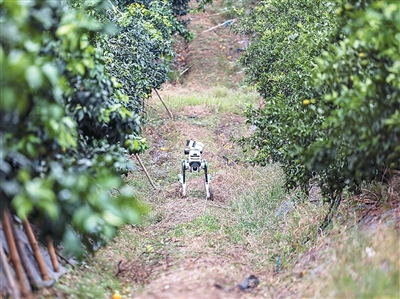
A robot dog patrols a citrus orchard at a modern agricultural park in Jiang'an county, Yibin city, southwest China's Sichuan Province, Sept. 15, 2026. (Photo/Zhuang Ge'er)
Data from CSCEC Science and Industry, also a subsidiary of CSCEC, shows robots can run continuously without interruption, raising overall efficiency across the entire production line by 22 to 40 percent, easing labor shortages and shortening delivery times on major landmark projects. A 3D laser vision system keeps positioning errors within 1 millimeter, and the first-pass weld qualification rate stays above 99.5 percent.
CSCEC Science and Industry began building a smart manufacturing team in 2015 and formally launched a platform dedicated to industrial robots in June 2025. Its six independently developed series of robots are built to withstand heat, dust and welding spatter, with heat-resistant covers and built-in cooling systems allowing them to run continuously in ambient temperatures above 40 Celsius degrees.
Logistics hubs present a different challenge: speed and volume. "Packages come in all shapes — rigid boxes, soft irregular parcels," said a technical team member at RobotEra, a Beijing-based developer of embodied-AI robots. Traditional robotic arms often fumbled damaged or off-balance items. RobotEra's robots sense an object's weight and material on contact and adjust their grip accordingly. In tests, they handled more than 1,200 packages an hour, with a success rate of around 95 percent.
Outdoors, legged robots are taking on rougher ground. "Early quadruped robots could only walk on flat, regular ground. Now they need to figure out what to do once they arrive," said Liu Chen, a product lead at Deep Robotics. In emergency response and industrial maintenance, they increasingly work in toxic gas and near-zero visibility, picking their way over rubble and through mud, sensing the terrain and rerouting as needed.
Learning to handle the unexpected
Hardware alone doesn't guarantee that a robot can work reliably — the real world is unpredictable, and adapting to change has become a key test of intelligence.
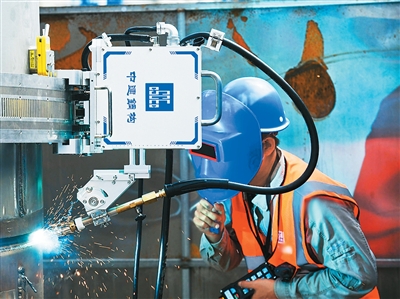
A technician with China Construction Steel Structure Corp. Ltd., a subsidiary of Chinese construction giant CSCEC, checks a flexible welding robot at work. (Photo/Liang Xu)
For example, switching production lines used to mean engineers spending hours manually reprogramming robots for each new part. CSCEC Science and Industry has built a database of more than 1,000 process templates paired with 3D vision technology that allows robots to detect deviations and correct their own paths, cutting changeover times for standard parts to 3 to 8 minutes.
Gao Jiyang, founder of embodied-intelligence company Galaxea AI, called this shift "zero-shot generalization" — robots being able to handle unfamiliar objects or settings without additional training.
At this year's Beijing E-Town Half Marathon and its humanoid robot race, Galaxea AI's R1 Pro and R1 Lite handed out water and towels to runners on their own — no remote control — navigating shifting light, crowds and athletes' unpredictable hand movements.
Deep Robotics has achieved something similar inside factories: a quadruped robot trained to read one type of gauge can handle the same gauge at a different plant, cutting the setup time for a new facility.
Moving up the value chain
China shipped more than 40,000 humanoid robots in the first half of 2026, accounting for 97 percent of the global total, according to industry data. A recent industry report said humanoid robots are shifting from small-scale trials toward routine, large-scale deployment.
Industry insiders say China's manufacturing base — its dense supplier networks and low production costs — is a major reason the sector has grown so quickly.
RobotEra relies on domestic contract manufacturers for production. Galaxea AI has taken a different route, designing for mass production from the start with a modular, standardized architecture. Its new bipedal robot Kengo achieves 23 degrees of freedom with just two core joint modules — fewer parts, lower cost.
As applications expand, the three companies' robots are showing up in increasingly varied settings. Deep Robotics' quadrupeds have been deployed in more than 1,200 locations, from power plants to security patrols. RobotEra's robots work in logistics centers, and Galaxea AI's R1 Pro assembles parts and inspects equipment on factory floors.
As the technology matures, China's robots are moving toward more capable designs — one more sign of the country's push to develop new quality productive forces.
Photos
 Tourists enjoy sunrise at Mount Tai in China's Shandong
 Basha Village in China's Guizhou draws tourists with charming scenery and folk customs
 Low-altitude tourism programs become growth point in Hongcun Village, China's Anhui
 Various cultural, tourism events draw visitors during National Day holiday
Related Stories
- How Chinese robot dancers find their rhythm on American TV show
- Activities featuring human-robot interaction held in Hangzhou
- China remains world's largest industrial robot market: report
- Robot-human dance stuns WorldSkills 2026 opening ceremony
- Diverse robot applications showcased at 2026 WMC
- China rolls out AI "classrooms" to fuel humanoid robot boom
Copyright © 2026 People's Daily Online. All Rights Reserved.
