



Two French travelers walk all the way to China in 518 days
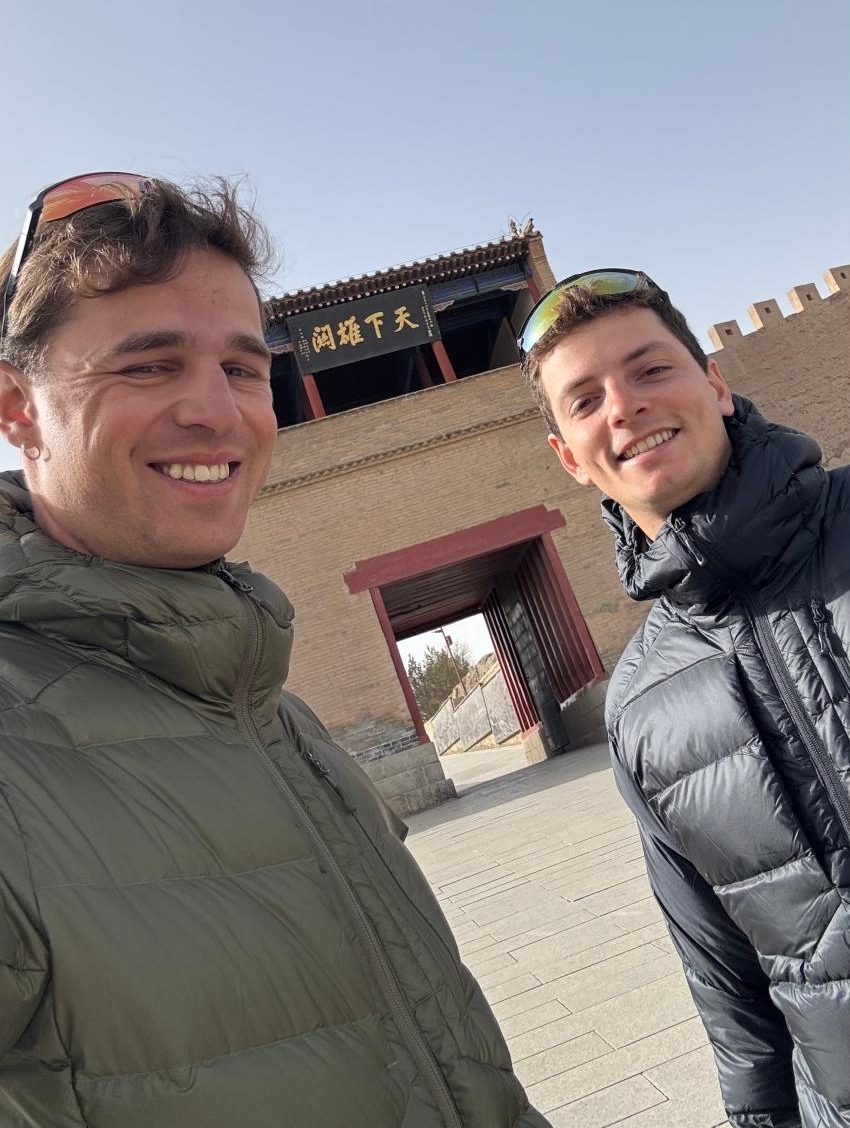
French travelers Loic Voisot (left) and Benjamin Humblot pose for a selfie in front of the Jiayu Pass of the Great Wall in northwest China's Gansu province.
"We've finally made it to our destination. We walked all the way to Shanghai, China -- and we did it!" French traveler Loic Voisot could barely contain his excitement as he and his friend Benjamin Humblot arrived at Shanghai's Bund early this year.
His voice was hoarse after the long journey, but his excitement was unmistakable. Across the Huangpu River, the Oriental Pearl Tower, a landmark of Shanghai's financial hub of Lujiazui, glittered against the night sky.
Over the course of 518 days, the two men walked from the foothills of the French Alps to the banks of the Huangpu River, crossing 16 countries across Eurasia and following the ancient Silk Road eastward. Along the way, they engaged in a remarkable dialogue with both ancient civilizations and contemporary China.
Before setting out, Voisot and Humblot led stable, predictable lives in Paris. Voisot worked in corporate sustainability, while Humblot was a software product manager. Having grown up near the Alps, both have loved nature and hiking since childhood.
Their knowledge of China had previously come mainly from textbooks, news reports and a handful of cultural images. "We really wanted to see what China was like up close," Voisot said.
"Why don't we just walk there, step by step?" Humblot asked one day. What initially sounded like a crazy idea gradually took root in both their minds.
"Walking is a great way to take the time to immerse yourself in local cultures and meet new people," they said. They quickly reached an agreement: why not just go? Three months before departure, they quit their jobs and prepared for the journey.
In September 2024, they set off on the adventure they had dreamed of.
"Day XX of walking to China!" That was how they began every video posted on the social media account they ran together. China was not only a clearly defined destination on the map, but also a kind of beacon that guided them through their long journey.
The physical demands of such a journey were immense. According to their plan, they had to walk an average of 45 kilometers per day. By evening, their feet were often so painful that they could barely stand.
"But we never seriously thought about giving up, because we were making our dream come true!" they said.
One year and one week after setting off, they finally reached the Horgos Port in northwest China's Xinjiang Uygur autonomous region, beginning more than four months of walking across China.
"Just moments earlier, we were looking at a vast, quiet desert. Then, after crossing the border, we saw high-rise buildings, busy streets and robots working in hotels." The striking contrast left a deep impression on them.
It was not only the urban landscape that surprised them. They also encountered an unfamiliar digital way of life in China. With help from local residents, they quickly downloaded WeChat, Alipay and map apps, learned to make QR-code payments, navigate their way around, and book hotels, and picked up a few of the most useful Chinese phrases.
Many people cross Eurasia by various means these days, but few have completed such a long journey relying almost entirely on their own feet.
Along the way, they were often struck by how time and space seemed to converge. As they crossed Eurasia, they felt as though they were walking into the long history of the ancient Silk Road. In Venice, Italy, they visited the former residence of Marco Polo. After reaching Zhangye in northwest China's Gansu province, they visited a statue of Marco Polo and paid tribute to the "pioneer" who helped foster exchanges between Eastern and Western civilizations.
From Georgia and Türkiye to Central Asia, many of the places they passed through had once been important nodes along the ancient Eurasian transportation and trade networks.
"The ancient Silk Road has not disappeared. Its form has simply changed," Humblot said. "The camel caravans are long gone, but we saw trucks streaming along the highways and freight trains constantly rushing past. The flow of goods and connections between regions never stopped. If anything, they have become even more active and closely linked."
Walking from Xinjiang to Shanghai allowed the two to experience China's vast geographical and cultural diversity firsthand. Traveling on foot also took them to places rarely visited by ordinary foreign tourists.
"We passed through villages and townships and saw farmers working in the fields, grain drying in courtyards and the bustle of roadside stalls. We also saw flat roads, well-developed lighting and stretches of solar panels in remote areas." In their eyes, the combination of traditional rural life and modern infrastructure formed a series of vivid, tangible images of China.
More memorable than the scenery were the people they met along the way.
Some villages may not have seen a foreign visitor in years. When children spotted the two travelers, they would gather around curiously. Speaking a mix of hesitant English and broken Chinese, they would chat with the pair happily. Villagers along the route often offered them water and snacks and repeatedly asked whether they needed any help.
Being invited to meals was also common, giving the two a firsthand taste of the "sweet burden" that cultural differences can bring.
"In France, finishing everything on your plate is a way of showing respect to your host. But here, every time we finished eating, our hosts thought we were still hungry and brought us more food. Eventually, we learned that we had to tell them clearly that we were really full," Humblot said with a laugh.
Throughout the journey, the two shared their experiences on Chinese platforms such as Xiaohongshu and Douyin. Their courageous adventure quickly attracted a large following. More and more users offered advice on routes, weather and supplies, while some even traveled to meet the pair along the way.
On the final day, about 70 Chinese and foreign followers spontaneously joined them for the last 10 kilometers. Some had traveled from other cities specifically to Shanghai to take part.
"That moment, when we completed the journey together with everyone, is something we will never forget. We walked and talked together, and the atmosphere was incredibly warm," the two said.
"This trip changed our one-dimensional impression of China," Humblot said. "China is so vast, and there are so many wonderful things waiting for us to discover."
For the two travelers, arriving in Shanghai was not really the end of the journey. It felt more like opening the door to a new beginning.
"On the map, China and France are very far apart," Humblot said. "But in our hearts, the distance between China and France has become much shorter, and we feel much closer to the Chinese people."
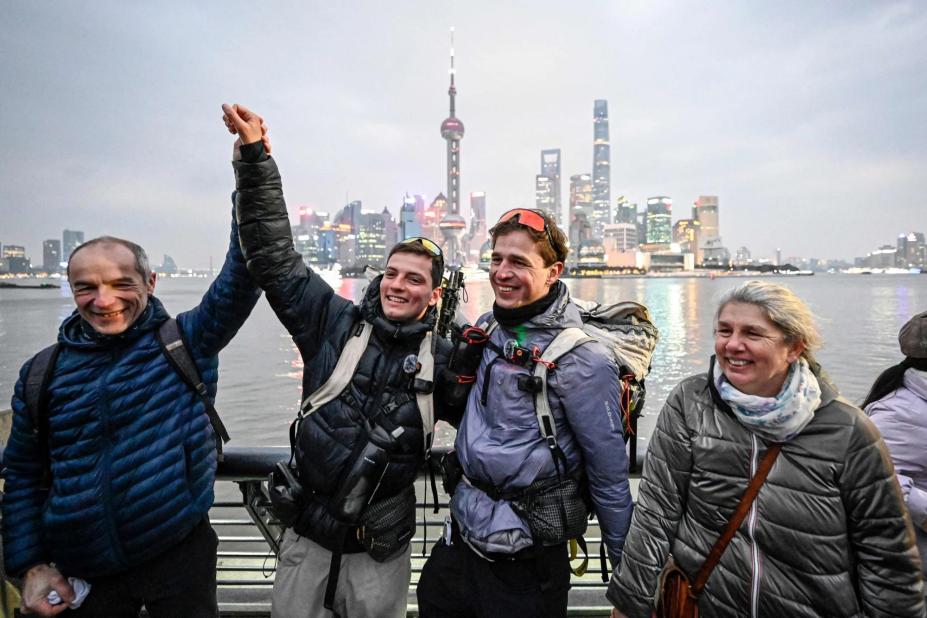
French travelers Loic Voisot and Benjamin Humblot arrive at the Bund, Shanghai and celebrate with Voisot's parents.
(Photos courtesy of the interviewees)
Photos


Related Stories
- Extended breaks, richer experiences add momentum to China's holiday travel boom
- China's transportation network sees travel peak on first day of National Day holiday
- Why more foreigners are choosing to visit China
- China Focus: China embraces summer inbound travel craze with niche draws, fresh moves
- Paddling, camping, birdwatching: How a greener China reshapes urban getaways, lifestyles
- Scenery of Bashang area, China's Hebei
- Tent festival held in Shiqu County, China's Sichuan
- What are foreign tourists buying in China?
- Travel for emotional fulfillment gains traction in China
- Tourists enjoy rafting in Huangping County, SW China's Guizhou
Copyright © 2026 People's Daily Online. All Rights Reserved.
