



Three new careers reflect China's shifting job landscape
A new wave of occupations recently recognized by the Ministry of Human Resources and Social Security is reshaping China's job market.
In Xiamen, southeast China's Fujian Province, 25-year-old Zhu Shaodong works as an embodied intelligence robot technician — one of China's newest officially recognized occupations.
"Robots don't leave the factory knowing how to move flexibly. Our job is to teach them to work in the real world," Zhu said.
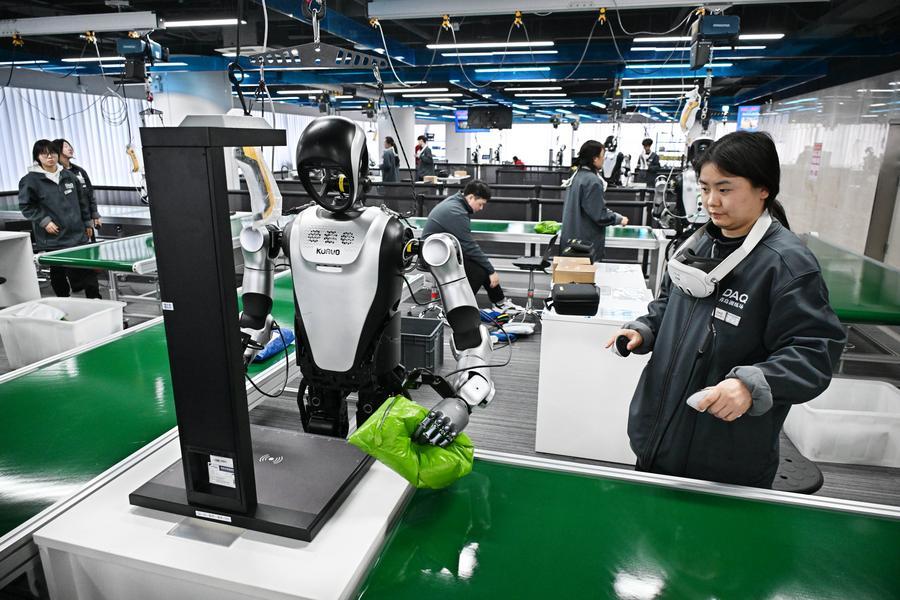
A trainer supervises the training of a humanoid robot in a logistics scenario at the Qingdao Humanoid Robot Data and Training Center in Qingdao, east China's Shandong Province, March 23, 2026. (Xinhua/Li Ziheng)
The role, Zhu said, requires skills in coding, AI perception systems and robotics, plus the ability to diagnose problems on the spot — whether they stem from software, hardware or external conditions.
This past Spring Festival, he directed a human-robot performance on a Xiamen pedestrian street after training robots with motion-capture data from professional dancers until their movements became smooth and synchronized.
Zhu was excited to see embodied AI robot application technician officially recognized as a new occupation. "Our company provides training in robot repair, maintenance and further development, and the industry is also developing rating standards for this new occupation," he said.
In central China's Hunan Province, sports data analyst Su Xing and his team have built an AI sports data analysis system that gives amateur basketball players a taste of stardom.
When college student Li Zhe sank a three-pointer at a court in Xiangjiang New Area, his phone buzzed with an AI-edited highlight clip, complete with shooting stats and a shot chart.
Su, a basketball fan and former civil engineering doctoral student, developed the system — called Qiuxiu — with classmates after bonding through pickup games.
Since launching in 2022, it has partnered with more than 2,000 basketball courts and served over 5 million users, while expanding into North America, Europe and Southeast Asia. Versions for badminton and tennis are also in development.
"AI innovation is connecting precisely with the way people play sports today, letting everyone who loves sports be seen and recorded — and giving nationwide fitness a technological boost," Su said.
In north China's Hebei Province, Gu Junming, an incense artisan, has spent more than 40 years practicing the traditional incense-making craft, a provincial-level intangible cultural heritage that blends herbal medicine, folklore and scent artistry.
Gu, a representative inheritor of the craft, has refined classic formulas — replacing hard-to-source pear ingredients with pears from Korla in northwest China's Xinjiang Uygur Autonomous Region, to perfect a centuries-old incense recipe — while co-authoring industry standards for the craft.
To bring incense-making out of ancient texts and into daily life, Gu has teamed up with cultural brands, working with the Palace Museum and the Temple of Heaven on co-branded cultural and creative incense products. He has also offered free heritage classes in schools and communities, introducing the public to incense materials and culture.
"Now that incense artisan has become a recognized new occupation, it will help push the traditional craft toward a more professional, standardized path of development," Gu said.
Photos



Related Stories
- China adds 158 new professions to occupation list
- New occupations become employment trend in China
- Emerging occupations increasingly popular among young Chinese
- Former HK chief executive calls for end of occupation
- 'Flash Occupation' staged in L.A. to demand Wall Street pay fair share
- Abbas to ask Obama for serious moves to end occupation: official
- Iraqis march in southern city on 7th anniversary of occupation
Copyright © 2026 People's Daily Online. All Rights Reserved.
