



China's Global Development Initiative gives Global South stronger voice, opportunities: former Egyptian PM
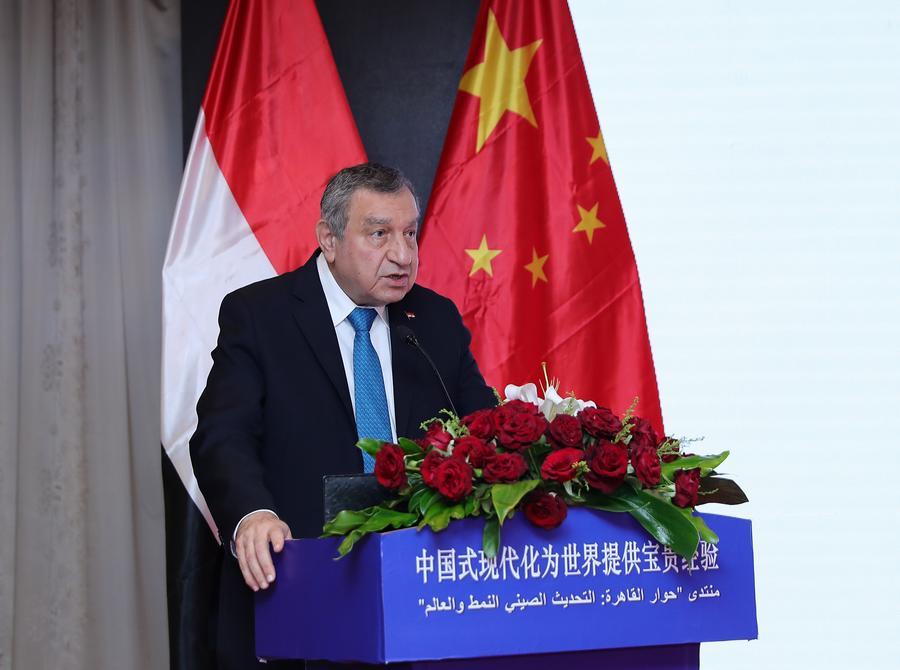
Former Egyptian Prime Minister Essam Sharaf addresses an event titled "Hong Ting Forum Cairo Dialogue: Chinese Modernization, Valuable Experience to the World" in Cairo, Egypt, on April 24, 2025. (Xinhua/Wang Dongzhen)
CAIRO, Sept. 20 (Xinhua) -- China's Global Development Initiative (GDI) helps give developing countries, especially those in the Global South, a stronger voice in global governance while creating broader opportunities for development, former Egyptian Prime Minister Essam Sharaf has said.
"After decades of major economic and social transformation, China has accumulated considerable development experience and become more willing to share this experience and its capabilities with other countries, especially those of the Global South," Sharaf, founder and chairman of the Sharaf Foundation for Sustainable Development, told Xinhua in a recent interview.
Sharaf said one of the GDI's most important contributions over the past five years has been to bring development back to "the heart of global attention" at a time of geopolitical conflicts, economic competition and successive crises.
"Development should not become a victim of these conflicts, but should remain a shared priority for the international community," he stressed, noting that peace and development are closely intertwined.
Sharaf said sustainable peace is difficult to build in a world where development gaps are widening, just as real development is difficult to achieve amid conflict and instability.
"One of the most important lessons reinforced by the initiative is that investing in development is, at the same time, an investment in stability, peace and the future," he said.
Sharaf said the GDI also reflects a broader understanding of development that goes beyond economic growth and new projects to improve people's livelihood, reduce poverty, ensure access to food and energy, and strengthen health, education and resilience to crises.
Turning to global governance, Sharaf said the GDI contributes to strengthening multilateralism by promoting greater participation of developing countries in international decision-making.
"From this perspective, I believe the GDI makes an important contribution to shifting from the concept of governance for countries to a broader concept of governance with the participation of countries," Sharaf said.
He said that the GDI's emphasis on participation is particularly important because major global challenges, from climate change and food security to energy and digital transformation, cannot be addressed by any single country alone.
"Ultimately, true multilateralism is not simply about having a large number of countries around one table; it is about ensuring that everyone feels they have a voice, and that their interests and needs are part of the process of shaping a shared future," Sharaf said.
He expected the digital sphere to be one of the most important areas for the GDI's future development, as artificial intelligence becomes increasingly central to one of the fastest technological transformations in human history.
Sharaf warned that if advanced technologies are available only to wealthier countries and societies, the world could move from the traditional development gap to an even more dangerous digital divide.
He said supporting the "Digital South" should go beyond expanding internet access and digital infrastructure to include building human capacity, transferring knowledge, strengthening digital education and scientific research, and ensuring equitable access to technology.
Sharaf said the GDI can play an important role in linking digital development with equitable development, while helping ensure that developing countries benefit from advances in artificial intelligence.
He also pointed to the China-led establishment of the World Artificial Intelligence Cooperation Organization, saying it aims to strengthen international cooperation and global AI governance while promoting the safe, equitable and inclusive development and use of artificial intelligence.
"I believe the GDI has a major opportunity to help shape an important principle for the next phase: the future of technology should not be a future for a limited number of countries, but a shared future for humanity," he said.
Photos

Related Stories
- Commentary: Five years on, GDI drives shared and sustainable development worldwide
- Debunking a flawed historical analogy: The myth of the "Modern Tributary System"
- GDI-themed youth event held in Bangkok to advance Digital South cooperation
- China's global initiatives offer new opportunities for cooperation, says Italian business leader
- Institute of Global Development welcomes first doctoral students
Copyright © 2026 People's Daily Online. All Rights Reserved.
