



'Robot kindergarten' opens in Beijing
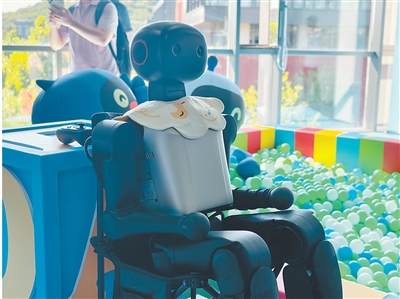
A robot "sits" in Beijing's "robot kindergarten." (People's Daily Overseas Edition/Liu Fawei)
A "robot kindergarten" recently opened at Shougang Park in Beijing's Shijingshan district. The facility was jointly established by Chinese tactile-sensing company Tashan Technology and Openmind, a team led by 2024 Turing Award winner Richard Sutton, known as the "father of reinforcement learning."
The facility has three areas: a testing zone, a learning zone and an interaction zone. Hou Guangdong, Tashan Technology's vice president of research and development, said the facility is not meant to simply train robots en masse, but to let them learn like children do — through perception, action, feedback and reflection — as they interact with the real world.
Robots from companies including Unitree Robotics and Booster Robotics were seen walking freely and interacting with visitors during a recent visit. Unlike conventional embodied-intelligence data training centers, where robots learn by imitating human movements, robots here learn through trial and error.
In the testing zone, one robot fitted with Tashan Technology's tactile "skin" registered discomfort and said "ouch" when its arm was gripped firmly.
Hou said the first phase focuses on extending robots' active operating time and reducing damage, with the goal of enabling them to interact with their environment for longer periods and charge autonomously — capabilities that could eventually help robots adapt to settings such as the home. The research team will gradually introduce more complex algorithms and experimental designs to help robots distinguish themselves from the outside world, master motion control, understand object interaction and, ultimately, achieve cooperation among multiple agents.
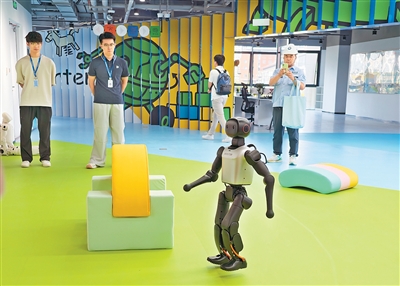
A robot "walks" in Beijing's "robot kindergarten." (People's Daily Overseas Edition/Liu Fawei)
Sutton called the opening of the "robot kindergarten" an unprecedented "zero-to-one" attempt, allowing robots to learn from mistakes as they engage with a complex world.
Robots must learn through interaction, achieving continuous learning through trial and error across their entire deployment lifecycle, Sutton said.
Tashan Technology CEO Ma Yang said tactile sensing is critical to this kind of learning, calling touch "the most fundamental channel" through which robots interact with the world.
The facility is also meant to serve as an experimental ground. At the opening, Openmind senior researcher Chris and Hou jointly unveiled the first batch of seven joint research topics, including mechanisms for tactile and pain sensing.
All robots at the facility will be equipped with tactile electronic skin, allowing them to develop safety strategies as they explore real physical environments.
"We ultimately want to build robots that can learn from experience and have their own learning systems," Chris said, adding that such robots could adapt on their own when their environment changes.
Photos


Related Stories
- China propels robots onto industrial frontlines with real-world applications
- China's robots advance from stage to shop floor
- Unitree robots dazzle America's Got Talent with martial arts to C-pop star Zhang Yixing's "Lit"
- Chinese NEV makers charge into robotics as new growth frontier
- Chinese robots shine at LEAP 2026 in Saudi Arabia
- 2026 China Int'l Consumer Electronics Exposition held in Qingdao, Shandong
- In pics: humanoid robot training facility in Cixi, China's Zhejiang
- Openness helps robots go faster, higher, stronger
- China's humanoid robots move from demonstrations to real-world applications
- 'Dancing robot' in India shows how China's exports are reaching new markets
Copyright © 2026 People's Daily Online. All Rights Reserved.
