



Wang Jie: Chinese research is reshaping the global fight against lung cancer
The 2026 World Conference on Lung Cancer (WCLC) was held in Seoul, South Korea, from Sept. 12 to 15 under the theme "Science Without Boundaries: Uniting the World Against Thoracic Cancer." Wang Jie, director of the Department of Internal Medicine at the Cancer Hospital, Chinese Academy of Medical Sciences, delivered a report at the conference's presidential forum, sharing her views on breakthroughs in small cell lung cancer (SCLC) treatment, China's clinical research achievements, and pathways for biopharmaceutical innovation.
This marked Wang's third appearance on the WCLC plenary stage, following 2023 and 2025. She said the most notable shift has been in role: Chinese researchers are no longer just attending to learn, but increasingly bringing their own data and questions into the discussion, both submitting their work for scrutiny and contributing solutions. She described this as reflecting China's broader shift from "observer" to "participant" and even "contributor" in international clinical research, noting that data itself has no borders, and that once a study draws international attention, its impact extends beyond China alone.
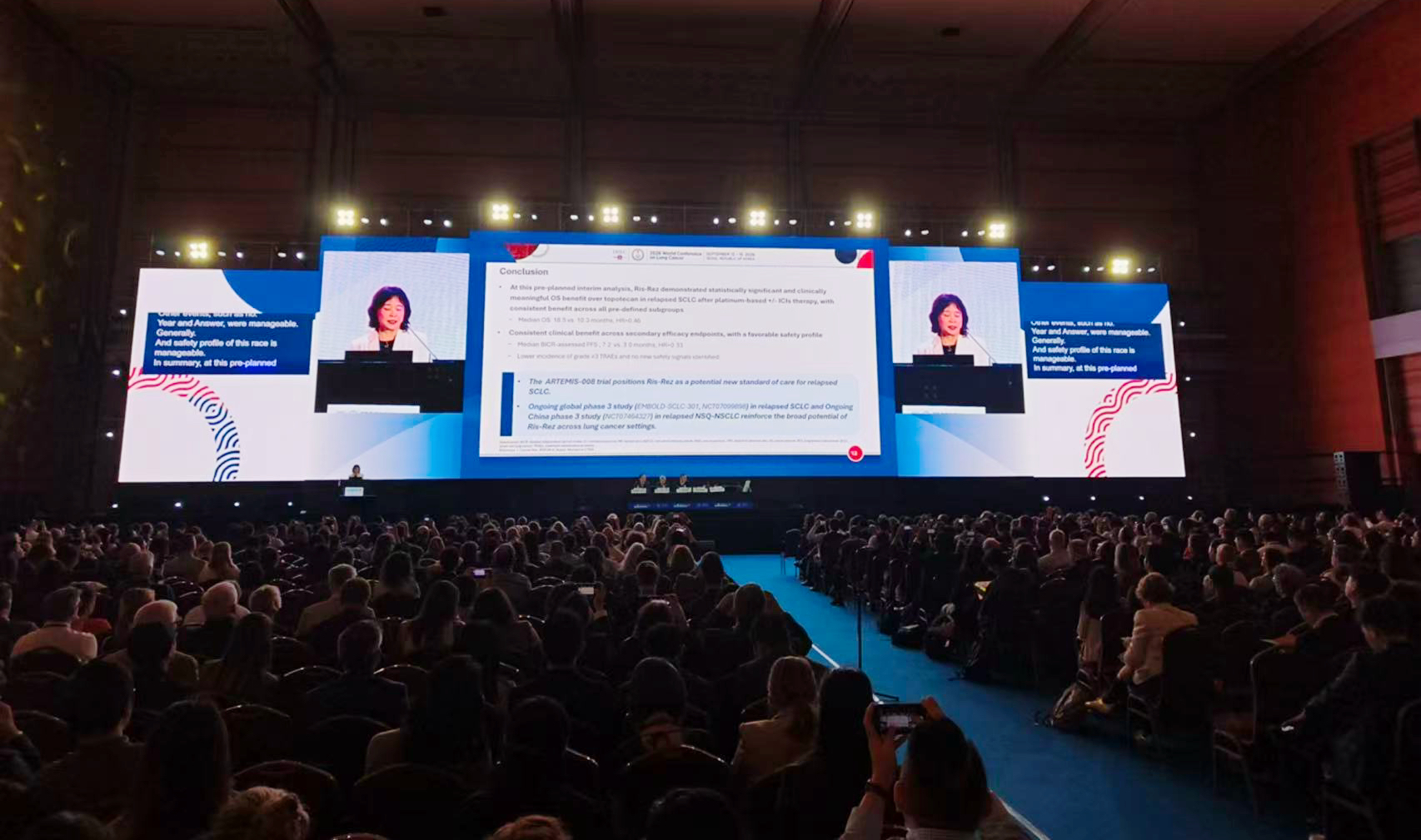
Wang Jie, director of the Department of Internal Medicine at the Cancer Hospital, Chinese Academy of Medical Sciences, delivers a report at the 2026 World Conference on Lung Cancer in Seoul, South Korea.
SCLC remains aggressive and fast-progressing, and for the past decade, Wang said, standard treatment relied mainly on conventional chemotherapy, with limited response rates and survival benefit, especially in second-line settings.
At the presidential forum, Wang presented interim results from the Phase III ARTEMIS-008 trial evaluating HS-20093, a B7-H3-targeted antibody-drug conjugate. With overall survival as the trial's primary endpoint, the positive results indicate the drug extends survival for second-line SCLC patients who have long lacked effective options, offering what Wang called validating evidence for further exploration of the target. She outlined future directions: moving the drug earlier into first-line combination therapy with immunotherapy or chemotherapy, deeper translational research on the target, expansion into other solid tumors, and exploration of combination strategies with targeted therapy or radiotherapy.
Citing China's 15th Five-Year Plan, which designates biopharmaceuticals a strategic emerging industry, Wang identified "source innovation, systems, and leadership" as key words for the sector's future. She said Chinese drug developers, long skilled at fast-following validated targets, must now be willing to be first movers on unproven ones, backing high-risk, high-originality projects with patient capital. The measure of a strong international trial, she added, isn't enrollment size but the precision of the scientific question it asks. She called for courage in target selection, smarter combination strategies, and rigorous, internationally credible trial data, expressing hope that more Chinese-originated therapies will reach patients worldwide.
Photos


Related Stories
Copyright © 2026 People's Daily Online. All Rights Reserved.
