



APEC cooperation benefits people in their daily lives
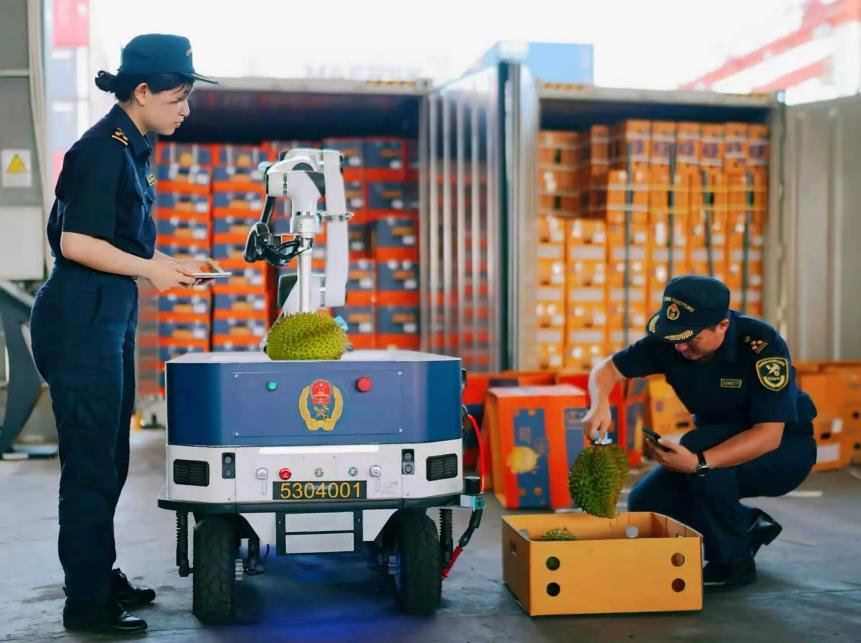
Customs officers use an intelligent inspection robot to examine durians imported from APEC economies at a smart port in Shenzhen, south China's Guangdong province. (Photo/Xia Huatian)
At a container terminal in Shekou, Shenzhen, south China's Guangdong province, a vessel carrying about 300 tons of premium Monthong durians from Thailand slowly docked.
Customs officers were already in position. An intelligent fruit inspection robot scanned the labels on the outer cartons, instantly verifying information such as the product name and place of origin. Samples were sent directly to a laboratory for testing, with results returned promptly.
The fruits were soon transported to wholesale markets across the Guangdong-Hong Kong-Macao Greater Bay Area (GBA) and placed on supermarket shelves.
At a fruit shop in Tianhe district, Guangzhou, capital of Guangdong province, Monthong durian was priced at 17.8 yuan ($2.65) per 500 grams, while some were available at special prices as low as 13.8 yuan.
Local resident Zhang Xin picked up a durian weighing about 3 kilograms. "Durians used to cost at least 20 yuan per 500 grams, so buying one would cost around 200 yuan. Now, it costs about 100 yuan -- quite a bit cheaper," she said.
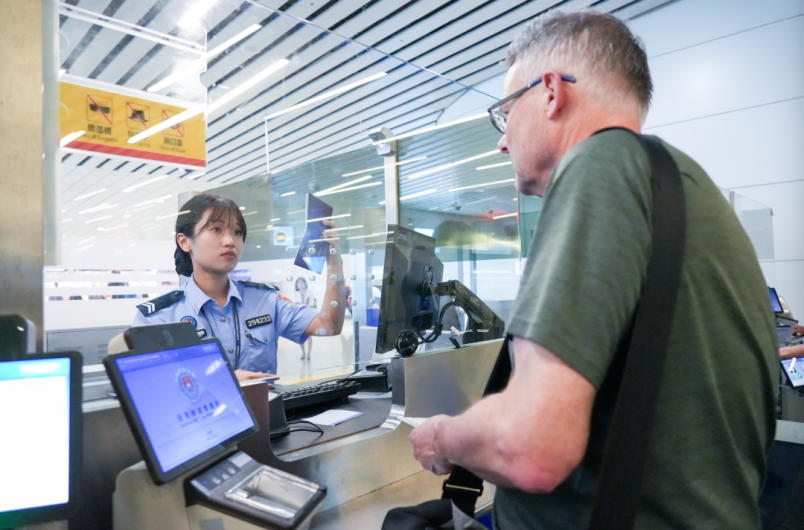
A foreign tourist enters China at Guangzhou Baiyun International Airport in Guangzhou, south China's Guangdong province. (Photo from Guangzhou Daily)
According to data from Shenzhen Customs, 26,200 tons of fresh durians worth 797 million yuan were imported through Shenzhen ports from April to July this year, up 40.86 percent and 22.62 percent year on year, respectively. Both figures hit record highs. Thailand, Malaysia, and other APEC economies are major sources of durian imports.
Benefiting from the continued efforts of APEC to promote trade and investment liberalization and facilitation, imported products such as cherries from Chile, cosmetics from South Korea, milk powder from New Zealand, and beef from Australia are becoming increasingly affordable in China, giving consumers more choices.
Late last year and early this year, special offers at many fruit shops across China brought the price of cherries down to as little as 99 yuan for 2.5 kilograms. Ten years ago, the same Chilean cherries could cost as much as 500 to 600 yuan per kilogram at some premium supermarkets.
During the 2025-2026 production season, Chile produced a record 655,000 tons of cherries, more than 90 percent of which were shipped to China.
Behind these numbers lies a complete "Asia-Pacific cooperation chain." The China-Chile Free Trade Agreement has reduced tariffs to zero on about 98 percent of products. The number of dedicated sea-freight services for cherries has increased to 32, and transit time has been cut from 28 days to 23. At Guangzhou's Nansha Port, fresh produce can be unloaded and cleared through customs in as little as two hours.
According to customs statistics, the combined import and export value between the nine non-coastal GBA cities and other APEC economies has increased by 46 percent over the past decade.
A small reduction in tariffs, a day saved in logistics, and an hour cut from customs clearance -- all ultimately translate into real savings for consumers.
At the international arrivals hall of Terminal 2 at Guangzhou Baiyun International Airport, passengers crowded the immigration counters. A Singaporean businesswoman surnamed Lynn walked down the gangway and headed straight for the dedicated lane for holders of the APEC Business Travel Card. An immigration officer took her passport and the Card, checked her information, entered the relevant details and cleared her for entry. The entire process took less than a minute. Years ago, she used to wait in line here for more than 20 minutes.
"Traveling in and out of China with an APEC Business Travel Card is essentially like having a five-year, multiple-entry business visa for 16 APEC economies," she said.

Photo shows a cityscape of Shenzhen, south China's Guangdong province. (Photo/Leng Wen)
According to the Baiyun immigration inspection station, more than 3.16 million entries and exits of foreign nationals from APEC economies were recorded at Guangzhou Baiyun International Airport this year through the end of August, up 36.4 percent year on year. Of these, about 16,000 were made by holders of APEC Business Travel Cards.
"The fruits of APEC-driven regional cooperation have long been woven into daily life, benefiting millions of households and profoundly reshaping ordinary people's food, clothing, accommodation and travel," said Shen Minghao, vice president of Guangdong University of Foreign Studies and director of the Guangdong Academy of Greater Bay Area Studies.
On the one hand, the zero-tariff import list has been expanded, cold-chain logistics networks strengthened, and cross-border e-commerce costs lowered. On the other hand, "shopping in China" is gaining traction. Drones, smartwatches, and AI glasses have become new "souvenirs" in foreign tourists' suitcases, while instant tax refunds upon departure are available nationwide.
Photos




Related Stories
- China willing to help advance global energy security, sustainable development: vice premier
- APEC CEO Summit 2026 to be held in Shenzhen from Nov. 17 to 18
- China's innovation offers more opportunities for Asia-Pacific cooperation
- Exploring new paths for sustainable development in Asia-Pacific
- Media cooperation key to trust
Copyright © 2026 People's Daily Online. All Rights Reserved.
