



Shared manufacturing helps firms cut costs, skip factory buildout
Shared manufacturing is a new business model that integrates advanced manufacturing with modern services. By pooling scattered and idle production resources, it enables raw materials, equipment, technology, talent and data to circulate on a broader scale.
From robot factories serving future industries to testing platforms for emerging sectors and coating lines for traditional industries, shared manufacturing is increasingly empowering the modern industrial system, helping address production bottlenecks and promoting industrial collaboration, cost reduction and efficiency gains.
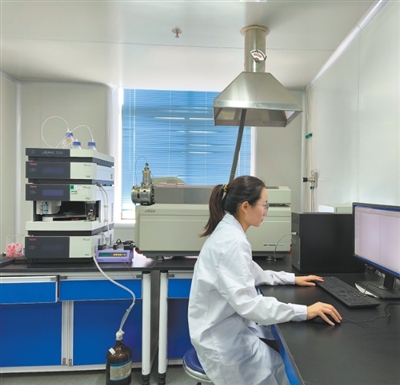
A staff member tests materials at a laboratory providing shared testing services in Meishan, southwest China's Sichuan Province. (Photo courtesy of the interviewee)
At Lingyi iTech's embodied intelligence super factory in the Beijing Economic-Technological Development Area, rows of humanoid robots hang just above the production line as workers prepare them for final assembly.
Construction of the factory began in February 2026, and the first robots rolled off the production line in April, said Wang Dajian, head of the factory. The facility now has the capacity for large-scale production and delivery, with annual output expected to reach 10,000 units this year.
For many humanoid robot companies, moving from prototypes to mass production remains a major challenge. Corenetic, founded in 2023, was one such company.
"As a startup, building our own factory would be too costly," said Xie Zheng, co-founder of Corenetic. "In mass production, we also need specialized production lines to ensure the quality and reliability of our robots."
Xie added that the company's robots have entered mass production.
Meanwhile, shared testing services are helping emerging industries address another bottleneck.
At Sichuan Micro World Inspection and Analysing Co., Ltd. in Meishan, southwest China's Sichuan Province, technicians place silicon-carbon anode materials into testing equipment.
"Companies can receive their test results within 24 hours," said Hu Yunlong, general manager of the company.
Meishan Silicon Carbon Lithium New Energy Technology Co., Ltd., a startup developing silicon-carbon anode materials, previously had to send samples to Chengdu for testing, a process that took about a week.
"Through the shared inspection and testing service platform in Meishan, the company can now find qualified testing providers locally, cutting the entire testing cycle to less than 36 hours," said Ding Chaobo, head of the company.
Launched in 2024, the platform matches companies' testing needs with available testing capabilities. It has integrated more than 1,600 pieces of equipment, brought together testing resources from 51 leading enterprises, and attracted 11 professional and accredited testing institutions. It now offers more than 5,000 types of testing services and has responded to more than 8,000 testing requests.
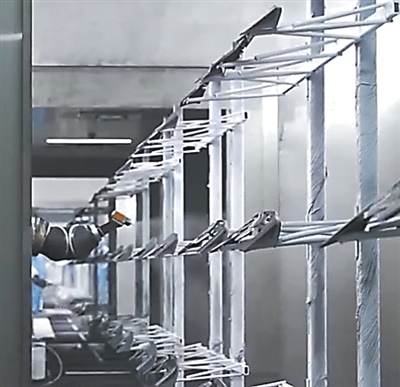
Auto parts undergo spray painting at a shared coating center in Xintai, east China's Shandong Province. (Photo courtesy of the interviewee)
At the Luzhong Environmental Protection Industrial Park in Xintai, east China's Shandong Province, auto parts that have undergone surface pretreatment are transported to a shared coating center.
"If it weren't for this coating center, we wouldn't have been able to set up here so quickly," said Dai Zhenhua, head of Alongsen (Shandong) Automotive Technology Co., Ltd.
Its parent company, headquartered in Changzhou, east China's Jiangsu Province, specializes in automotive films and interior and exterior parts. As orders grew, it needed to expand production capacity. However, coating is a technically demanding process that requires substantial investment and entails stringent environmental requirements. The shared center offered a practical solution.
Xintai is home to 227 automotive companies, and the shared coating center is helping address common challenges across the automotive and machinery industries. A crane machinery company in Yangliu town, Xintai, for example, saw its product qualification rate rise to more than 95 percent after shifting coating operations to the shared center.
The center has now been upgraded to provide one-stop services ranging from customized coatings and spraying to environmental treatment.
Photos

Related Stories
- China's Liaoning advances digital and intelligent transformation of manufacturing sector
- China's manufacturing powerhouse blends research, industry to fuel innovation
- County in E China's Jiangxi becomes global insulator powerhouse
- China exports first homegrown F-class heavy-duty gas turbine
- How emerging industries are driving manufacturing upgrades in central China
Copyright © 2026 People's Daily Online. All Rights Reserved.
