



Humanoid robots fuel growth of related industries
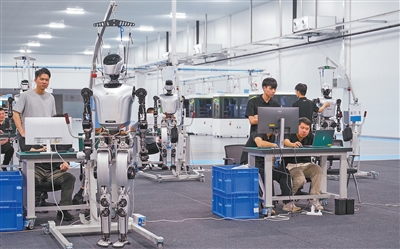
Staff members test humanoid robots in the production workshop of DF Primo Robotics (Guangdong) Co., Ltd. in Nanhai district, Foshan city, south China's Guangdong Province. (Photo/Jiang Xiaodan)
Visitors to the robot factory of DF Primo Robotics (Guangdong) Co., Ltd. in Nanhai district, Foshan city, south China's Guangdong Province, are greeted by a bright, spotless workshop where intelligent equipment operates in an orderly fashion.
Jointly established by Leju Robotics and Guangdong Dongfang Precision Science & Technology Co., Ltd., the plant can produce 10,000 humanoid robots a year.
Mass production, however, remains a hurdle for the industry. Li Deping, director of the artificial intelligence teaching and research office at Jinan University, said there are no unified industry standards for components, and the supply chain for sensors and biomimetic parts is still underdeveloped. As a result, each robot model requires separate calibration of motion and force-control parameters, making it extremely difficult to mass-produce robots with consistent performance.
DF Primo addresses those challenges through an integrated intelligent production line.
In the smart materials management area, a highly automated system streamlines component handling. Once a worker's identity is verified, the designated storage cabinet opens automatically for part retrieval. The system then weighs, counts and verifies the inventory, instantly detecting and recording the removal of even a single screw or washer.
After sorting, automated guided vehicles (AGVs) deliver components precisely to designated workstations. Following preset routes, the AGVs avoid one another and move without human assistance, ensuring efficient material flow throughout the factory.
The core assembly area uses a modular, synchronized and flexible production model. Key components, including the arms, legs, torso and head, are assembled simultaneously at different workstations, where technicians work closely with automated equipment. Structural assembly, wiring, sensor calibration and dozens of other procedures proceed in step.
The production line is also highly flexible. Different humanoid robot models and configurations can be produced simultaneously.
"From the outset, we designed the production line for flexible manufacturing," said Cao Yu, assistant vice president of Leju Robotics. "Simply switching production instructions in the system allows us to change models and configurations in just a few minutes."
At the end of the production line, every robot undergoes a final inspection before leaving the factory. Technicians give the robot a firm push to test its balance, and the robot demonstrates its mobility by rotating its waist 180 degrees and flexing its joints smoothly.
Engineers also simulate real-world conditions to conduct comprehensive tests, ensuring each robot can operate reliably in practical applications. Only those that pass every assessment are approved for delivery.
"The challenge of mass production is not producing more or faster, but producing consistently and reliably," said the technical director of DF Primo. "That's why we place such emphasis on testing, to ensure no product with potential defects reaches the market."
According to Cao, humanoid robots have already found initial applications in industrial manufacturing, commercial services, education and scientific research. As the technology matures, use cases expand and demand grows, humanoid robots will take on a broader range of tasks and play an increasingly important role.
At a laboratory of Shougang Zhixin Electromagnetic Material (Qian'an) in north China's Hebei Province, R&D engineer Zhang Bao examines a sample of ultra-thin electrical steel just 0.2 millimeters thick, developed specifically for humanoid robots.
Zhang explained that the custom-designed steel sheet, about the thickness of a human hair, enables compact motors to deliver powerful performance while meeting demanding requirements for lightweight construction, high torque density and high power density.
"A single humanoid robot typically contains 40 to 50 motors, or even more," he said. "Each one relies on electrical steel to enable agile movement, precise operation and stable power output."
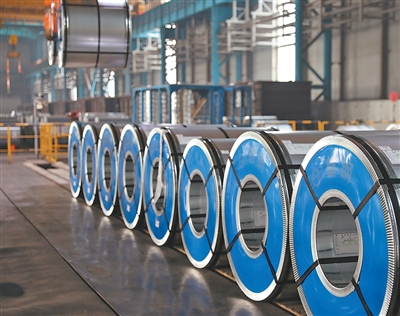
Photo shows electrical steel produced by Shougang Zhixin Electromagnetic Material (Qian'an) in north China's Hebei Province. (Photo/Tang Fengning)
Humanoid robot motors are smaller and more highly integrated than those used in new energy vehicles, and they place stricter demands on materials.
To meet those demands, the company's R&D team carried out more than 600 formulation tests and over 10 rounds of industrial validation in the course of a year, ultimately developing an electrical steel that strikes the optimal balance among magnetic induction, core loss and torque.
Compared with conventional products on the market, the new 0.2-millimeter electrical steel reduces core loss by 20 to 30 percent, making robot motors smaller, more powerful and more energy-efficient.
Today, the company's electrical steel products are supplied to all of the world's top 10 new energy vehicle manufacturers by sales volume and hold a one-third share of the domestic market.
"Estimates suggest that every 10,000 humanoid robots require about 100 tonnes of electrical steel," said An Dongyang, chief technician at Shougang Zhixin Electromagnetic Material (Qian'an). "As humanoid robots eventually enter households on a large scale, this ultra-thin steel could unlock a market worth hundreds of billions of yuan (1 yuan is about $0.15)."
China mastered advanced electrical steel production technologies and manufacturing processes during the 14th Five-Year Plan period (2021-2025). High-end products, including electrical steel for new energy vehicles and ultra-high-voltage power transmission projects, reached or surpassed the world's leading standards.
According to the China Iron and Steel Association, China's electrical steel output reached 19.63 million tonnes in 2025, up 9.6 percent year on year and accounting for 2.04 percent of the country's total crude steel production.
At a garment workshop in Jiangqiao town, Jiading district, Shanghai, Lei Wen sews a silver-colored outer covering for a humanoid robot. The protective suit twists effortlessly as a robotic arm rotates 180 degrees. If the robot falls, the suit cushions expensive joints like an airbag.
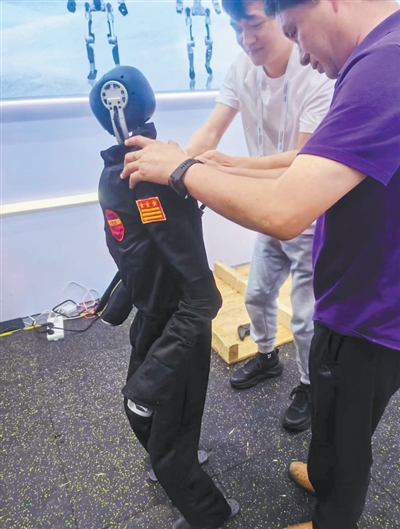
Staff members put a fire-resistant suit on a robot. (Photo/Sun Yangyang)
Lei, originally from Xiantao city, central China's Hubei Province, moved to Shanghai and founded Shanghai Zixi Co., Ltd. in 2004 to manufacture conventional workwear. As intelligent manufacturing advanced, he noticed that imported protective suits for industrial robots often cost tens of thousands of yuan and took months to arrive.
Lei led his team in developing the company's own heat-resistant fabrics of their own. The welding and spray-painting protective clothing the company produces in-house sells for just half the price of imported alternatives, winning orders from numerous companies.
The company shipped 1,000 sets of humanoid robot coverings in 2025, becoming a supplier to leading robotics companies including Unitree Robotics and AgiBot.
Photos
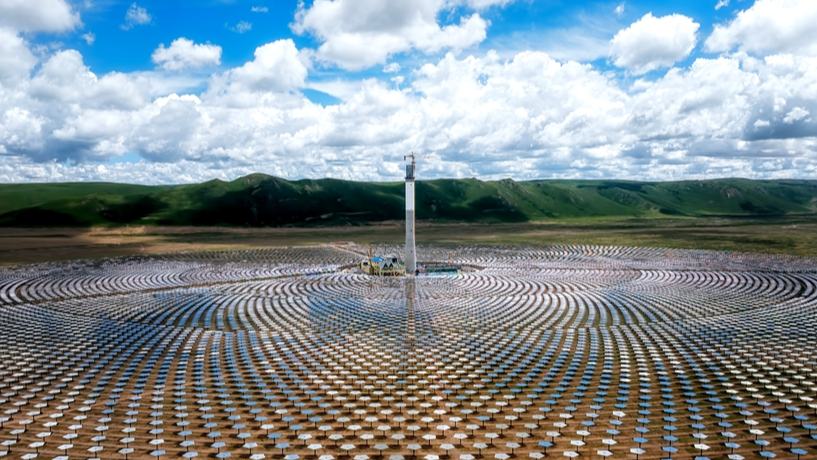 World's highest-altitude solar thermal power plant completes heliostat installation in SW China's Xizang
 Immersive experiences increasingly popular amid China's summer travel boom
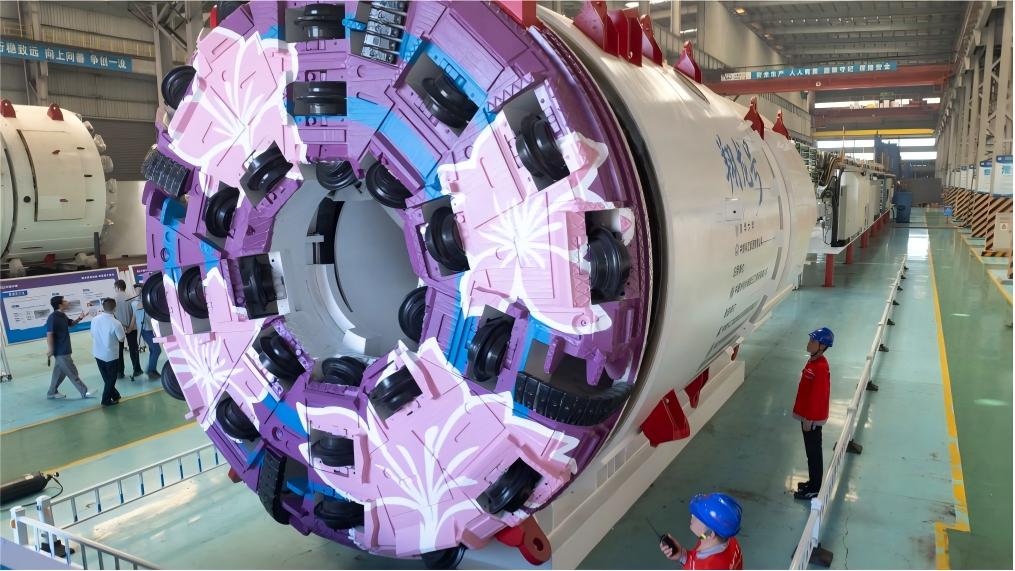 China's first boring and blasting machine rolls off production line in Wuhan, China's Hubei
 Aerial crop protection operations launched in fields of NE China's Heilongjiang
Related Stories
- Embodied intelligence robots trained in real-world scenarios in Shanghai
- China's embodied intelligence endeavors reshaping productivity
- In E China's Hefei, robots break out of the exhibition hall and into retail
- Lab meets real world at China's robot "vocational school"
- Washington's robot ban misses the bigger picture
- Two attitudes toward Chinese robots: A mirror revealing who is reversing course
- Hangzhou deploys biomimetic robotic fish for West Lake patrols
- Embodied AI training facility drives intelligent robot development in Hefei
- China's humanoid robots face their real test on the factory floor
- China's humanoid robots face their real test on the factory floor
Copyright © 2026 People's Daily Online. All Rights Reserved.
