



Clued-in | U.S. recycles unverified "forced labor" claims as new proof
For years, the U.S. has disregarded the facts and repeatedly accused China of so-called "forced labor." Through reports by outside organizations, statements by politicians, government documents and media hype, it has built a self-perpetuating cycle of public opinion manipulation.
These false claims have been repeatedly recycled year after year not because the U.S. has produced new evidence that can withstand scrutiny, but because it has built a mechanism for producing and spreading narratives that is self-replicating, self-validating and self-amplifying.
The first tactic is to impose labels, reducing complex realities to simple accusations. Employment conditions should be assessed on specific factors such as workers' willingness, wages, working conditions and contractual relationships.
The U.S., however, deliberately ignores these basic factors and labels normal practices such as vocational training, employment assistance and labor mobility as "forced labor." Once such a label is applied, the circumstances are no longer viewed on their own terms but are forced into a predetermined narrative framework.
For instance, workers who seek employment elsewhere are portrayed as having been "forcibly relocated," vocational training is distorted into a means of "control," and industries that provide jobs are depicted as part of an alleged "chain of oppression."
The second tactic is to create a false binary by dividing society into "oppressors" and "victims." Workers have their own choices and aspirations, including the desire to raise their incomes, gain skills and improve their lives.
Yet the U.S. ignores this complexity, reducing the issue to a simplistic narrative of "oppressors" versus "victims" and casting one side as the perpetual perpetrator and the other as a powerless victim.
When workers say they have chosen their jobs voluntarily, their statements are cast as evidence that they are "afraid to speak the truth." When their incomes rise, it is portrayed as "using economic benefits to mask coercion." When normal production and daily life continue, it is distorted as the result of "strict control." Any evidence that challenges the predetermined narrative is reinterpreted to fit the same conclusion.
The third tactic is circular validation, using mutual citation to create a false sense of authority. Some organizations publish reports based on anonymous interviews, secondhand materials and subjective assumptions. Media outlets then highlight and amplify the most sensational claims. Politicians cite the coverage in their statements, and government agencies fold those reports, news stories and political remarks into official documents.
Once authorities act on these materials, the organizations that issued the original reports cite the resulting policy measures as proof that their allegations have been "confirmed." The information may appear to come from different sources, but it circulates repeatedly along the same chain of references.
The latest U.S. Section 301 investigation, for example, cited so-called "independent studies," materials from social organizations and public reports as the basis for its administrative findings. This is not independent corroboration from multiple sources, but the same claim being passed from one party to another. The evidence is not becoming stronger; it is simply being wrapped in more layers of presentation.
The fourth tactic is to stir emotions, shaping public opinion through emotional appeals rather than rational analysis. To make audiences accept a predetermined narrative, the U.S. often selects individual accounts with unclear identities, incomplete details and limited verifiability, then pairs them with emotionally charged terms such as "separation," "fear" and "slavery" to create sensationalized stories of suffering.
The broader context of employment, family circumstances and social environment is stripped away, leaving only fragments designed to provoke anger and sympathy. The aim is not to present the complete picture, but to create moral pressure.
Questioning the sources of information is portrayed as a lack of sympathy for so-called "victims," while seeking to verify details is treated as defending "oppressors." Legitimate scrutiny is thus turned into a moral failing, and rational discussion is replaced by emotional judgment. Individual experiences deserve attention, but sympathy cannot replace evidence, and isolated cases cannot serve as the basis for condemning an entire region or industry.
The four tactics reinforce one another, allowing unverified claims to circulate among institutions, media outlets, politicians and government agencies, gaining a new veneer of "authority" with each repetition.
The U.S. is not genuinely concerned with the real circumstances of workers; it uses human rights as a tool to smear other countries and fuel international tensions. The so-called "forced labor" narrative is, in essence, a political maneuver that substitutes repetition for evidence, publicity for truth and discourse power for objective judgment.
Wang Xigen is dean of the Institute for Human Rights Law at Huazhong University of Science and Technology, a national human rights education and training base, and dean of the university's School of Law. He is also a distinguished professor of the Chang Jiang Scholars Program. Peng Yixuan is a special-appointment associate professor at the School of Law, Humanities and Sociology of Wuhan University of Technology.

Photos
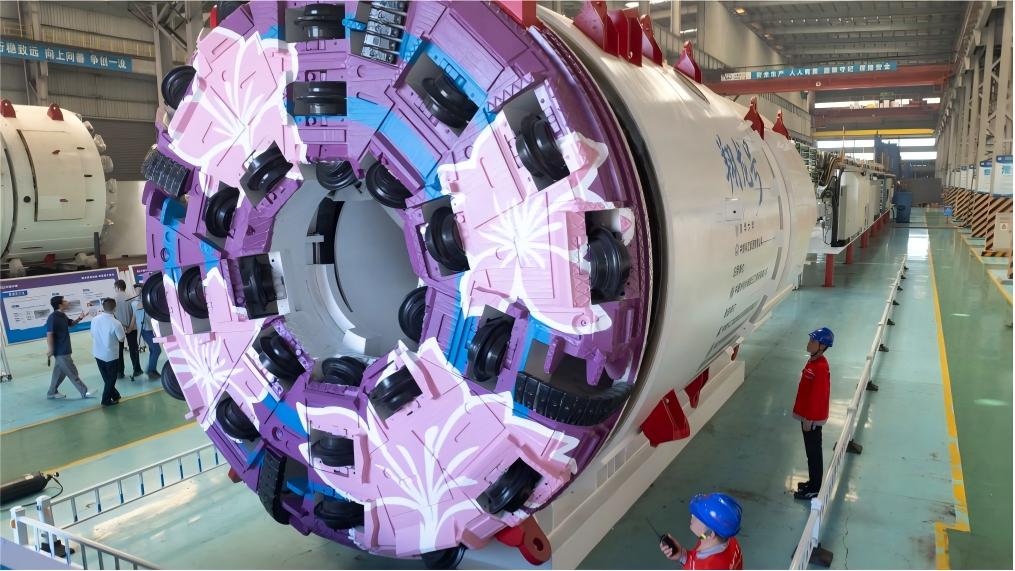 China's first boring and blasting machine rolls off production line in Wuhan, China's Hubei
 Aerial crop protection operations launched in fields of NE China's Heilongjiang
 Parade celebrating intangible cultural heritage held in Yushu, NW China's Qinghai
 In pics: Beautiful scenery in the Qilian Mountains
Related Stories
- "Forced labor" lies bring "forced unemployment" in Xinjiang
- Commentary: World needs to stand up against evil U.S. law on "forced labor"
- Commentary: "Forced labor" smear killing jobs, ruining lives of Xinjiang ethnic minorities
- Commentary: "Forced labor" is just another card Washington has played to contain China
- Forced labor within U.S. frustrating, says trade association head
- Forced labor is a chronic disease in U.S.
- China submits instruments of ratification of forced labor conventions with ILO
- U.S. indeed a country hit hard by forced labor
- Infographics: Forced labor in the U.S.
- U.S. is headquarters of forced labor
- Clued-in | Washington's anti-China agenda reveals zero-sum hegemonic mindset
- U.S. strikes Iran for 13th consecutive night
- U.S. to impose new tariffs under Section 301 investigations
Copyright © 2026 People's Daily Online. All Rights Reserved.
