



National park in NE China protects wildlife through science
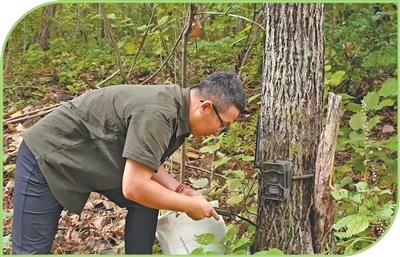
Zhao Yan sets up an infrared camera in the Northeast China Tiger and Leopard National Park. (People's Daily/Zheng Zhiwen)
"The soil is soft, the print is fresh, and the pad is about 9 centimeters wide. This should be a female Siberian tiger." Zhao Yan, deputy director of the research center at the Hunchun management and protection center of the Northeast China Tiger and Leopard National Park, jotted down the details as he examined tracks in the dirt. It's a routine he has repeated countless times in the park's dense woods.
Hunchun, a border city in Yanbian Korean Autonomous Prefecture in northeast China's Jilin Province, sits at the heart of the park. Since the park was launched as a pilot project in 2017, the Hunchun management and protection center team has carried out regular field patrols and scientific research and monitoring to protect wildlife using science-based methods.
Patrolling is central to the center's work. Hundreds of patrol officers and locally hired ecological rangers, many recruited from nearby villages, watch over the forest and record the movements of wildlife.
"Patrols help us understand what's happening in the mountains and record where wildlife has been. Even with infrared cameras now, we still need to check things on the ground ourselves," said Hao Ruiping, deputy head of the center's protection division.
Hao has worked his way up from a grassroots forestry station and knows the forest's plants and wildlife well. He recalled that patrols once focused on clearing snares and traps, which were especially hard to spot under fallen autumn leaves. As villagers' conservation awareness has grown, the work has shifted toward maintaining infrared cameras and collecting biological samples, and snares have become far less common.
Each patrol officer carries a roughly 5-kilogram backpack loaded with flare signals, an intercom, an air horn, infrared cameras and other gear, which Hao called their "all-purpose pack."
Patrols now go out in teams of five. Patrol officers check the park's space-air-ground integrated monitoring system beforehand to see where wildlife has recently been spotted, allowing them to plan safer routes.
At the management and protection center, staff member Duan Lianru opened the same system on her computer, scanning real-time video feeds from infrared cameras posted throughout the park for tiger and leopard sightings.
The system, covering the entire park, integrates digital technologies and allows round-the-clock monitoring. It has become a key data source for tracking the movements and growth of Siberian tigers and Amur leopards over time.
Duan compared it to watching a child grow up, snapping photos of the same tiger every so often to see how much it has changed.
Individual tigers are identified by their stripe patterns, which are unique and permanent, Duan said, though distinguishing between animals with such complex markings takes careful, frame-by-frame comparison.
"It's like giving each tiger an ID card," she said, noting that the data also helps researchers understand the animals' territory and diet.
Duan previously helped issue early warnings to nearby villages when tigers or leopards were spotted near populated areas.
Deep in the forest, Zhao, joined by patrol officers, tracked down an infrared camera strapped to a tree trunk, quickly swapping its battery and checking the footage on his phone.
Zhao has now spent 16 years working in these mountains. He switched from a forestry job to wildlife protection after China ended commercial logging of natural forests in the region's key state-owned forest areas.
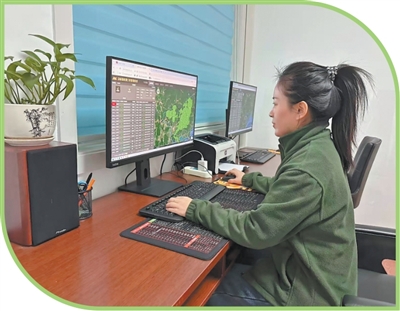
Duan Lianru checks the space-air-ground integrated monitoring system in her office at the Hunchun management and protection center of the Northeast China Tiger and Leopard National Park. (Photo courtesy of the Northeast China Tiger and Leopard National Park)
"Doing research at the grassroots level mainly means putting proximity to the field to good use, maintaining infrared cameras, measuring population density, surveying disease, and tracking the movements of tigers and leopards," Zhao said.
During one survey of hoofed animals, he walked an 8-square-kilometer route daily to gather data. The work showed rising animal density, a sign that more wildlife is returning to and settling in Hunchun.
Today, in the vast forest, Siberian tigers and Amur leopards live undisturbed, sika deer and Siberian roe deer are a common sight, and rare species such as Siberian musk deer, sables and lynxes appear frequently as well.
"Protecting these tigers and leopards isn't just about the animals themselves. It's about protecting the whole ecosystem they represent," Zhao said.
In his spare time, he gives talks at local schools, hoping to inspire the next generation of conservationists. "Protecting Siberian tigers and Amur leopards is really about protecting our own home," Zhao added.
Photos



Related Stories
- In pics: Siberian tigers in China's Heilongjiang
- In pics: snow-covered Siberian Tiger Park in Harbin
- China reports its first sighting of wild Siberian tiger quintuplets
- Sneaky tiger pranks sleeping friend!
- Population of Siberian tigers in China bouncing back with restoration of habitats: national administration
- Siberian tiger cubs flourish at park in NE China
- Sino-Russian lab to help advance Siberian tiger conservation
Copyright © 2026 People's Daily Online. All Rights Reserved.
