



Embodied intelligence gains traction in factories, homes and stores
SHANGHAI, July 20 (Xinhua) -- Batteries are stacked, headlamps fitted and cables routed in an assembly line display at the 2026 World AI Conference (WAIC) in Shanghai, serving to demonstrate how robotic intelligence is transforming mechanized automation.
In this factory line replica, fitted inside the expo hall by Shanghai TARS Robotics Co., Ltd., robots appear not as mere tools, but as "co-workers" capable of sensing their environment and adapting to changes on their own. The innovation reflects a deeper transition, where embodied intelligence is making its way from research laboratories into industrial mainstream applications.
The trend is reflected in the latest official data. According to the State Administration of Taxation, revenue in the embodied intelligence sector grew 22.4 percent year on year from January to May 2026, following a 13.9 percent increase for the full year of 2025. Industrial purchases of embodied intelligence robots more than tripled during the same period.
Shanghai has set a target of deploying 100,000 humanoid robots in factories by the end of the 15th Five-Year Plan period (2026-2030), with AI agent adoption among large-scale industrial enterprises expected to exceed 80 percent.
At the national level, embodied intelligence is now positioned as a strategic pillar of future industries. The 2025 proposal for the 15th Five-Year Plan included embodied intelligence in the country's medium and long-term industrial roadmap for the first time, followed by the 2026 outline that identified it as a new growth driver. Government work reports for two consecutive years have also mandated concrete actions for its development.
According to a document released by the State Council, the adoption rate of next-generation intelligent terminals and AI agents should surpass 70 percent by 2027 and exceed 90 percent by 2030, making the AI-driven economy a major contributor to national growth.
While industrial deployment is accelerating, companies are also exploring how embodied intelligence could serve households and consumers. At the 2026 WAIC, Shanghai-based robot maker Fourier unveiled an immersive living space titled "A Day with the Robot Butler."
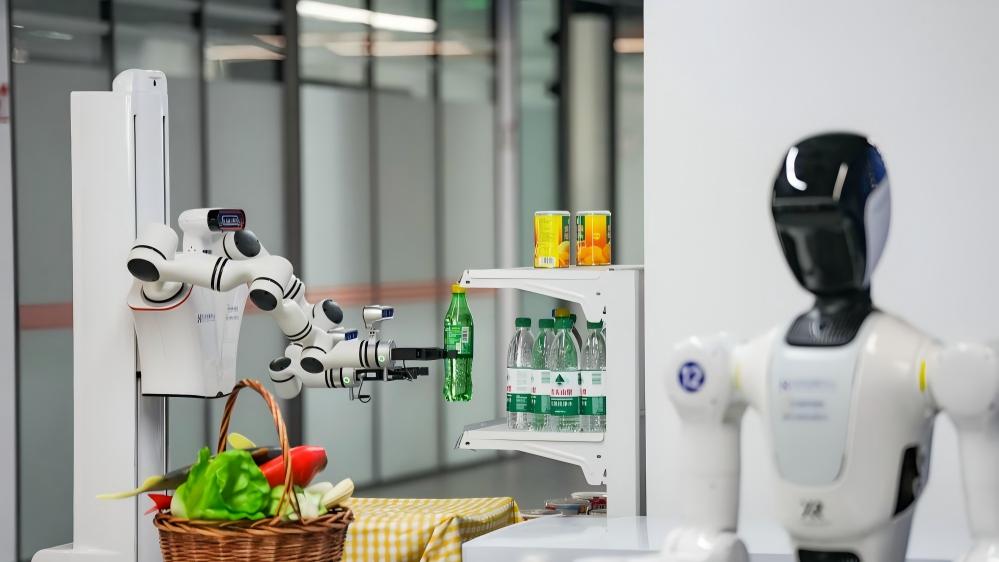
The booth is set up like a living room -- complete with a dining table, a sofa and a coffee table. A humanoid robot moves with steady steps, picks up a bottle of water, and hands it to a visitor standing in front of it. The entire interaction unfolds on its own, without remote control or the use of buttons.
The robot on display, Fourier's GR-3, powered by a semantic task-execution hub, integrates large language models, 3D spatial mapping, navigation planning, and control execution into a single pipeline. The robot can memorize room layouts, identify object locations, understand functional areas, and act on natural language commands.
When a user says, "I'm thirsty," for instance, the GR-3 interprets the intent, locates the dining area and beverages using its spatial semantic map, and autonomously plots the most efficient route to retrieve and deliver a drink -- closing the loop between AI cognition and physical action without explicit step-by-step instructions.
The system runs on Fourier's proprietary FOCUS centralized control platform, which coordinates real-time path planning and task allocation. When two robots cross paths, the system assigns priority based on mission urgency, enabling dynamic collision avoidance and smooth coordination.
Embodied intelligence is also reaching consumers beyond the home. Inside a shopping mall on West Nanjing Road in Shanghai's Jing'an District, a boxing ring is set up in the passageway outside Unitree Robotics' experience store, drawing crowds to watch two humanoid robots in pink and red helmets duke it out. Many onlookers pull out their phones to capture the intriguing action.
The store, which opened on May 31, is the first of its kind in Asia. It occupies a corner on the second floor of Jiuguang Department Store, nestled among women's clothing boutiques, but stands out. Though small, the store draws crowds from morning until night, with many visitors coming from overseas. Families especially children also flock to see robot dogs climb slopes, jump, and turn, while humanoid units replicate gestures and perform fluid movements.
The 100-square-meter store features Unitree's latest consumer products, including the G1 and R1 humanoid robots and the Go2 robot dog. More than a retail outlet, it offers visitors a tangible glimpse of a future where embodied intelligence is part of daily life.
Among the visitors was Alex Butler, general manager of Shanghai Spotlight, a local media company. "I think the humanoid robot's dance moves are really funky," he said. "It's very lifelike, and obviously a very impressive stepping stone on the future of humanoid robotics."
Despite all the spectacle, industry experts caution that the real economic value lies elsewhere. Zhou Aimin, dean of the Shanghai Institute of AI for Education at East China Normal University, said most humanoid robots are still confined to research displays and theme-park performances. Their core value, he noted, will emerge in industrial production and eldercare services, though both require further technological iteration.
Over the long term, however, Zhou is optimistic. He believes embodied intelligence could reshape China's labor structure by filling industrial gaps and easing eldercare burdens as the population ages -- potentially making it a pillar industry surpassing automobiles or real estate.
Yet for all the promise, a cognitive gap remains between the public and AI adoption. Job displacement fears and data privacy concerns are widespread, while older adults and workers in traditional industries often struggle with digital tools.
To bridge this divide, Chen Jie, a researcher at Shanghai Jiao Tong University, suggests a two-pronged approach. On one front, he advocates regular AI outreach -- factory open days, community workshops -- to show how robots can fill labor gaps and ease eldercare pressures, helping to relieve job anxieties.
On the other, he calls for stronger governance: clearer accountability rules, easier intuitive interfaces and voice-enabled features for elderly users, and tighter privacy protections. The ultimate goal, he said, is to ensure AI both empowers industries and benefits the public.
Photos

Related Stories
Copyright © 2026 People's Daily Online. All Rights Reserved.
