



Ancient Qinqiang Opera reaches wider global audiences
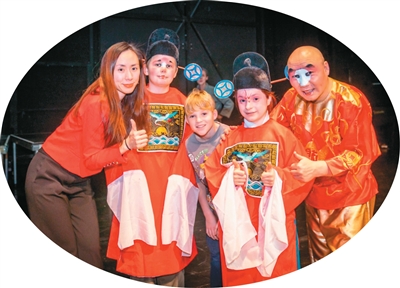
Foreign kids clad in Qinqiang Opera costumes pose for group photos. (Photo courtesy of the Shaanxi Opera Research Institute)
The popular television drama "The Protagonist" has brought renewed public attention to Qinqiang Opera, a folk opera genre originating in northwest China's Shaanxi Province that is gaining recognition well beyond its traditional heartland.
Known for its powerful vocals, bold rhythms and distinctive local dialect, Qinqiang Opera has been staged in North America, Central Asia and Europe. Meanwhile, a growing number of foreign artists and international students have traveled to Shaanxi to learn the art form and experience its unique appeal firsthand.
Behind Qinqiang's expanding international appeal are dedicated performers, meticulous translators and enthusiastic overseas learners, each helping the ancient art form bridge linguistic and cultural divides.
For veteran Qinqiang artist Li Mei, overseas audiences have repeatedly shown that genuine emotion transcends language.
Li, president of the Shaanxi Opera Research Institute and one of China's most acclaimed Qinqiang performers, has performed in more than 50 countries and regions during her four decades on stage. She still vividly remembers her first European commercial tour in the 1990s, when performances were packed despite her initial concern that foreign audiences might struggle to appreciate such a regionally distinctive art form.
Her belief was further reinforced in 1998, when she performed a Qinqiang classic during an arts festival in Berlin. Asked by local media to describe the production in one sentence, she called it "China's classical version of the supernatural romance film 'Ghost.'" Although most audience members did not understand Chinese, they were captivated by the story of a beautiful woman's spirit seeking justice. The performance received prolonged applause, and local media hailed Li as "the beautiful Oriental goddess of revenge."
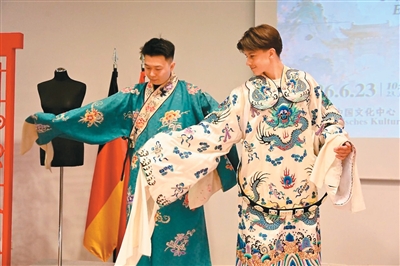
A foreign youngster learns the basic movements of Qinqiang Opera. (Photo courtesy of the Shaanxi Opera Research Institute)
Thoughtfully tailored productions have also played an important role in engaging overseas audiences.
Last October, the Shaanxi Opera Research Institute staged a Qinqiang Opera piece in Austria with no elaborate lighting, scenery or special effects. The actors performed entirely with their natural voices on a simple stage. The minimalist production matched the atmosphere of a small European theater, and after the performance, many local teenagers stayed to talk with the actors, with some even imitating Qinqiang stage movements.
In recent years, the institute has expanded its international cultural exchanges, hosting youth delegations from Pakistan and India, as well as musicians from 16 Central and Eastern European countries. While veteran performers have long been the backbone of its overseas tours, a younger generation is now increasingly taking center stage in promoting Qinqiang abroad.
During performances held at the China Cultural Center in Berlin from June 23 to 24, actors from the institute, whose average age is just 26, showcased demanding techniques including stylized walking, martial movements and acrobatics. Twenty-one teachers and students traveled over 200 kilometers by train from Dresden to watch the performances.
If performers bring Qinqiang abroad, translators help overseas audiences understand it.
Cao Daqin is associate dean of the School of Translation Studies at Xi'an International Studies University in Xi'an, capital of Shaanxi Province. Eight years ago, Cao translated "Three Drops of Blood," a masterpiece of Qinqiang Opera, into English after years of working primarily in scientific and technical translation.
The task required him to learn everything from Qinqiang's musical styles to its stage conventions.
Unlike technical translation, opera translation demands not only accuracy but also elegance, given its reliance on dialect, metaphors and implied meanings.
One memorable example was a scene known as "Affinity from the Tiger's Jaws," in which two young characters fall in love while escaping danger. Rather than translating it literally, Cao sought an English expression that would preserve its emotional implication.
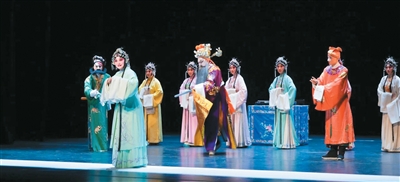
Li Mei (second left), a Qinqiang Opera performer from the Shaanxi Opera Research Institute, stages a performance. (Photo courtesy of the Shaanxi Opera Research Institute)
His team has since completed English subtitles for more than 800 lines of a Qinqiang classic, translated the script of another classic piece, and provided subtitles for a 120-minute Qinqiang gala featuring winners of China's Plum Blossom Award.
To suit theater audiences, Cao follows a strict rule that each English subtitle should remain concise enough to be read within about three seconds.
"Translation should help overseas audiences understand the story while preserving the cultural character of Qinqiang," he said, adding that artificial intelligence can assist with routine tasks but cannot replace human judgment in conveying artistic expression.
Over the past several years, universities and language service providers in Shaanxi have stepped up research and practical work on translating Qinqiang, attracting a growing number of newcomers.
Qinqiang is also attracting growing interest from foreign learners in China.
On May 17, 16 international students from countries including Pakistan, Nigeria and Cameroon took to the stage at the Yisu Theater, a century-old opera theater in Xi'an, after months of studying a Qinqiang Opera piece with professional performers.
An increasing number of foreigners in China are donning Qinqiang costumes and stepping onto the stage themselves, experiencing the unique charm of the ancient art form firsthand.
In recent years, Qinqiang has also reached wider overseas audiences through animation, online videos, music productions, video games and micro-dramas.
Photos

Related Stories
- Pic story of Qinqiang Opera performers in China's Xi'an
- U.S. exhibition honors renowned Chinese opera artist
- China Theatre Association vows greater support for rare opera genres
- "Happy Chinese New Year" Peking Opera tour staged in Canada
- Feature: Centuries-old Wu Opera staged in Cambodia ahead of Chinese New Year
- Wuju Opera staged in Zhejiang countryside
- Mainland college students present Kunqu classic "The Peony Pavilion" in Taipei
- Feature: Opera Turandot deepens cultural exchange between China and Italy
- Centuries-old Kunqu opera finds new life with youthful energy
- "Living-fossil" folk opera connects SW China village to its past
Copyright © 2026 People's Daily Online. All Rights Reserved.
