



Smart construction turns old rail yard into modern logistics hub
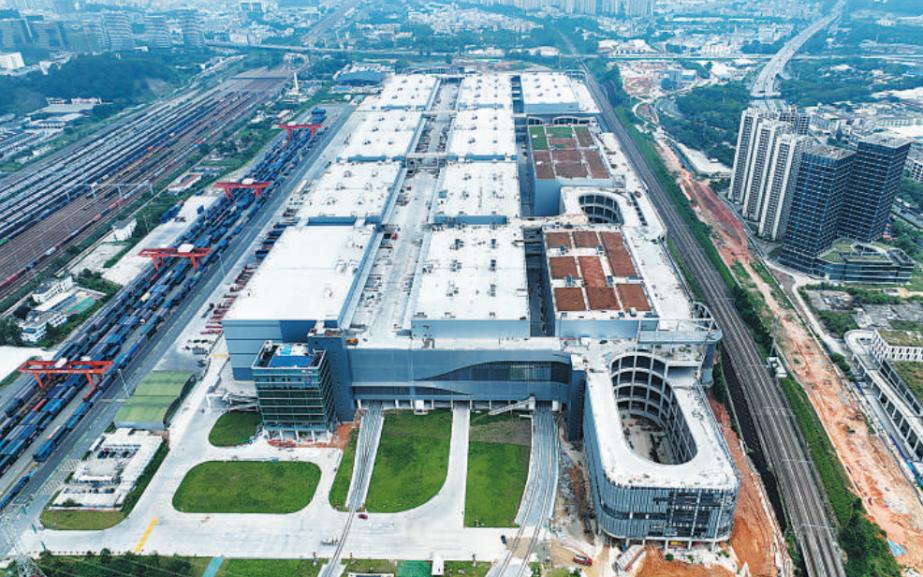
Photo shows the Pinghunan Integrated Logistics Hub. (Photo courtesy of China Railway 25th Bureau Group Corporation Limited)
A once-deserted railway freight yard in Pinghunan, Shenzhen, in south China's Guangdong province has been transformed into a dense cluster of towering steel structures. The Pinghunan Integrated Logistics Hub has realized the ambitious vision of constructing a logistics park directly atop an active railway line.
"The idea of 'a logistics park built over a railway' sounded ambitious when it was first proposed, but today it has become a reality," said Gu Feng, project manager at the Shenzhen engineering construction command of the China Railway Guangzhou Group Co., Ltd.
The concept is straightforward yet highly innovative: the ground level remains dedicated to railway operations, while the space above the railway is developed into logistics and warehousing facilities. By preserving the existing rail yard and expanding upward, developers have constructed smart warehouses on a platform above the tracks, creating a new model for three-dimensional land use.
As Gu elaborated, this model effectively integrates railway resources with local industrial resources and greatly boosts land output value. The project has saved over 20 hectares of land. With new technologies including intelligent sorting systems and unmanned warehousing, the old railway freight station has been revitalized with digital capabilities.
Viewed from above, the steel frames of the project's 11 logistics warehouses stretch across the site like the spine of a giant dragon poised for flight. The scale is remarkable: the project uses more than 140,000 tonnes of steel, involves total investment of about 9.04 billion yuan ($1.33 billion), and has a total floor area of 1.11 million square meters.
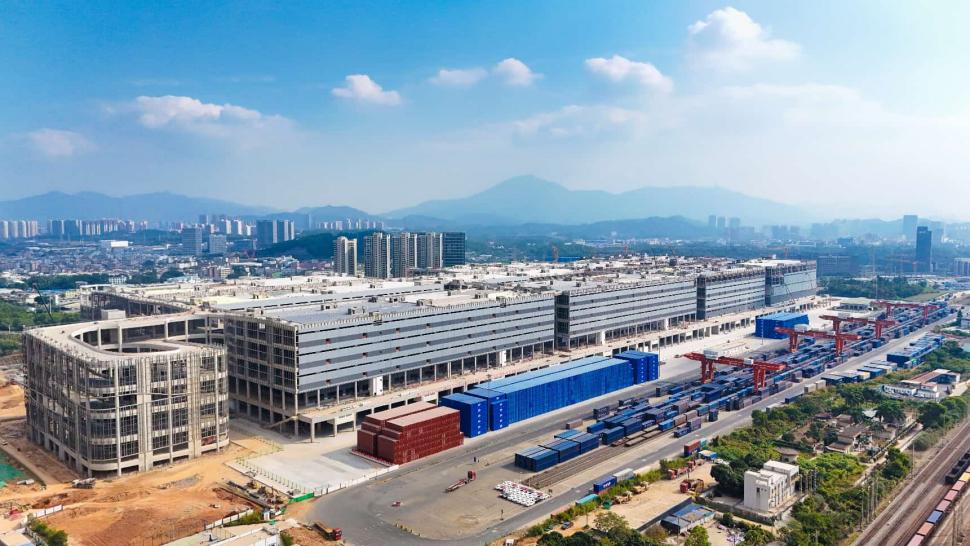
Photo shows the Pinghunan Integrated Logistics Hub. (Photo/Deng Lianxu)
On Dec. 30, 2025, the ground-level railway component of the Pinghunan Integrated Logistics Hub was completed and became operational, marking the official launch of the hub's core rail transportation functions and its successful connection to China's national railway network.
At the construction site, rows of steel components, each more than 11 meters long and weighing nearly 3 tonnes, await installation. "These steel components will be lifted and assembled to form the logistics warehouses," one construction worker explained.
Ensuring the precise assembly of more than 140,000 tonnes of steel components, however, posed a major engineering challenge.
With such a vast number of components, even minor deviations during on-site assembly could lead to significant construction difficulties and delays. To solve the problem, the engineering team turned to Building Information Modeling (BIM) technology.
"We use BIM to conduct virtual assembly and make real-time adjustments before actual construction begins, significantly improving both the efficiency and precision of steel assembly," one project engineer said.
During a demonstration, an operator used digital acquisition devices to scan the steel columns on site, converting them into digital form and feeding all data into the system. On the screen, a virtual model of the steel structure warehouse occupied the center, with technical data on steel beam-column joints and stress monitoring listed on the left.
With a single click, arch ribs underwent virtual assembly, laying out numerous complex spatial connections. Inside the 3D model generated by BIM technology, the status of all components could be seen clearly at a glance.
When deviations appeared in the virtual assembly results, operators could promptly revise the dimensions of steel structural members and rerun the assembly simulation. Once the revised design was verified, the updated data was transmitted to the manufacturing plant for fine adjustments.
"Every processed steel column is assigned its own QR code," said engineer Duan Rong. "The code contains 12 parameters, including the component's dimensions, lifting weight, and installation coordinates."
Eliminating potential errors before installation is only the first step toward achieving precision construction.
The project requires the sequential installation of 6,795 steel columns and 32,624 steel beams. Under conventional construction methods, the team would have to rely on repeated manual measurements and adjustments.
"Now, we first create a full-scale 1:1 BIM model and define the parameters of every component down to the millimeter," Gu said. "We then simulate the lifting process in advance, planning the exact positions of cranes, lifting points, and hoisting angles."
"It's like equipping every component with its own navigation system," he added. "During installation, the BIM model continuously compares real-time site data. If a deviation exceeds three millimeters, the system automatically issues an alert."
According to project inspections, all steel components installed so far have achieved a 100 percent qualification rate.
Once fully completed, the Pinghunan Integrated Logistics Hub is expected to handle around 1.4 million twenty-fow ot equivalent units (TEUs) of sea-rail intermodal cargo for Shenzhen each year.
The project is expected to improve regional logistics efficiency by 30 percent while reducing logistics costs by 20 percent. It is also set to become Asia's largest single Road-Rail-Sea multimodal transport center and a national-level comprehensive logistics hub.
It will significantly strengthen Shenzhen's drive to become a global logistics hub city and inject fresh momentum into the economic development of the Guangdong-Hong Kong-Macao Greater Bay Area.
Photos



Related Stories
- China's logistics sector sees improved performance in June
- China's logistics sector sees improved performance in June
- Chinese enterprises empower Poland's logistics industry
- China's logistics sector returns to expansion in May
- China's logistics sector shows steady recovery in April
- China's logistics costs-to-GDP ratio hits record low in 2025
- China's logistics sector reports continued expansion in November
- Low-altitude logistics takes off in China
- Logistics enterprises in China's Yinchuan at full capacity for "Double Eleven" peak
- Booming demand fuels growth in China's cold-chain logistics
Copyright © 2026 People's Daily Online. All Rights Reserved.
