



China's Hainan plans to ban sales of fuel cars by 2030
HAIKOU, July 14 (Xinhua) -- South China's island province of Hainan has set the goal of banning the sale of combustion-engine cars by 2030, taking the lead in the country's transition toward new energy vehicles (NEVs).
By 2030, all newly added and replaced private vehicles, as well as all new and replacement vehicles in public service and commercial operation in Hainan, must be NEVs, with the exception of special-purpose vehicles, according to the province's 2026-2030 plan for building a national demonstration zone for ecological civilization.
It is estimated that by that time, the share of NEVs in Hainan's total vehicle fleet will rise from 23.75 percent in 2025 to 45 percent. The province will also improve its charging infrastructure network, with the vehicle-to-charging-pile ratio kept below 2.5 to 1, said the recently issued plan.
Hainan first proposed the goal in 2018 of banning the sale of fuel cars by 2030, becoming the first Chinese provincial-level region to announce such a target. The latest plan reiterated that the province is steadily pushing forward this goal.
The plan has sparked discussions online as the latest confirmation of China's dedication to carbon reduction and NEV at a time when the West backpedaled on green policies. Late last year, the European Commission announced plans to relax its effective ban on new combustion-engine cars from 2035, marking a notable retreat.
The industry and information technology department of Hainan said that as of October 2025, the NEV penetration rate in Hainan had reached 67.14 percent, meaning that two out of every three newly registered vehicles in this island province were NEVs. Over the past five years, the province ranked first and second nationwide, respectively, in terms of NEV market penetration and the NEV share of total vehicle ownership.
The rapid transition toward NEV is underpinned by the province's shift in energy structure. At the end of June 2026, Hainan's installed capacity of new energy, mainly from photovoltaic and wind power, accounted for 50.1 percent of its total installed capacity.
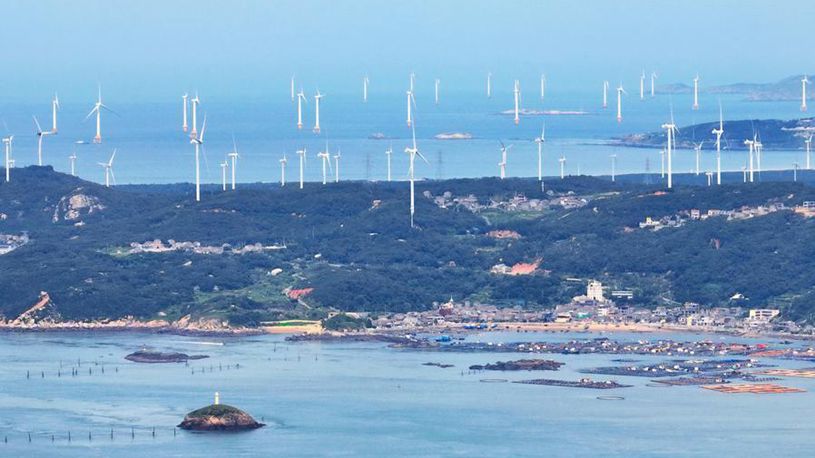
In its 2026-2030 plan, Hainan has promised efforts to scale up offshore wind power, explore integrated wind-solar projects, and build a number of offshore photovoltaic demonstration projects, all to ensure that incremental electricity demand will be met primarily by clean energy.
China unveiled its new Nationally Determined Contributions last September, setting ambitious goals for 2035. These include reducing economy-wide net greenhouse gas emissions by 7 to 10 percent from peak levels, increasing the share of non-fossil fuels in total energy consumption to over 30 percent, and expanding the installed capacity of wind and solar power to more than six times the 2020 levels.
Photos


Related Stories
- Sunset view over waters surrounding Xisha Islands, S China's Hainan
- Exploring Laobacha teahouse culture in S China's Hainan
- Typhoon Maysak makes landfall in south China's Hainan, disrupting transport
- China's Hainan island expects over 8.25 million air passenger trips in summer travel season
- People shop in Haikou during Dragon Boat Festival holiday
Copyright © 2026 People's Daily Online. All Rights Reserved.
