



Why grasslands matter more than ever
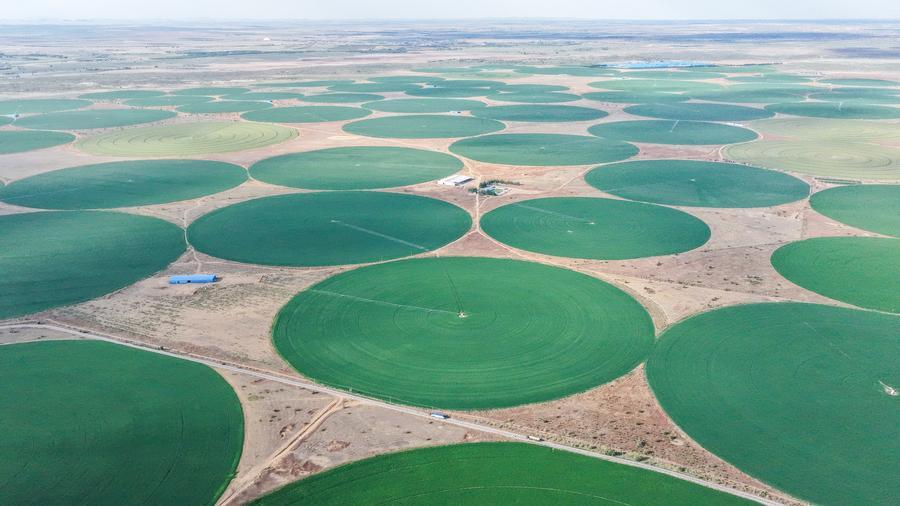
An aerial drone photo taken on May 31, 2026 shows forage fields in Ar Horqin Banner, Chifeng, north China's Inner Mongolia Autonomous Region. (Photo by Li Fu/Xinhua)
HOHHOT, China, July 14 (Xinhua) -- For centuries, caravans crossing the grasslands of Eurasia carried silk, spices and porcelain. The one that rolled into Hohhot, in northern China, on Monday carried something less tangible: ideas about how to keep the grass beneath its wheels alive.
The Silk Road Caravan, an initiative of the United Nations Convention to Combat Desertification (UNCCD), has covered some 6,000 km since leaving Türkiye in May. Its Chinese leg began in Inner Mongolia, part of the International Year of Rangelands and Pastoralists -- a UN designation meant to draw attention to landscapes that, though they cover roughly half the planet's land, are routinely overshadowed in environmental debates by forests, oceans and wetlands.
So why do grasslands matter, what is happening to them, and why are pastoralists central to their future?
MORE THAN PASTURE
"Grassland" conjures an open field, somewhere cattle graze. Scientists and international organizations prefer a broader term: "rangelands" -- a mix of grasses, forbs, shrubs and sometimes trees, grazed by livestock and wild animals alike.
Rangelands cover 54 percent of the world's land surface and, according to the Food and Agriculture Organization (FAO), support the livelihoods of around 2 billion people -- and more than 70 percent of the feed that livestock consume worldwide.
That makes rangelands part of the foundation of the world's food system: milk, meat, wool and hides, produced on land too dry, cold or mountainous to plow, that still yields nutrition and income.
Their importance extends well beyond livestock: grassland soils store carbon, roots hold soil in place, vegetation regulates water, and the landscapes themselves shelter wildlife, from antelope on the Asian steppes to elephants and wildebeest on the African savanna.
Unlike forests, much of a grassland's carbon is stored below ground. That can make its climate value less visible, but not less significant. Managed grasslands and rangelands contain nearly 20 percent of the world's soil organic carbon stocks, according to FAO.
"Grasslands are not merely magnificent natural landscapes," Long Ruijun, an ecology professor at Lanzhou University, said in an interview with Xinhua. "They are living communities that sustain ecological security, pastoral livelihoods and cultural diversity."
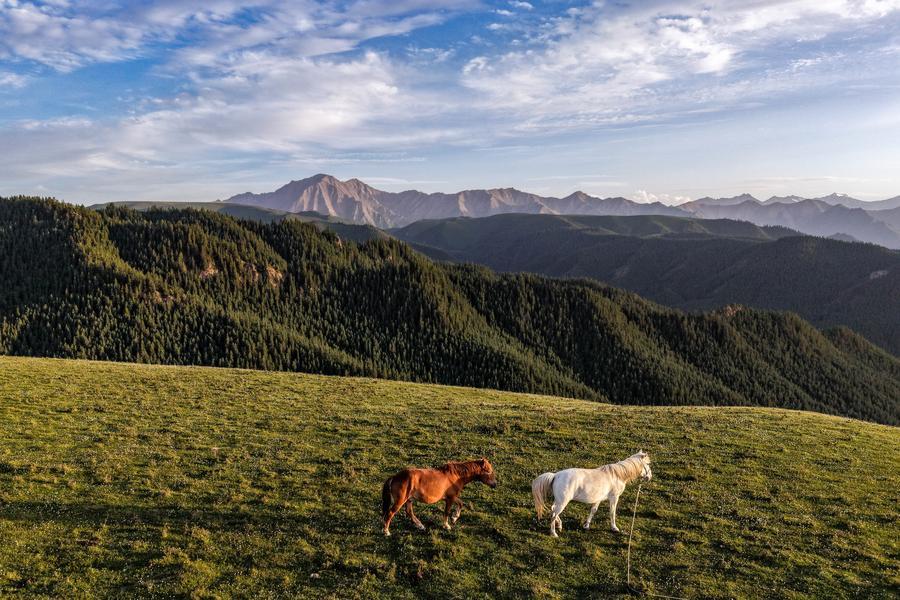
Horses graze on a grassland at the northern foothills of the Qilian Mountains in Sunan Yugur Autonomous County of Zhangye, northwest China's Gansu Province, July 5, 2026. (Xinhua/Lang Bingbing)
ECOSYSTEM UNDER STRAIN
Despite their scale, rangelands have long been the quiet cousins of forests and wetlands -- attracting far less public attention and investment.
Part of the problem is perception: treeless land looks empty, unproductive, ripe for conversion. But an ecosystem adapted to open ground can be just as easily wrecked -- by the plough, by fences that cut migration routes, or by tree-planting schemes that mistake bare ground for a blank canvas.
The pressures vary by place, but the list is long: land conversion, infrastructure, mining, poor grazing management, invasive species, and policies that strip pastoralists of the mobility they need to chase the rain. Climate change piles on longer droughts, hotter temperatures and wilder weather.
Up to half the world's rangelands are degraded or at risk, FAO said in June. The consequences can form a reinforcing cycle: thinning vegetation exposes soil, erosion reduces productivity and declining productivity places greater pressure on both the land and the people who depend on it.
These pressures, Long said, cannot be understood as environmental problems alone. In China, climate-driven droughts and harsh winters are cutting pasture productivity and killing off livestock -- even as pastoralists themselves grapple with rising costs, unstable incomes, an aging population and the flight of young people from grassland communities.
The problem is part of a broader land crisis. Up to 40 percent of the planet's land is degraded, affecting nearly half of humanity, according to UNCCD figures.
China illustrates both the scale of the challenge and the possibilities for recovery. The country has about 267 million hectares of grasslands, covering 27 percent of its total land area.
Han Fengze, an official at the National Forestry and Grassland Administration, said China has leaned on two main tools: grazing bans to keep livestock numbers in line with available forage, and ecological compensation payments to herders in exchange for improving grassland conditions.
About 180 million hectares of grasslands are now rated healthy or sub-healthy, accounting for more than 70 percent of the total.
Such gains, however, come with a caveat: restoration is not a one-off engineering project. Grasslands differ by climate, soil and how they are used, and recovery can be slow. Han called for science-based, locally adapted measures blending natural recovery, targeted intervention, monitoring and sustained management.
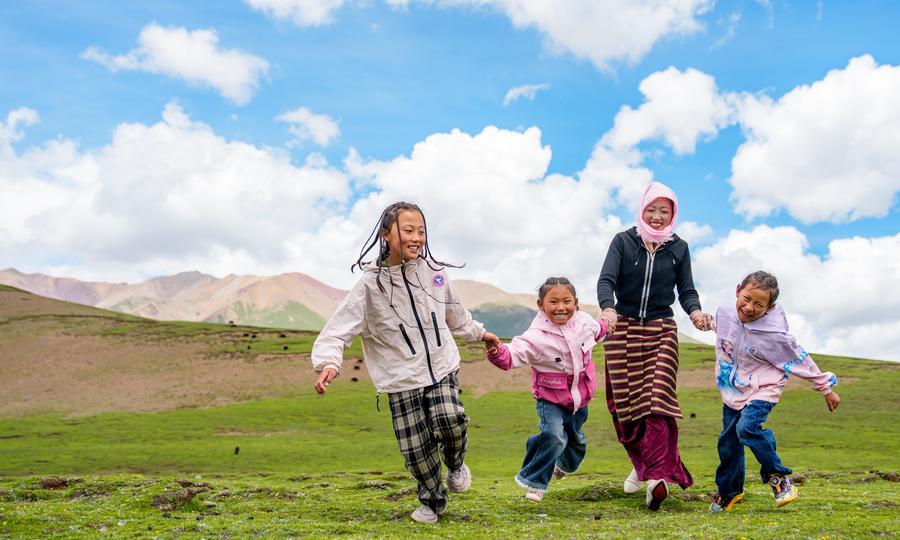
Tatso (2nd R) and her three daughters have fun on a pasture in Damxung County of Lhasa, southwest China's Xizang Autonomous Region, June 21, 2026. (Xinhua/Tenzin Nyida)
WORKING WITH PASTORALISTS
Rangelands' future is bound up with the people who have managed them for generations.
More than 500 million people rely on pastoralism for their livelihoods, the UNCCD estimates. Their mobility is often dismissed as backward, even environmentally damaging. In dry, unpredictable environments, though, it is closer to the opposite: moving herds in step with seasonal water and forage lets grazed land rest and recover.
Long described seasonal migration as a way of life tuned to nature's own rhythm: pastoralists move their herds to summer pastures when vegetation is abundant, giving winter grazing grounds time to rest and recover.
"It's a hard life," Long said, "but one filled with respect and gratitude for nature. People, livestock and grasslands have formed an interdependent relationship, passed down through generations."
It is, he said, a real-world example of "one health," the principle that human, animal and ecosystem health are all bound together.
Pastoralists also hold detailed knowledge of plants, animals, weather and water sources. Treating them only as beneficiaries of conservation or as a problem to be controlled can exclude knowledge essential to successful land management.
"They are not merely inhabitants of these lands; they are the custodians," Ricky Rej, goodwill ambassador for UNCCD, said at the event. "They are among our greatest partners in restoring and sustaining them."
That is not to say tradition alone can withstand climate change and modern development pressures -- rather, that good policy marries science with local knowledge, and gives pastoral communities a real seat at the table.
Grassland development, Han said, should aim to raise incomes and secure livelihoods for pastoralists, linking ecological restoration to modern animal husbandry, culturally rooted tourism and other industries that allow communities to benefit directly from conservation.
The caravan's next stop is Ulan Batar, Mongolia, host of the UNCCD's next conference (COP17). But its real test lies beyond the road: whether attention generated by a UN-designated international year can produce lasting investment, better data and policies shaped with pastoralists rather than simply for them.
Long put the stakes in simpler terms.
"Grasslands are not merely scenery. They are the cradle of life, the lifeblood of culture and the skin of the earth," he said. "The resources we depend on today were not inherited from our ancestors. They were borrowed from our children."
Photos

Related Stories
- China sees fewer spring sandstorms following decades of anti-desertification efforts
- China cracks down on illegal bird hunting, wildlife crimes
- New study adds scientific support for regional desertification control, eco-restoration
- China restores marine ecosystem for underwater wildlife
- Chinese researchers discover large gathering of endangered sea turtles on Huangyan Dao
Copyright © 2026 People's Daily Online. All Rights Reserved.
