



Innovation powers Shanghai's Changxing Island into world-class shipbuilding hub
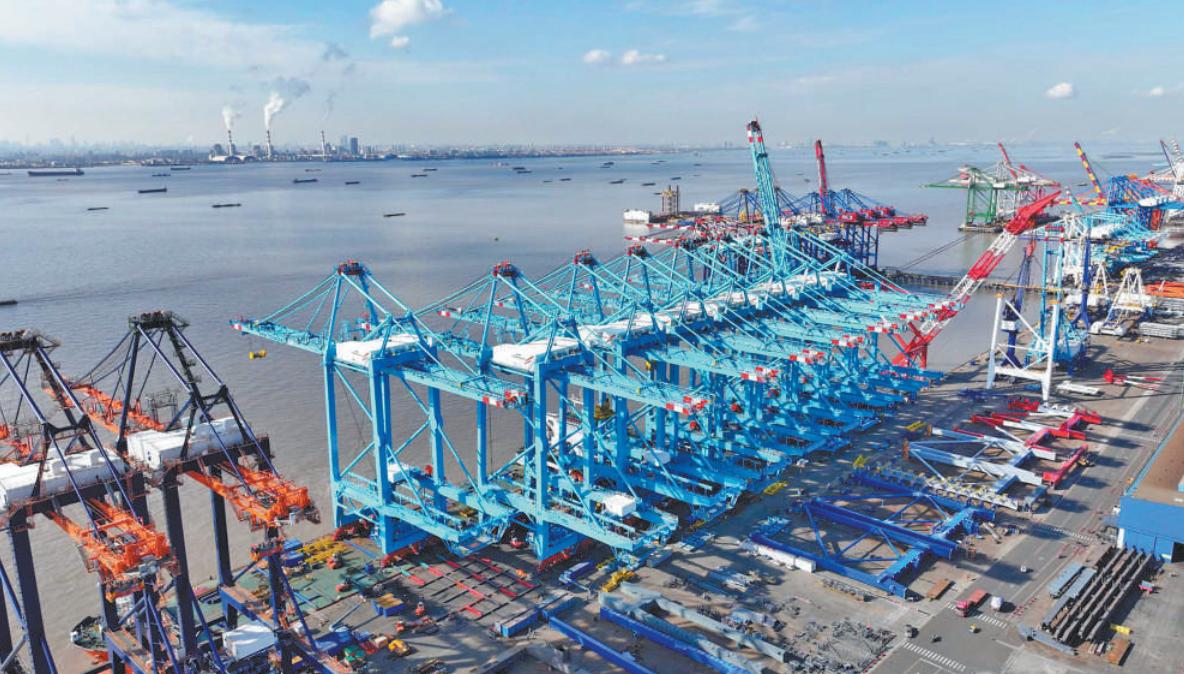
Photo shows a production base of Shanghai Zhenhua Heavy Industries Co., Ltd. on Changxing Island. (Photo from the news office of Chongming district, Shanghai)
On Changxing Island in Shanghai's Chongming district, a new high-tech vessel was launched roughly every seven and a half days last year.
Today, order books at shipbuilders on the island, including Jiangnan Shipyard (Group) Co., Ltd. and Hudong-Zhonghua Shipbuilding (Group) Co., Ltd., both under China State Shipbuilding Corporation Limited, are already filled through around 2030.
Behind the ability to build better ships and build them faster is one driving force: innovation.
Process innovation is reshaping how ships are built.
"Shipbuilding is like assembling building blocks. The larger each module becomes, the faster the assembly process," said Qu Huanjun, deputy director of Production Operations Department II at Jiangnan Shipyard, as he guided People's Daily reporters through the construction process of a 175,000-cubic-meter LNG (liquefied natural gas) carrier.
At the dockyard, enormous hull blocks towering more than 10 stories high and resembling giant slices of the ship's body were lifted simultaneously by twin gantry cranes and precisely joined together.
Nearby, massive cargo tank ring sections weighing thousands of tons slowly moved on transport systems toward floating docks, where they were launched and moored before installation of containment systems began.
"Over the past two years, improvements in precision during block joining and transportation have allowed these processes to be carried out simultaneously across different production areas before final assembly," Qu explained.
Today, the construction cycle for an LNG carrier on the island has been reduced from more than 30 months to around 16 to 18 months, reaching internationally leading levels.
Technological innovation is also reducing labor intensity while improving efficiency.
Inside a giant cargo tank designed to store LNG at minus 163 degrees Celsius, machines hummed continuously.
Stud mounting robots and insulation panel fitting robots stretched their extendable arms and carried out automatic construction work along the inner walls of the gigantic 50,000-cubic-meter decahedron vessel.
These robots, co-developed by Shanghai Jiao Tong University and Jiangnan Shipyard, have replaced dangerous high-altitude and edge operations previously carried out manually while doubling efficiency.
"Slightly shake the welding torch and keep the angle lower…"
Several hundred meters away in another workshop, senior welder Li Taotao demonstrated multi-layer welding techniques while lying sideways inside steel structures barely wider than an arm.
"My job is to translate Li's craftsmanship into code and teach it to our new seven-axis automatic welding robots," explained Luo Cheng, assistant researcher at the hull quality intelligent control research center under Shanghai Jiao Tong University's Changxing Ocean Laboratory.
"The goal is for robots entering similarly confined structures to start working much faster," she said.
As she spoke, Luo continuously photographed welding operations and made notes. Her phone contained hundreds of images of different steel structures.
Changxing Ocean Laboratory alone hosts 22 research teams like this, closely connected with shipbuilding and marine engineering companies across the island.
Meanwhile, nearly 20 marine research institutions, including the Shanghai Research Center of Hanjiang National Laboratory, the 704 Research Institute of China State Shipbuilding Corporation Limited and the Shanghai Merchant Ship Design and Research Institute, have gathered on the island to tackle key technological bottlenecks.
Collaborative innovation in core technologies has strengthened resilience across industrial and supply chains.
In early April, on the dock of Jiangnan Shipyard, Zhang Yan, a research and development engineer from Shanghai Qiyao Environmental Technology Co., Ltd. under the 711 Research Institute of China State Shipbuilding Corporation Limited, grew teary-eyed as he witnessed China's first domestically built large cryogenic reliquefaction system for LNG carriers being slowly lowered and fully mounted onto a ship.
Dubbed a "super refrigerator," this reliquefaction unit continuously reliquefies vaporized natural gas. "Magnetic levitation rotors weighing dozens of kilograms spin tens of thousands of times every minute, yet their vibration amplitude measure less than half the diameter of a human hair," Zhang said. "We had no prior references to draw upon. We had to review and sum up lessons repeatedly amid nearly 1,000 failed trials."
As technological breakthroughs accumulated, localization rates for supporting equipment supplied to shipbuilders such as Jiangnan Shipyard and Hudong-Zhonghua Shipbuilding rose from less than 30 percent over a decade ago to around 80 percent today.
Since 2020, output from Changxing Island's shipbuilding and marine engineering equipment sector has grown rapidly. In 2025, total output value exceeded 90 billion yuan ($13.3 billion).
According to an official with the Administrative Committee for the Development and Construction of Changxing Island, Shanghai aims to build Changxing Island into a world-class modern shipbuilding hub, with plans to expand industrial output beyond 120 billion yuan by 2027.
Photos



Related Stories
- Innovation story from smart factory floor in NE China
- Under China's innovation drive, sci-tech talent moves into corporate leadership
- China committed to open-source development for greater innovation, shared gains
- Beijing approves space computing industry innovation center
- China issues blue book analyzing future industries' sci-tech innovation, development
- Feature: Scientists encouraged to embrace "unconventional" ideas for innovation
- Digital technologies shine at 22nd China (Shenzhen) Int'l Cultural Industries Fair
- Interview: China emerging as major force in global biopharma innovation, Bayer executive says
- China's Yili launches global innovation initiative in Cambridge
- Private firms power China's innovation drive
Copyright © 2026 People's Daily Online. All Rights Reserved.
