



Anji's low-carbon tea industry gains international recognition
Experts from the Tea Research Institute of the Chinese Academy of Agricultural Sciences recently completed a reassessment of tea plantations in Anji county, east China's Zhejiang Province, confirming that local practices for green pest control, low-carbon fertilization and carbon sequestration met required standards.
The inspection came after the county received a plaque from the Food and Agriculture Organization (FAO) of the United Nations recognizing it as China's demonstration base for eco-friendly and low-carbon tea cultivation under the FAO's One Country One Priority Product initiative. The honor highlights growing international recognition of Anji's green and low-carbon development efforts in the tea industry.
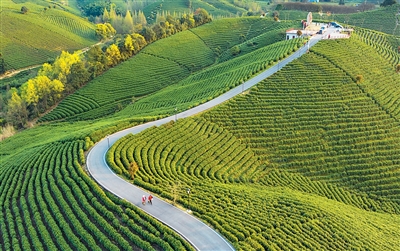
Photo shows a tea garden in Xilong township, Anji county, east China's Zhejiang Province. (Photo courtesy of Xilong township government)
Anji was selected in 2021 as one of China's first pilot counties to promote eco-friendly and low-carbon tea cultivation on a county-wide basis. Since then, it has established technical standards for low-carbon cultivation of Anji white tea while building a traceability system covering the entire supply chain from plantation to consumer.
Local tea growers have adopted a range of eco-friendly measures. At a tea garden in Lujia village, ground-cover plants help suppress weeds naturally, while trees intercropped in tea gardens improve soil quality, conserve water and enhance carbon storage. Internet of Things and blockchain technologies enable remote management of the tea garden.
Built in 2021, a white tea big data center in Anji county serves as the digital hub of the county's tea industry. Connected to environmental monitoring devices, video surveillance systems and smart irrigation facilities across tea plantations, the platform collects and analyzes real-time data, enabling full-process monitoring of white tea production, services, brand protection and regulatory activities.
This year's spring tea harvest also introduced time-based carbon footprint labels for all processed tea products in the county.
Xu Ying, head of the tea station under Anji county's bureau of agriculture and rural affairs, said Anji has promoted low-carbon practices across the entire tea production chain. Tea growers adopt precision nutrient management to reduce greenhouse gas emissions during cultivation, while processors follow clean and energy-saving standards to minimize carbon emissions. These efforts have helped establish a low-carbon management system covering the entire tea industry chain.
Anji is also making sustained efforts to bring tea plantation carbon sinks into the carbon trading market, extending its low-carbon ambitions beyond production into the broader environmental economy, said Liu Bin, director of the county's bureau of agriculture and rural affairs.
Photos



Related Stories
- China-Laos tea culture exchange activities held in Laos
- China's Guangxi emerges as global hub for tea industry amid tech upgrade
- Feature: Myanmar, China brew friendship through tea on International Tea Day
- Celebration marking International Tea Day held at UN headquarters in New York
- Chinese tea culture event held in Uzbekistan
- Chinese tea culture event held in Indonesia
- 8th China Int'l Tea Expo kicks off in Hangzhou
- Chinese tea cultural event held in Budapest, Hungary
- China's tea hills brew new paths to shared prosperity
- Cultural salon featuring Chinese tea, Western classical music held in Auckland
Copyright © 2026 People's Daily Online. All Rights Reserved.
