



Former industrial base transforms into digital cultural innovation hub in Wuhan, C China's Hubei
Once an industrial hub, Hanjiangwan in Qiaokou district, Wuhan, central China's Hubei Province, is now reinventing itself through urban renewal and adaptive reuse, transforming aging factories into digital culture innovation hubs.
At the former site of Wuhan Chenchuang Chemical Machine Manufacturing Co., Ltd., renovation work is in full swing. In just three or four months, a modern film and television production base is set to open.
According to Lai Xiangyu, a staff member at Wuhan Qiaojian Digital Media, six existing buildings are being upgraded into an AI-driven film and television innovation park, integrating five core functions: R&D and innovation, content production, exhibition and trading, talent training, and industrial services.
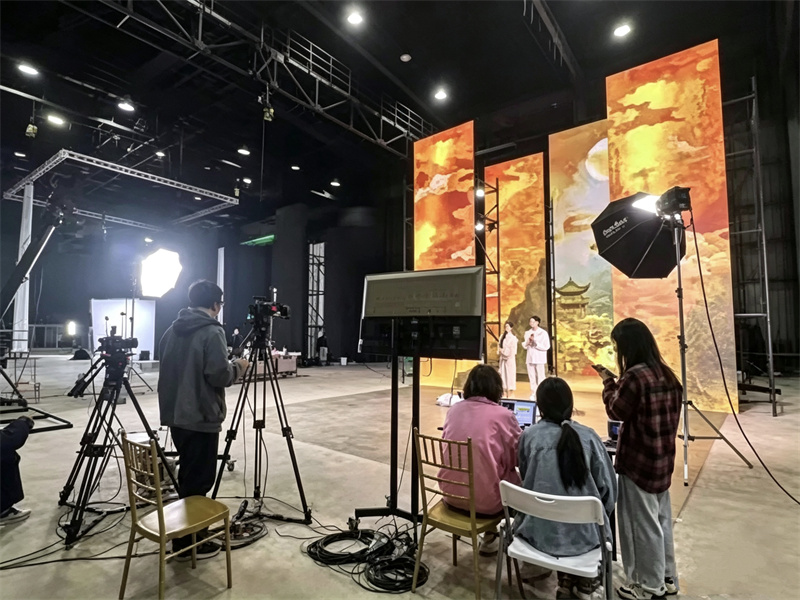
Studio 1 at Chenchuang Industrial Park has attracted many production teams with its distinctive overhead catwalk design. (Photo courtesy of the Publicity Department of the Communist Party of China Qiaokou District Committee)
"A production crew can arrive with just a script and complete the entire shoot here," Lai said. The confidence comes from the park's comprehensive support system, which includes more than 100 planned filming sets. Supported by the supply chain network of Hanzheng Street, a commercial and trade area, props can be delivered within 20 minutes.
At the Hikoon Music Industrial Park, hit songs have spread across the internet from studios converted out of a former factory space. The industrial park now holds a steady 12 percent share of China's music copyright market.
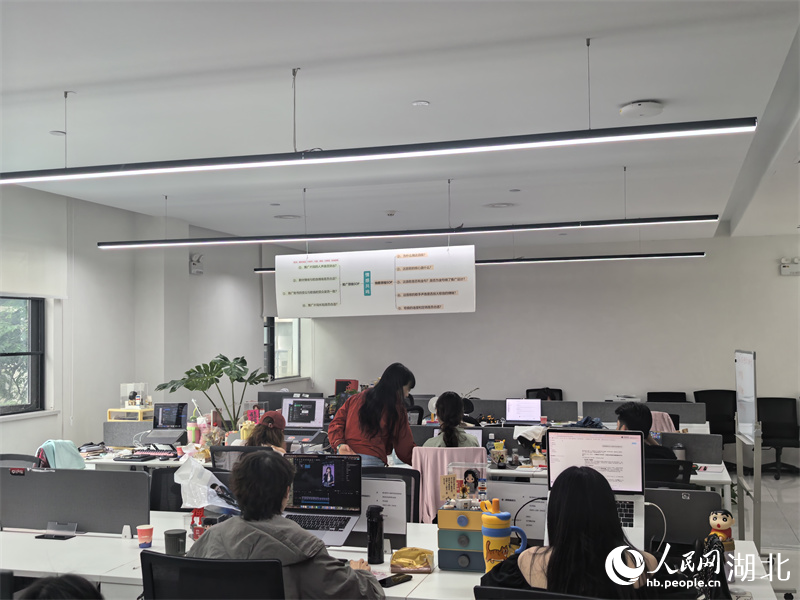
Photo shows an office at the Hikoon Music Industrial Park in Qiaokou district, Wuhan, central China's Hubei Province. (People's Daily Online/Zhou Wen)
"We moved here last May, and the renovated space was operational in less than a year," said Gao Xiaoguang, a staff member at Hikoon Music Group. Pointing to the preserved factory structure, he explained that the renovation followed a principle of leaving the exterior largely unchanged while adapting the interior for open-plan offices and compact recording studios. The entire project cost just over 10 million yuan (about $1.48 million).
Founded in Beijing in 2009, the company relocated its core team to Qiaokou district in 2019. At the time, it had just over 30 employees. Today, it has grown into one of China's leading music copyright platforms, having incubated and partnered with more than 200 music studios.
Photos

Related Stories
- 'Rooftop economy' breathes new life into Wuchang ancient town in C China's Hubei
- China issues top-level red alert for flash floods in Anhui, Hubei
- View of East Lake scenic area in Wuhan, China's Hubei
- National nature reserve in China's Hubei becomes ideal habitat for milu deer
- Geological wonder transformed into immersive light-and-shadow show in Zhongxiang, C China's Hubei
- Performance aiming at boosting spring cultural tourism staged in Jingzhou, China's Hubei
- China's Hubei cracks down on crimes related to precursor chemicals for fentanyl
- New Year on the Frontlines: Qianjiang produces crayfish year-round
- New Year on the Frontlines: Journey of Yingshan medicinal herbs out of mountains
- "Hubei New Spring International Consumption Season" kicks off in Wuhan
Copyright © 2026 People's Daily Online. All Rights Reserved.
