



Qingdao carwash builds better future for people with intellectual disabilities
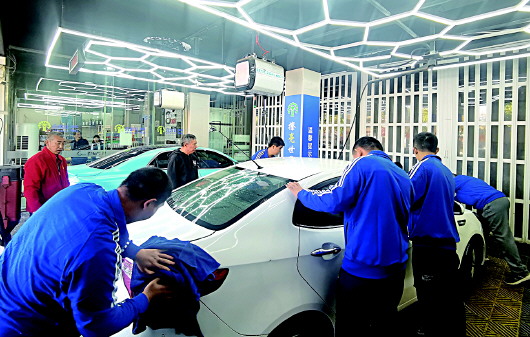
A car is washed at Xihan'er Carwash. (Photo from Bandao Metropolis Daily)
For many adults with intellectual disabilities, one of the hardest challenges after growing up is finding stable work and living independently. In Qingdao, east China's Shandong province, a small car wash center is trying to offer a different possibility by helping young people with autism, cerebral palsy and Down syndrome gain job skills, confidence and a greater sense of self-reliance through steady employment.
As a car slowly pulled into Xihan'er Carwash in Qingdao's Shibei district, it was soon surrounded by a group of car wash attendants. Tall in stature, they wore innocent smiles and had clear eyes, brimming with childlike purity. Among them was 26-year-old Wu Jilin, who immediately picked up cleaning cloths and got to work alongside his teammates.
"These young people have intellectual development disorders, including cerebral palsy, autism or Down syndrome," explained Cui Yonglan, director of the Chunyu employment assistance center for persons with disabilities, which is based in Shibei district.
"Although many of them are already in their twenties, some have cognitive abilities similar to children aged five or six. Their families often worry about how they will live independently in the future. Through vocational training, they've finally found jobs here," Cui told People's Daily.
In 2023, Cui founded the first Xihan'er Carwash outlet in Qingdao, creating employment opportunities for adults with intellectual disabilities. In less than three years, the carwash has hired 15 employees and cleaned more than 7,000 vehicles.
Wu was diagnosed with autism at the age of four. Children with autism often struggle to build emotional connections and face challenges in language development and social interaction.
His mother, Li Dongmei, spent years coping with grief, confusion and self-doubt. After extensive research, she learned that while autism cannot be completely cured, early intervention can greatly improve outcomes. She eventually quit her job to accompany her son at a special education school.
Tasks that most children might learn in days could take Wu months or even years to master independently.
"If he can't live independently, what will happen when we're gone?" Li said. It is a question shared by many parents of children with autism.
A turning point came when Li met Cui during an activity organized by the Chunyu center. For the first time, she began to imagine a future in which her son could work and support himself.
At the center, Wu started with simple repetitive tasks such as threading cords and folding envelopes. Gradually, he found work that suited him. As his confidence grew, Li herself joined the center and became a vocational training instructor helping other people with intellectual disabilities.
Wu has developed a passion for cars since childhood, so when the Xihan'er Carwash opened, he became one of its first employees.
"I never dared even imagine he could have a job and support himself," said Li. "We don't expect him to make a lot of money. Just having steady work and being able to contribute to society already means happiness to us."
While washing cars, Wu often repeats instructions softly to himself. A movement that most people can learn after watching a few times took him three months of repeated practice to master.
At the car wash, every task -- from handling water hoses to cleaning tires, wiping doors and vacuuming interiors -- is broken down into small, manageable steps. Trainers patiently guide employees through the same routines again and again.
Gradually, Wu has picked up the skills of car washing, and regularly shares his day with his mother after work, telling her he has cleaned the steering wheel without honking the horn and polished the car till it shone brightly.
Watching her son grow increasingly confident, Li could not be happier. "Since he started working, his communication skills have improved a lot, and he is always eager to tell me about his day," she said.
The Chunyu center, located a few hundred meters from the carwash, was founded by Cui in 2014.
"I sustained a work-related injury at the age of 25, which left me with a permanent impairment," Cui recalled. "It was devastating, and I cried almost every day." Later, with support from the local federation of persons with disabilities, Cui gradually rebuilt her confidence and decided to help others facing similar challenges.
Employment has long been one of the greatest difficulties for people with intellectual disabilities. Over the years, the Chunyu center has experimented with different employment models, working with more than a dozen companies to create tailored positions based on each individual's abilities. Today, the center has more than 20 instructors and serves over 100 people with intellectual disabilities.
With support from the Qingdao municipal government, the local federation of persons with disabilities and social welfare organizations, the Xihan'er Carwash officially opened in October 2023.
Dou Yunfeng, manager of the partner carwash business, admitted he initially had doubts. "At first, I worried whether they could really do the job well," he said. "But they learned much faster than expected. They are incredibly conscientious. If the rule says a wheel must be wiped three times, they will do it exactly three times, never less. Customers really like them, and some people travel from far away just to have their cars washed here."
Sometimes customers try to leave extra money as tips, but the employees politely refuse.
"We can't accept it. Rules are rules," they insist gently but firmly. Rather than asking for sympathy or special treatment, they are earning respect through their own work.
They wash more than 10 cars a day on average. The number rises to over 30 on weekends and 50 on holidays.
"I like washing cars," Wu said. "I want to make every car shiny."
Inside this modest carwash, Wu and his coworkers are doing more than cleaning vehicles -- they are slowly building brighter, more independent futures for themselves.
Photos

Copyright © 2026 People's Daily Online. All Rights Reserved.
