



Young volunteers bring digital skills to China's older generations
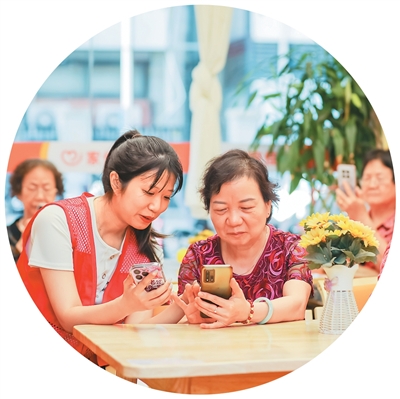
A volunteer helps an elderly resident learn how to use her smartphone at the elderly service center in Gulou district, Fuzhou, southeast China's Fujian Province. (Photo/Xie Guiming)
China had 161 million internet users aged 60 and above as of June 2025. Across the country, young people are teaching their parents and grandparents how to navigate the digital world.
This process often requires patience and repetition. More importantly, it creates moments of understanding, empathy and reconciliation between generations.
On a recent Friday morning, a smartphone photography class got underway at a community activity center in Tiantan subdistrict, Beijing. The teacher was a university student, while the pupils were retirees.
The class is part of "See Young," a youth volunteer initiative dedicated to digital support for the elderly. Over the past 15 years, the group has conducted 15,000 free training sessions, reaching millions of elderly people.
In the classroom, more than 30 elderly learners leaned forward attentively, following every detail on screen. Once hands-on practice began, the classroom quickly turned lively. What seemed simple to younger users proved surprisingly complex for seniors.
"For young people, it's intuitive. For older users, it's a completely new system of abstract symbols," said Zhang Jiaxin, an associate professor at Beijing University of Posts and Telecommunications, and founder of "See Young".
He recalled their early failure in 2011 when no one showed up to a lecture on computer basics. That experience made them realize that digital education must be grounded in everyday needs and plain language.
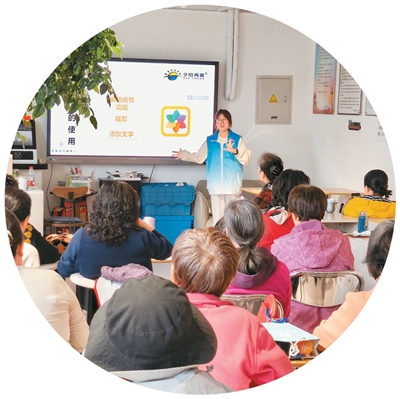
Zhao Qianqian teaches a smartphone photography class for elderly learners. (Photo/Wu Xuecong)
"The hardest part isn't teaching operations; it's building digital literacy," said volunteer Zhang Chenyu, a student from Capital Normal University, adding that the goal is for elderly people to understand the logic and learn independently.
Today, "See Young" has become a nationwide volunteer network, with more than 20,000 members from over 100 universities, carrying its programs into more than 500 residential communities across China.
Intergenerational digital support is not limited to classrooms. It often plays out at home, where it becomes a test of patience.
Professor Zhou Yuqiong at Shenzhen University has long studied intergenerational digital support. She noted that many adult children simply set up their parents' devices for them, skipping the more time-consuming but essential process of teaching them how to do it themselves. In the long run, this limits older adults' ability to engage meaningfully with digital life and undermines genuine digital inclusion efforts.
Teaching digital skills to older generations goes far beyond transferring technical skills. The objective, more importantly, is to help older adults overcome their fear of the unknown and of aging itself.
While volunteering, Zhang Chenyu observed a common mindset among many elderly people. They frequently say things like, "I'm too old for this" or "I'm no longer useful," he noted, adding that many define themselves simply as "old" and assume they are inevitably out of touch with the times.
Peng Huamao, a professor at Beijing Normal University, said that stereotypes about old age need to be dismantled and replaced with a more flexible and resilient understanding of later life.
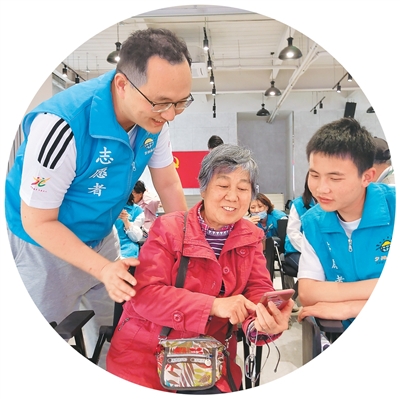
Zhang Jiaxin (left) explains the everyday applications of 5G technology to an elderly citizen. (Photo courtesy of the interviewee)
"As teachers, we don't see older participants as students to be instructed or children to be comforted," Zhang Chenyu explained. "We treat them as equals and explore the digital world together with respect and curiosity."
Today, one in every two older adults in China is online, and an increasing number are using the internet to showcase their talents and find enjoyment.
"For many older people, what they truly need is not data or forced digital inclusion, but to be understood, listened to and accompanied," said Hu Yong, a professor at Peking University.
Photos




Related Stories
- China's digital industry revenue up 12.9 pct in Q1
- 9th Digital China Summit opens in Fuzhou
- Digital transformation emerges as new engine for sustainable development in Asia: report
- 9th Digital China Summit to spotlight achievements, tech advancements, ecosystem development
- China's manufacturing digital drive reaches mass adoption stage: report
- China accelerates high-quality digital development in 2025
- Digital trade set to take wing
- City showcases digital urban future
- Intelligent integration will define digital future
- China Int'l Digital Economy Expo 2025 kicks off in Hebei
Copyright © 2026 People's Daily Online. All Rights Reserved.
