



Sci-tech backyard helps promote transformation of seaweed industry, rural revitalization in E China's Zhejiang
On the shores of Xihu harbor in Huangbi'ao township, Xiangshan county, Ningbo, east China's Zhejiang Province, the harvest of Ulva prolifera, a species of seaweed algae, has just concluded.
"The institute paid me over 60,000 yuan (about $8,810.7) in harvesting fees," said Qiu Yonggao, a villager of Baiyu village in the township. "Who would have thought this stuff growing on the mudflats could actually be worth something?"
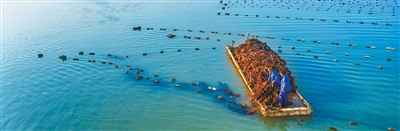
Farmers harvest kelp in Huangbi'ao township, Xiangshan county, Ningbo, east China's Zhejiang Province. (Photo/Shen Yang)
The institute Qiu refers to is the Xiangshan seaweed science and technology backyard (STB), jointly operated by the local government, a university and a leading enterprise. Anchored along a stretch of coastline linking four villages — Gaoni, Xingjiao'ao, Baiyu and Hugang — it is helping Xiangshan's seaweed industry transition from a traditionally extensive model to a modern, intensive one.
The township has three signature products — Ulva prolifera harvested in April, kelp soon after, and laver in September and October. The STB, which was among 285 such backyards announced by the China Rural Special Technology Association last May, has helped build a complete industrial chain stretching from cultivation and processing to overseas markets, boosting incomes for more than 180 households.
Inside the 900-square-meter seedling workshop of a seaweed production base, technicians are experimenting with indoor cultivation of Ulva prolifera. Zhu Wenrong, chairman of Xiangshan Xuwen Seaweed Development Co., Ltd., the enterprise partner behind the operation, said the algae grown here is processed into a food seasoning ingredient purchased in bulk by well-known overseas snack companies.
The base provides farmers with free seedlings and technical guidance, along with a guaranteed purchase price. During this year's harvest of Ulva prolifera, more than 100 local villagers worked at the site each day, with daily purchases of fresh Ulva prolifera peaking at over 40,000 kilograms. Every one of them could earn up to 1,500 yuan in a single day.
In addition to Ulva prolifera, the base has gradually introduced quality kelp and laver seedlings. Zhu said kelp output remained steady at more than 2,000 tonnes last year, most of it shipped to supermarkets and restaurants in Shanghai and Hangzhou. Laver from Huangbi'ao township, meanwhile, often struggles to meet demand.
Ulva prolifera fixes nitrogen and carbon dioxide as it grows, and its carbon sequestration capacity can now be scientifically measured and monetized.
On Feb. 28, 2023, China's first-ever auction of blue carbon, carbon absorbed by ocean and coastal ecosystems, was completed — 2,340.1 tonnes of annual fishery carbon sink from Xihu harbor were sold at 106 yuan per tonne, generating roughly 248,000 yuan in total.
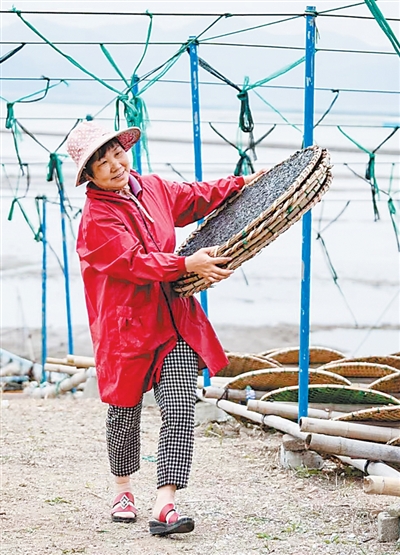
A farmer dries laver at Xihu harbor in Huangbi'ao township, Xiangshan county, Ningbo, east China's Zhejiang Province. (Photo/Zheng Kaixia)
Since that inaugural auction, Huangbi'ao township has completed nine transactions of seaweed carbon sinks, totaling more than 6,000 tonnes and over 450,000 yuan.
The distribution of blue carbon trading proceeds has given villagers a tangible stake in protecting the marine environment. Under the distribution scheme, the proceeds are used to purchase seaweed seedlings, which are then distributed to villagers free of charge to continue farming.
Last year, villager He Shichang of Hugang village received seaweed seedlings worth 1,200 yuan as his share. "This is money earned by protecting the ocean," he said, adding that fishermen now take extra care to avoid damaging the marine environment when out at sea.
Innovation has extended into the courts as well. In a landmark 2024 case, a defendant convicted of illegal fishing voluntarily purchased 422.5 tonnes of blue carbon credits from Huangbi'ao township as ecological compensation.
Ningbo University researcher Chen Haimin leads a resident team that supervises cultivation and trains graduate students at the STB. "Universities used to struggle to commercialize their findings. Now, findings from the lab can be tested and scaled up right here in the waters of Xihu harbor," Chen said.
Ecotourism has added another layer. In Gaoni village, a coastal agri-tourism complex combines seaweed farming with fish-and-crab cultivation in paddy fields and boutique B&Bs, creating jobs for more than 30 villagers. Visitors can try their hand at harvesting and take home packaged seaweed products.
The township's experience shows that the ocean, a vast "blue granary," holds enormous promise for advancing China's all-round rural revitalization.
Photos




Related Stories
- No. 5 main tower of Taoyaomen highway-railway bridge in China's Zhejiang topped out
- Continuous beam of Qujiang grand bridge spanning Shanghai-Kunming expressway completes closure
- E China's town draws tourists during May Day holiday
- Village in China's Zhejiang develops rural cultural and eco-friendly tourism
- Green Rural Revival Program boosts common prosperity in China's Zhejiang
Copyright © 2026 People's Daily Online. All Rights Reserved.
