



Digital intelligence accelerates growth of China's service sector
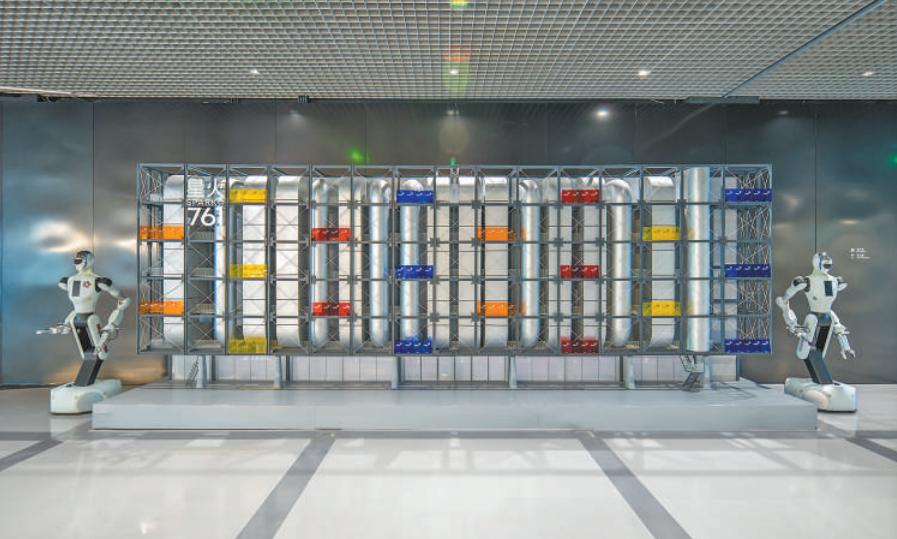
Photo shows an exhibition hall of the Beijing Digital Economy Computing Power Center. (Photo/Li Dong)
From AI-powered geological analysis and industrial design review to more efficient cross-border data services, digital and intelligent technologies are rapidly reshaping China's service sector and creating new drivers for economic growth.
In Beijing's Chaoyang District, companies are turning long-dormant data resources into productive assets. New digital platforms are enhancing service efficiency across diverse industries, including engineering, healthcare, manufacturing, and international data exchange. The result is a more agile, innovation-driven service economy powered by digital intelligence.
Data once locked away in archives is now generating new value.
At Beijing Urban Construction Survey and Design Institute, rows of filing cabinets hold decades of geological survey materials, including yellowed blueprints, handwritten reports and aging hard drives collected over nearly 70 years of work.
According to chief engineer Gao Tao, the archives contain surveying data from more than 50 cities and hundreds of subway lines, totaling over 12 million linear meters of investigation records.
"In the past, we were sitting on a gold mine of data but had no practical way to use it," Gao said.
Today, the institute has transformed itself from a traditional geological surveying enterprise into a participant in data trading and artificial intelligence (AI) development.
After organizing and digitizing its paper-based geological data, the company built a cloud platform for survey data. Through procedures including data rights confirmation, compliance review and desensitization, previously dormant archives were turned into usable digital assets. The company eventually obtained a data asset registration certificate from the Beijing International Data Exchange and started close cooperation with a research institute.
"We're not just selling data; we're providing services," Gao said.
Drawing on decades of accumulated geological information, the company independently developed a large AI model for the geotechnical surveying industry. The model can retrieve geological information and predict urban groundwater levels, among other functions.
"In the past, predicting groundwater level changes in a specific area required collecting monitoring data from multiple institutions and spending significant time on modeling and analysis," Gao explained. "Now, users can simply input a location and obtain visualized results within minutes."
Making data valuable also requires making it flow more efficiently.
For years, cross-border data transfer remained a major obstacle for many businesses due to complicated compliance procedures, lengthy approval processes and high costs.
In October 2024, Chaoyang district launched an international cross-border data service platform, supported by the local government and invested in by Jingmin Digital Technology (Beijing) Co., Ltd. The platform can intelligently classify and identify enterprise data based on official industry data catalogs and standards, automatically determine filing pathways and generate application materials with a single click.
One early beneficiary was Beijing Obstetrics and Gynecology Hospital, affiliated with Capital Medical University. The hospital needed to transfer ultrasound imaging data overseas for international scientific research cooperation.
"Through our services, the client met filing requirements on its first submission," said Huang Wendan, director of the data elements center at Jingmin Digital Technology (Beijing) Co., Ltd. "The filing process was shortened from seven working days to five."
Since its launch, the platform has improved overall efficiency in cross-border data services by more than 40 percent.
Beyond activating existing data resources and removing bottlenecks, companies are also equipping data systems with what many describe as a "smart brain."
At the Universal Business Park in Chaoyang district, Lei Jian, vice president of Beijing Ling-Y Innocenter Technology Co., Ltd., demonstrated the company's "Yangmei" industrial platform. After importing a design drawing for an automobile part, the system quickly generated a detailed analysis report showing whether the design complied with industry standards and identifying potential problems.
Industrial drawings serve as a crucial link between design and manufacturing. A standard passenger vehicle may involve thousands of component drawings. "Traditional manual review is time-consuming, labor-intensive and heavily dependent on experienced experts," Lei said.
The platform can not only "understand" various types of industrial drawings but also operate continuously around the clock, he added.
The system has already integrated more than 1.6 billion pieces of industrial data covering 41 major industrial sectors of the national economy.
"By embracing open-source collaboration, our more than 12,000 registered users have developed over 1,000 industrial intelligent agents," Lei said. "Each intelligent agent is essentially a digital service that can be subscribed to, called upon and customized."
Digital and intelligent technologies are helping China's service sector expand capacity and improve quality, while the sector's high-quality development is also attracting more leading enterprises and institutions.
Entities including the Beijing Digital Economy Computing Power Center, the Beijing International Data Exchange and Beijing Data Group have all established operations in Chaoyang district. On March 30 this year, the World Data Organization also chose to locate there.
In the first quarter of this year, Chaoyang district's service sector generated an added value of 231.18 billion yuan ($34.02 billion), up 5.3 percent year on year.
Photos



Related Stories
- China's 2025 data production hits 52.26 zettabytes
- China solicits public opinions on 22 national standards for data sector
- World Data Organization established to bridge global data divide
- Subsea server cooling: pioneering green data centers emerge in S China
- Chinese vice premier calls for enhancing global data governance
- World Data Organization established in Beijing
- Harnessing Xizang's high-plateau environment to build greener, more efficient data centers
- China to beef up personal data protection in internet applications
- China to accelerate building data property rights registration system
- China advances international cooperation on data standards
Copyright © 2026 People's Daily Online. All Rights Reserved.
