



5G powers smarter mining with autonomous ore trains
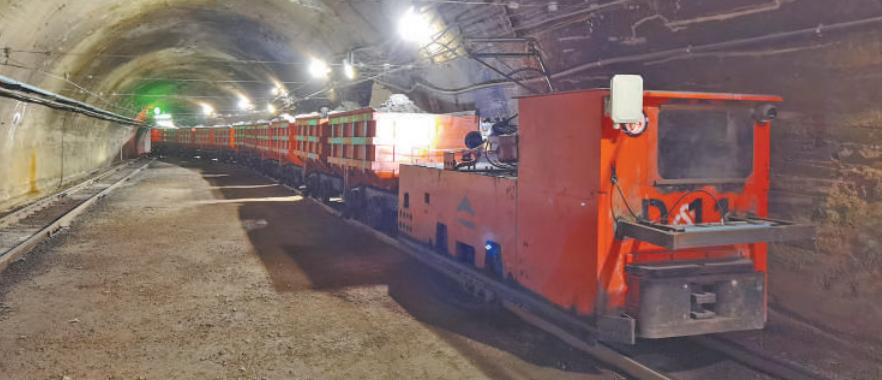
A driverless electric locomotive runs underground. (Photo provided by Jinchuan Group Co., Ltd.)
At the Longshou Mine operated by Jinchuan Group Co., Ltd. in northwest China's Gansu province, 5G-powered driverless electric locomotives are now transporting ore through tunnels hundreds of meters underground. Backed by an intelligent dispatching system, these unmanned trains operate entirely underground without on-site human drivers.
Tasks that once required locomotive operators and track workers deep underground can now be managed remotely from an intelligent control center above ground, improving both safety and efficiency in one of mining's most demanding environments.
Inside the mine's smart control room, real-time operational data from underground locomotives flashes across large digital screens. Former locomotive driver Mei Songbo, now an operator, monitors the status of rail switches remotely. As a train approaches a junction, the corresponding virtual switch icon on the screen automatically turns green and changes track settings in sync.
"Before, changing rail switches required precise coordination between the locomotive driver and track workers underground," Mei said. "Now it can all be done remotely with a control handle and buttons."
For years, underground locomotive operation depended heavily on skilled manual driving and constant, intense focus. Seeking to enhance safety, working conditions, and efficiency, Longshou Mine began exploring autonomous driving technology for mining workflows in 2018.
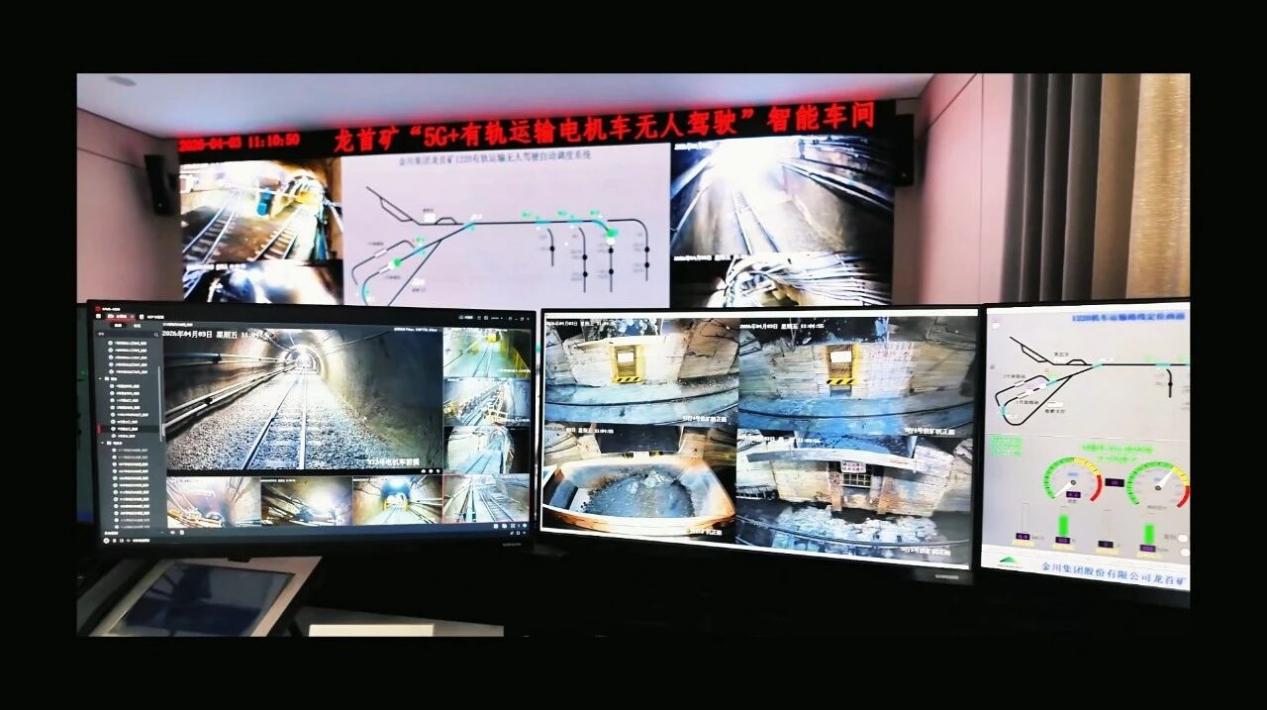
Photo shows a control room for 5G+ driverless electric locomotives of the Longshou Mine. (Photo provided by Jinchuan Group Co., Ltd.)
Driverless electric locomotives were soon introduced underground. However, ensuring their reliable and safe operation proved far more complex than simply getting them to move.
At the time, the mine relied on WiFi communication, which suffered from short transmission distances, limited bandwidth and severe signal loss inside winding underground tunnels. Video feeds transmitted back to the surface experienced delays of up to one or two seconds.
"Even a one- or two-second lag is enough for a locomotive to drift three to five meters off course with no human intervention," said Zhao Peng, director of the transportation section at Longshou Mine. "The safety risks were unacceptable."
The growing number of underground sensors and video monitoring points placed even greater demands on communications infrastructure. Real-time video transmission, instant command delivery and the simultaneous operation of multiple locomotives quickly exceeded the capabilities of traditional WiFi systems.
In March 2020, Longshou Mine's technical team joined forces with communications technology companies to begin developing a new solution.
"At that time, 5G wireless communication was just beginning to be applied in industrial settings," Zhao said. "Gansu's industry and information technology authorities were collecting use cases for 5G applications across the province, and its low latency and high bandwidth matched our mining needs perfectly."
Yet standard consumer-grade 5G systems initially struggled to perform underground.
Consumer 5G networks are designed mainly for downloading data, such as streaming videos to smartphones. Underground mining operations, however, required the opposite: large amounts of upstream data, including real-time video feeds and vehicle control signals sent from locomotives back to the surface control center.
After rounds of field testing, network redesigns and fine-tuning of on-board terminals, the technical team reallocated uplink and downlink bandwidth and created dedicated communication channels for the locomotives. By the end of 2020, the mine launched trial operations of its first locomotive equipped with a 5G communication system.
Removing people from underground operations made the trains run faster.
"When locomotives pull ore cars underground, they can only move forward and can't reverse direction on their own," Mei explained. "In the past, after reaching a loading or unloading point, the driver had to walk to the other end of the locomotive to continue operating it. Just loading and unloading added another 10 minutes to each trip. Now the system can automatically switch the powered end of the locomotive, improving efficiency by 20 percent."
Technology is transforming mining operations: workers no longer need to descend with heavy machinery but can monitor and control processes remotely from the surface.
Starting with the first "5G + driverless locomotive," Longshou Mine has since turned its communications platform into a broader incubator for intelligent mining solutions.
Beneath the surface, "5G + AI" image recognition enables precise docking between ore loaders and mining cars. Above ground, a 5G-enabled digital twin platform visualizes and monitors the mine's entire operational process in real time.
The mine's heating system can now be adjusted on demand across the entire site through the 5G network, while intelligent inspection robots have also been deployed.
What began as a single autonomous driving application has evolved into an all-in-one intelligent platform supporting mine safety, equipment maintenance and dispatch management.
The digital transformation has also created new career paths for veteran miners like Mei and his coworkers. Years of hands-on underground experience have become invaluable in bridging the gap between new technologies and real-world operational scenarios. Some former drivers now work in control rooms overseeing dispatch systems, while others help maintain equipment and optimize technical parameters.
"Our years of underground experience help these new technologies adapt perfectly to real mining conditions," Mei said. "And the new technologies are improving our working environment as well. I truly believe smarter, digital mines will bring a better future for every worker here."
Photos



Related Stories
- From connectivity to intelligence, global mobile industry showcases new wave of innovation
- China's 5G base stations top 4.83 million by end of 2025
- China commences second phase of 6G technical trials
- China sees strong growth in 5G base stations
- 2025 China 5G + Industrial Internet Conference opens in Wuhan
- Chinese medical team performs remote 5G robotic eye surgery over 4,000 km away
- China reports 4.7 mln 5G base stations by end of September
- China home to nearly 4.65 million 5G base stations
- Beijing to build at least 20 5G factories by 2027
- Nation leading in 5G connections, application
Copyright © 2026 People's Daily Online. All Rights Reserved.
