



Guangzhou expands large-scale use of unmanned farming technologies
Guangzhou in south China's Guangdong Province has been accelerating the large-scale application of unmanned farming technologies in recent years.
At 6 a.m. in Huangpu district, the "digital farm manager" at a "super farm" run by XAG, a Guangzhou-based agritech firm, was already at work. The farm serves as a testing ground for a new kind of agriculture — one built around robots, artificial intelligence (AI) and the Internet of Things (IoT).
An agricultural drone lifted off automatically from a rooftop landing pad and swept over the paddy fields at 8 meters per second, seeding nearly 300 mu (20 hectares) in 30 minutes.
"Once the rice sprouts, our drone can scan the entire farm at centimeter-level resolution," said Ye Yonghui, the farm's operations manager. "Our AI system flags everything from leaf color and plant height to areas affected by pests or disease."
The efficiency gains are substantial. "During the peak transplanting season, conventional methods would need 10 to 15 workers to cover 300 mu of paddy fields," Ye said. "With smart farm equipment, two or three people can handle the same workload."
Ye pointed to an AI map on the screen — a tool that identifies field boundaries and obstacles, and then automatically generates task instructions for targeted fertilizer application.
This level of automation runs through every stage of the crop cycle. At seeding time, the digital farm manager configures the drone's flight parameters — altitude, speed, seeding rate — and plots the optimal flight path.
Loaded with nearly 80 kilograms of rice seeds, the drones crisscross the fields at up to 50 times the speed of manual sowing. Tractors equipped with the BeiDou Satellite Navigation System handle field preparation autonomously, with an operating margin of error of no more than 2.5 centimeters.
IoT devices — soil sensors, weather stations and smart cameras — upload readings every 15 minutes. Temperature, humidity, light levels and soil fertility all feed into what Ye calls the "field brain," where AI algorithms analyze the combined data. The system then generates recommendations for irrigation, fertilization and pesticide application.
"Last year, the whole system reduced water and electricity costs per mu of paddy fields by 47 percent and pesticide use by 30 percent, and boosted fertilizer efficiency by 40 percent," Ye said, adding that the true value of smart agriculture lies in AI's ability to fine-tune the details.
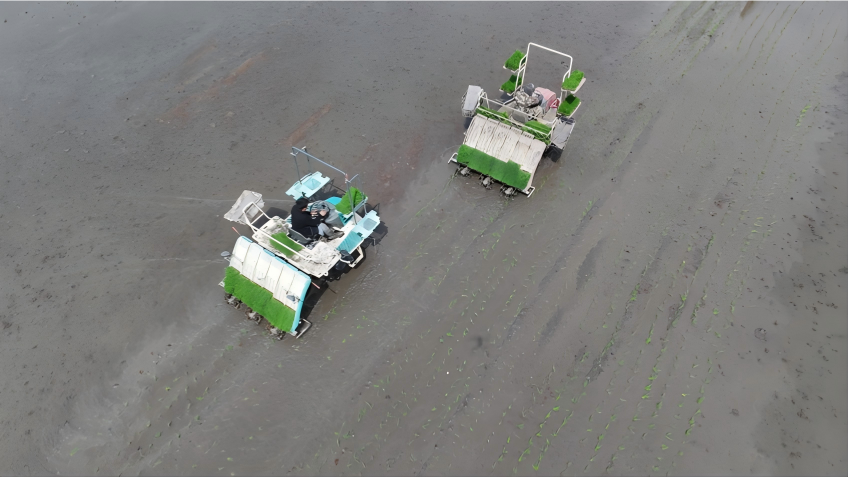
In the seeding phase, conventional transplanting machines rely on the operator's judgment, often leaving patches of land underutilized. AI-planned routing for autonomous transplanting machines has raised land utilization per mu by 15 percent.
In crop protection, AI has helped ensure pesticides are applied more precisely. During last summer's rice blast outbreak, the system identified areas of mild infection where reduced dosing was sufficient, saving more than 10,000 yuan (about $1,467) in pesticide costs alone.
"The most tangible savings are in labor costs," Ye said. Field inspections that once required workers to walk the land are now done by drones, which produce high-resolution imagery and detailed vegetation data across the entire farm. Only three technical staff members are needed year-round.
The model has proven even more effective at XAG's "super cotton field" in northwest China's Xinjiang Uygur Autonomous Region. There, two employees manage 3,000 mu of cotton — achieving a per-mu yield 16 percent higher than conventional farming and reducing overall costs by 22.89 percent.
Guangzhou is using smart grain farming as a pilot to bring together the BeiDou Navigation Satellite System, intelligent equipment and agricultural big data platforms into a fully unmanned system covering the entire crop cycle — from land preparation to harvest. The goal is to build model smart farms across the city.
"Through policy support, opening up application scenarios, and pilot demonstrations, we are accelerating the large-scale application of unmanned agricultural technologies across the city," said an official with the Guangzhou Agriculture and Rural Affairs Bureau.
Photos


Related Stories
- China's tech innovation in tree planting reshapes efforts to green arid land
- China's agricultural technology makes leap forward in going global
- Modern agricultural machinery, techniques boost production in NW China's Qinghai
- Smart technology improves rice seedling cultivation efficiency in E China's Jiangxi
- China's Shouguang germplasm resource center collects over 26,000 vegetable seed species
Copyright © 2026 People's Daily Online. All Rights Reserved.
