



From underdog to contender: China's motorcycle breakthrough signals industrial advancement
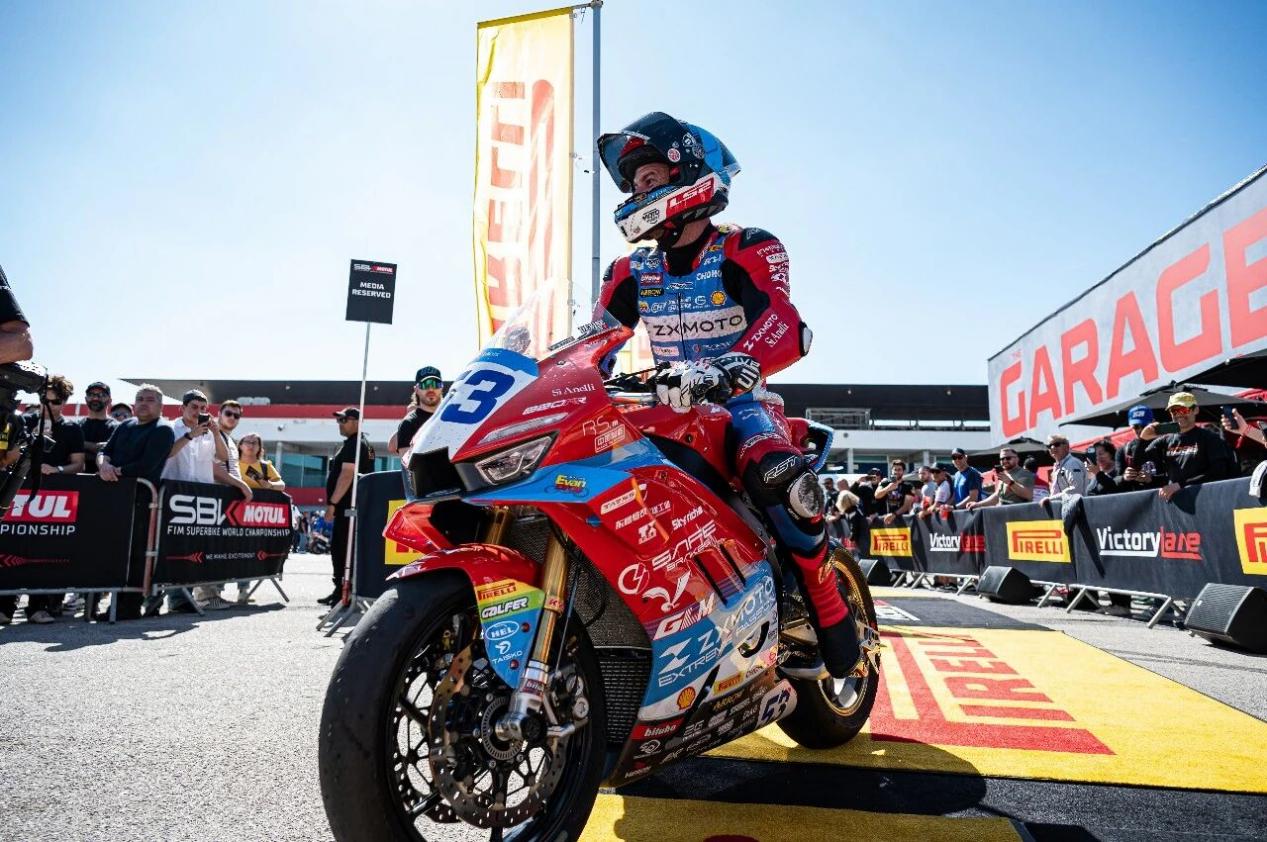
French rider Valentin Debise rides a bike manufactured by ZXMOTO at the Portugal round of the Superbike World Championship. (Photo provided by ZXMOTO)
At a recent round of the Superbike World Championship (WSBK) in Portugal, Chinese brand ZXMOTO, founded just two years ago by Zhang Xue, claimed victory in the World Supersport (WorldSSP) category, breaking a decades-long dominance by European, American and Japanese manufacturers.
The achievement quickly captured significant international media attention and trended on social media. Many commentators hailed it as a "stunning upset" and the potential dawn of "a new era in superbike racing."
Why has this breakthrough resonated so widely? A closer look at international coverage offers a clear answer. "Breaking stereotypes -- this time China means business," read a headline from an Italian automotive outlet.
At one time, labels such as "poor quality," "weak performance," and "low-end imitation" were attached to Chinese motorcycles.
ZXMOTO's success, however, challenges these perceptions by demonstrating solid technological capability. The company 100% independently develops all core components -- from engines and frames to electronic control systems -- achieving a localization rate exceeding 90%.
One innovation has drawn particular global attention: the engine, hailed as the "heart" of a motorcycle.
For decades, Japanese and European brands maintained a near-impenetrable advantage in mid-to-large displacement engines, particularly four-cylinder and twin-cylinder designs, built upon years of accumulated expertise and patent protections.
Confronted with these technological barriers, ZXMOTO rose to the challenge, waging a "patent breakthrough campaign" over 18 months and ultimately conquering the "tough nut" of the three-cylinder liquid-cooled engine.
What distinguishes a three-cylinder engine? Simply put, while twin-cylinder engines offer strong initial acceleration but may lack sustained power, and four-cylinder engines provide smoother, sustained power but potentially less immediate thrust, a three-cylinder design effectively combines the strengths of both. It delivers robust acceleration and consistent power while offering a more compact, lightweight package, enhancing agility, especially in corners.
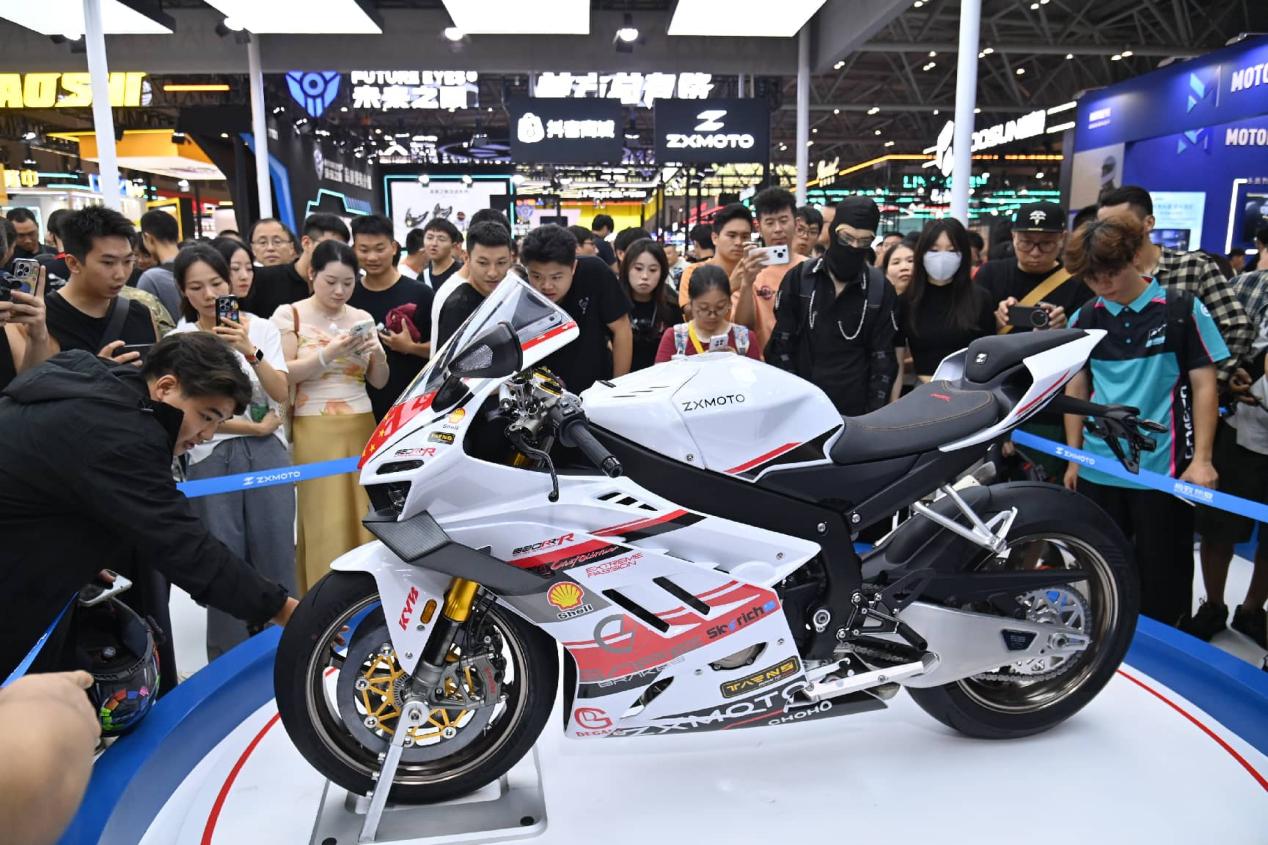
A bike manufactured by ZXMOTO is exhibited at the 23rd China International Motorcycle Trade Exhibition held in southwest China's Chongqing municipality, Sept. 20, 2025. (Photo/Sun Kaifang)
The championship-winning 820RR–RS model of ZXMOTO not only features higher power output, lighter weight and a lower center of gravity, but is priced at just 1/3 of comparable foreign models. It challenges the long-held assumption that high performance must come at a high price, making quality motorcycles more accessible to a broader range of consumers.
In fact, this is not the first time Chinese motorcycles have shone on the global stage. Chinese brands have previously secured race wins and even a season championship in lighter WSBK categories. Yet this latest breakthrough in the more technically competitive middleweight category carries even greater significance.
A Japanese motorcycle media outlet had earlier noted that, supported by passionate and dedicated engineers, China's motorcycle industry is entering a new phase of global expansion.
For a long time, Chinese motorcycle exports were largely focused on low-end, high-volume markets, often struggling to gain traction in the premium segment. Today, brands like ZXMOTO are reigniting overseas consumer interest through improved technology and quality. Its products are now exported to markets including Italy, Spain, the United Kingdom, the United Arab Emirates and Russia.
As one British internet user observed, "The arrival of Chinese motorcycles in Western markets is good for the industry. Some say motorcycling as a hobby is fading, but China is showing real confidence in the recreational motorcycle market and offering products major brands no longer provide."
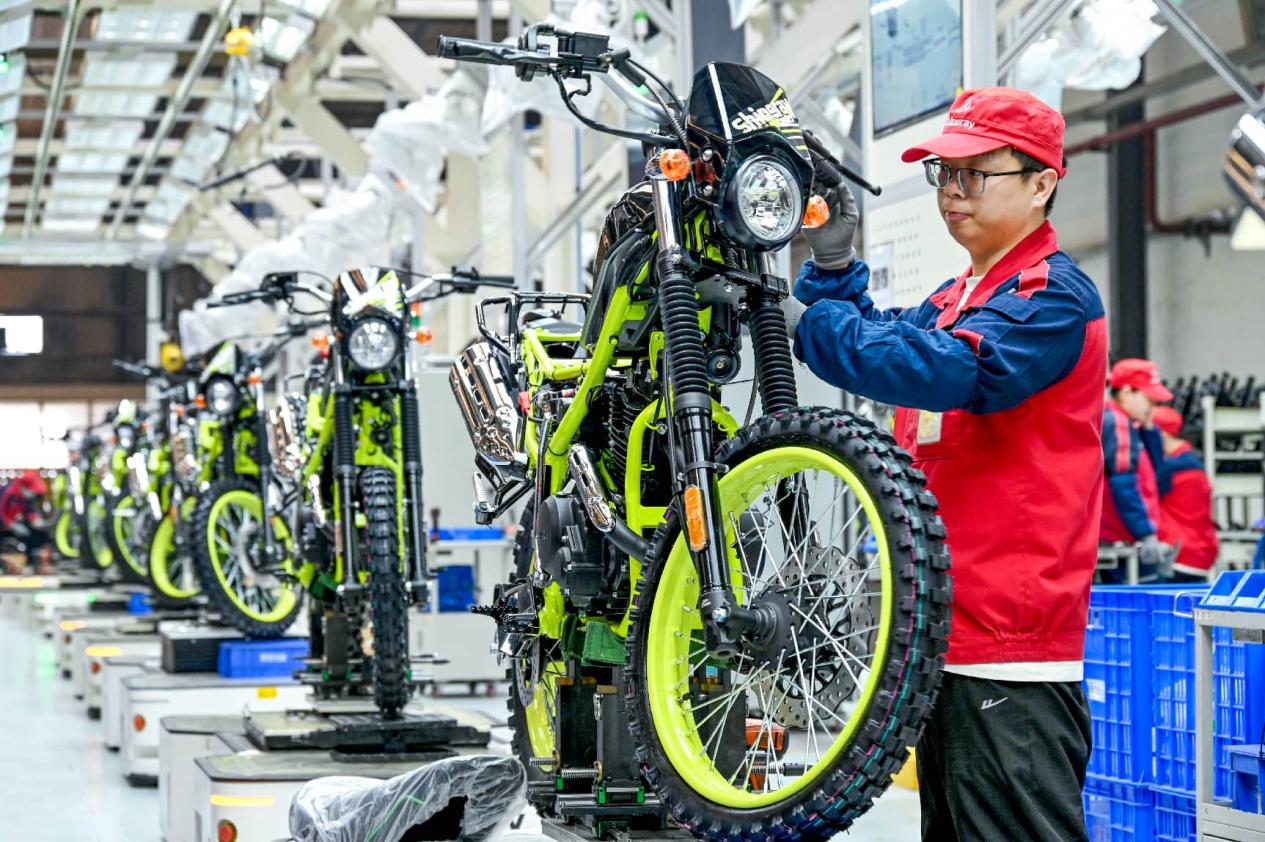
Workers fulfill overseas orders in a smart workshop of a motorcycle manufacturer in southwest China's Chongqing municipality. (Photo/Lei Jian)
In this sense, ZXMOTO acts as a "catfish" in the industry, stimulating competition, showcasing China's technological strength, injecting new momentum into the global motorcycle sector, and offering global consumers more choices.
The journey of Chinese manufacturing is evolving from overcoming outdated stereotypes to gaining genuine recognition. Backed by sustained innovation and a complete industrial system, ZXMOTO's success represents more than a single race win. It marks a broader transformation. Chinese manufacturing has entered a new era: one that delivers higher-quality products and adapts a more open and inclusive approach to meet the rising global expectations of the world.
Photos




Related Stories
- PD Explainer | The rise of ZXMOTO: China's 'Fast & Furious' moment in motorcycles
- Two decades of pursuit: founder Zhang Xue leads ZXMOTO to historic double victory in WSBK
- Formula 1 Grand Prix makes roaring comeback
- Highlights of vehicles at Munich Motor Show 2023
- 100th Brussels Motor Show to be held in Brussels, Belgium
- In pics: MotoGP race of Teruel Grand Prix
- Tesla recalls 48,442 vehicles in China
- China has 365 mln motor vehicles at end of September
- 2019 edition of Seoul Motor Show held in South Korea
- China completes test ignition of largest solid-fuel rocket motor
Copyright © 2026 People's Daily Online. All Rights Reserved.
