



China's database industry powers massive systems and gains global share

Photo shows a big data industrial park in Luyang district, Hefei, east China's Anhui province. (Photo/Ma Erhu)
China's technological capabilities are increasingly evident in the critical field of database software. During the peak of the 2026 Spring Festival travel season, China's railway ticketing platform 12306 handled over 1 million queries per second, sold over 1,000 tickets per second at peak times, and recorded more than 80 billion daily visits, making it the world's largest real-time ticketing system.
Amid such massive traffic surges -- with hundreds of millions of users vying for tickets within seconds -- China's homegrown databases have played a pivotal role. They not only provided essential support but also served as the foundation engine ensuring the system's stable, efficient, and secure operation.
In recent years, China has ramped up investment in core database technologies. A growing number of Chinese database solutions have broken the long-standing dominance of international players, empowering digital transformation across a wide range of industries.
Databases are critical to national economy and people's livelihoods, and represent a core technology in the software sector.
Data from the China Academy of Information and Communications Technology show that China's database market is now valued at nearly 60 billion yuan ($8.71 billion), with 164 database products available. Globally, one in every four database companies is based in China.
Demonstrating strong capabilities in stability, storage, and computing power, these domestic databases highlight China's advancements in foundational software and contribute to higher-quality development.
The drive for self-reliance has deep roots. In the late 1970s, Feng Yucai, founder and chairman of Wuhan Dameng Database Co., Ltd. (Dameng), visited Wuhan Iron and Steel Corporation for technical training. At the time, the plant had imported a costly automated management system from abroad. After installation, foreign engineers destroyed three truckloads of technical documentation on-site.
Deeply affected by the incident, Feng resolved to develop China's own database system. After eight years of research, he created China's first domestically designed database management system prototype using the Pascal programming language.

Photo shows an exhibition hall of the National Big Data (Guizhou) Comprehensive Pilot Zone in Guiyang, southwest China's Guizhou province. (Photo/Jia Zhi)
As a fully self-developed native distributed database, OceanBase maintains full control over its source code. Since its launch, it has avoided reliance on external technologies and instead focused on achieving independent control over core technologies by writing its kernel code from scratch. In October 2019, OceanBase ranked first in a leading international database benchmark, ending nine years of leadership by foreign companies.
Beyond native distributed databases, China has also outperformed global peers in cloud-native database. In January 2025, Alibaba Cloud's PolarDB claimed the top position in the TPC-C benchmark, widely regarded as the "Olympics" of the database performance. The test simulates 1.6 billion current users conducting transactions. During the evaluation, PolarDB completed 2.2 trillion data operations with a fluctuation rate of just 0.16 percent, ensuring 100 percent data accuracy. It also set new world records for performance, processing 2.055 billion transactions per minute, and cost efficiency, at 0.8 yuan per unit.
According to Wang Yuan, head of database product technology architecture at Alibaba Cloud, it is precisely the real-world stress tests of massive events like China's Double 11 shopping festival that have enabled domestic databases to achieve world-class capabilities, driving continuous improvements toward extreme performance and greater simplicity and usability.
Moving from the lab to the market, domestic databases must overcome not only technical challenges but also barriers of market trust. Years ago, foreign database products accounted for over 80 percent of the Chinese market, nearly monopolizing core systems in key sectors such as finance, telecommunications, and energy. For these industries, foreign databases were almost the default choice.
"Even a one-second delay can lead to serious consequences," said Yang Chuanhui, CTO of OceanBase. "This is especially true in the financial sector, where requirements are extremely stringent.
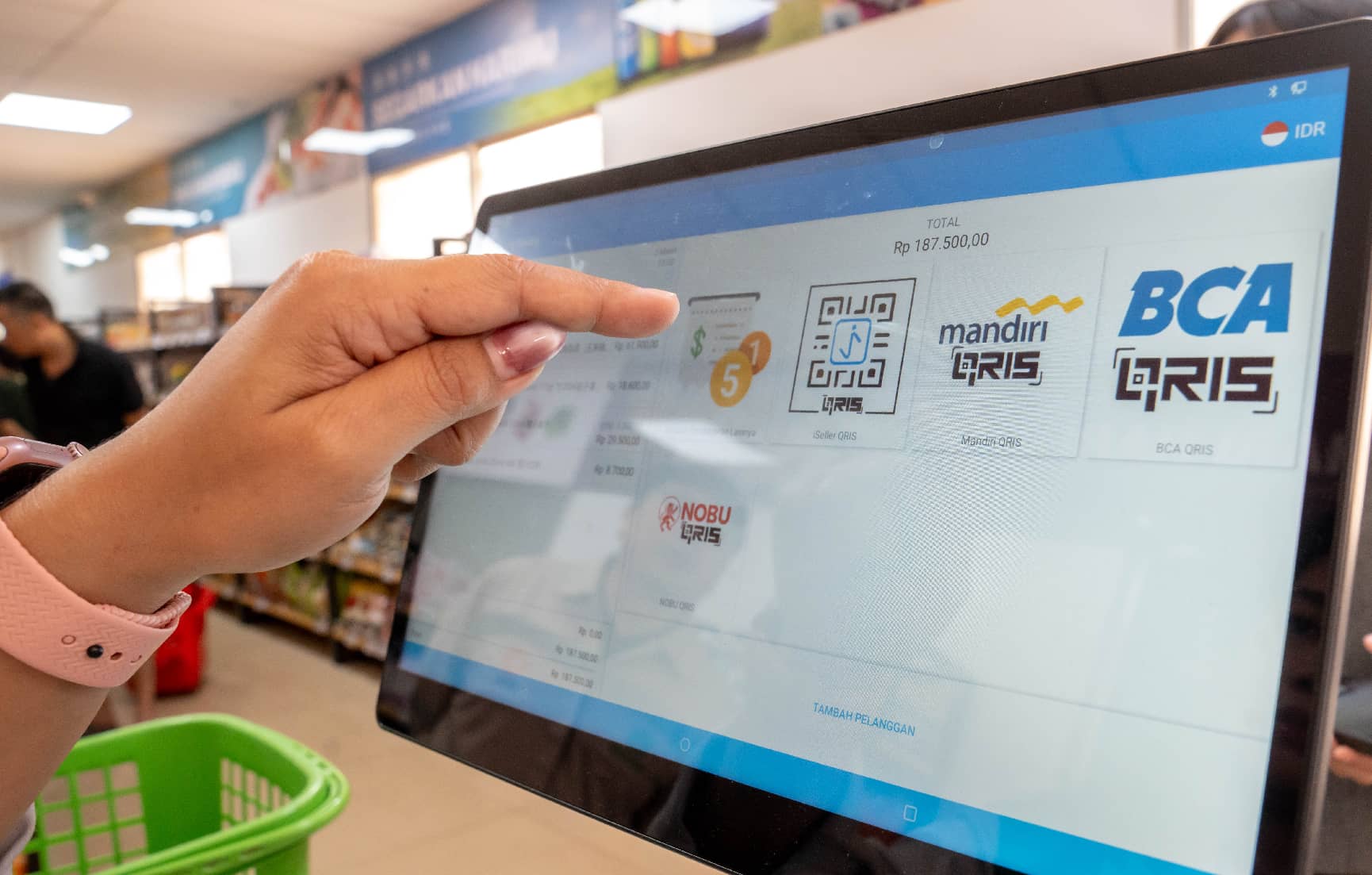
Chinese mobile payment platforms Alipay and UnionPay are available at a supermarket in the Indonesia Morowali Industrial Park. (Photo/Fan Jiageng)
To prove their reliability, OceanBase tackled challenges head-on. Its teams often worked on-site, earning trust through technical excellence. Over more than a decade, OceanBase has not only supported all core accounting systems of Chinese payment services platform Alipay, but also achieved stable operation across more than 300 financial institutions, serving over 4,000 clients.
Dameng spent more than a decade developing shared-storage cluster technology for databases, enabling it to move from peripheral systems into the core of high-end markets. Previously, only one foreign company possessed this technology. Driven by market demand, Dameng achieved a breakthrough.
"Good software is shaped through use. Databases, in particular, require continuous refinement in real-world applications to evolve and meet market needs," Feng said.
Today, domestic databases have become standard infrastructure in key sectors. As their capabilities continue to grow, they are also gaining global traction. From ride-hailing platforms in Southeast Asia and smart city projects in the Middle East to emerging e-commerce in Africa and digital banks in Latin America, Chinese database solutions are offering new options for global digital applications.
"At present, Alibaba Cloud's database services cover 29 regions and 92 availability zones worldwide," said Li Feifei, senior vice president of Alibaba Cloud.
Photos


Related Stories
- China launches digital database of classic graphics
- Chinese academic database fined for privacy violations
- National Library of China releases databases for dissemination, study of ancient books
- China renews database of standard place names
- Huawei launches New Database & Storage Product
- Chinese researchers build database for Circular RNA studies
- China uses data base to curb online porn
- China provides free digital academic resources for users across world
- China's online court record database now world largest: official
- National Library of China to create database of Japan’s historic investigations of China
Copyright © 2026 People's Daily Online. All Rights Reserved.
