



Correct understanding of governance performance strengthens global confidence in China's role
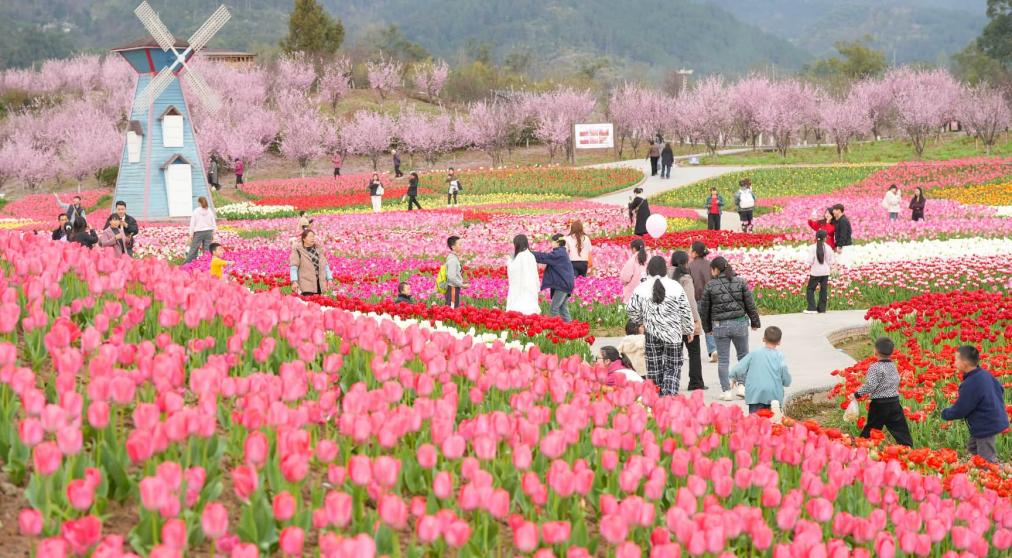
Tourists visit a tulip garden in a scenic area in Dianjiang county, southwest China's Chongqing municipality. (Photo/Gong Changhao)
International attention on China's "two sessions" -- the annual meetings of the country's top legislature, the National People's Congress, and top political advisory body, the Chinese People's Political Consultative Conference -- has brought the concept of "understanding of governance performance" into frequent global discourse.
As China enters the opening year of the 15th Five-Year Plan period (2026-2030), the Communist Party of China (CPC) has emphasized establishing and practicing a correct understanding of governance performance.
This focus highlights China's consistent approach: unwavering stability in policy continuity and people-centered commitment, and steady progress through concrete actions and sustained efforts -- building small wins into major victories and opening up new horizons for development.
A look at this year's government work report and the outline of the 15th Five-Year Plan reveals a strong problem-oriented approach and a pragmatic spirit. Balancing needs with feasibility, the plan proposes keeping GDP growth within a reasonable range, with annual targets to be determined according to circumstances.
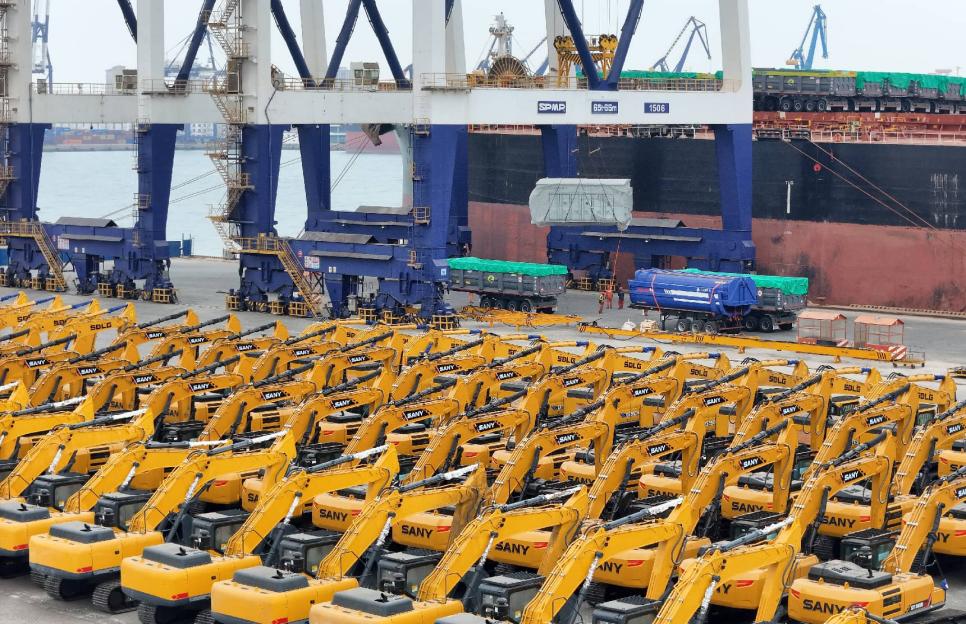
Excavators are hoisted onto a vessel at Yantai Port, east China's Shandong province. (Photo/Tang Ke)
It sets five binding indicators related to green and low-carbon development. It also calls for closely integrating efforts to improve people's well-being with measures to boost consumption, and for combining investment in physical assets and human capital. The CPC's emphasis on earnest and practical work reflects a conscious commitment to continuing China's development miracle.
Every achievement made during the previous 14th Five-Year Plan period is the result of hard work and perseverance. Despite a complex global environment, China's GDP achieved four consecutive leaps, growing at an average annual rate of 5.4 percent, while contributing around 30 percent to global economic growth.
How did China maintain such forward momentum under pressure? The answer lies in the CPC's commitment to reality-based policymaking guided by objective development laws -- systematically implementing tasks and transforming plans into tangible outcomes.
China's experience shows that with steady and sustained efforts, new breakthroughs can be achieved even in the face of challenges, and the certainty of domestic development can help offset uncertainties in the external environment.
The understanding of governance performance is closely intertwined with the philosophy of development. One shapes and is shaped by the other. The overarching requirements -- serving the public good, benefiting the people, making reasonable decisions and delivering concrete results -- uncover an action logic centered on the people and aimed at high-quality development.
They demonstrate policy patience balancing near-term needs with long-term goals. They also embody a governance wisdom that coordinates visible achievements with long-term gains, harmonizes local interests with the bigger picture, and balances development imperatives with improvements in people's well-being.
Emphasizing the establishment and practice of a correct understanding of governance performance at the outset of the 15th Five-Year Plan period demonstrates a people-centered, truth-seeking and pragmatic approach to development. It also shows the determination to translate blueprints into reality through sustained efforts.
As Pakistan's Minute Mirror observed, in an era marked by geopolitical tensions and economic uncertainty, China's stability provides a solid foundation for sustained development and sends a message of stability and forward-looking optimism.
The governing principles embedded in a correct understanding of governance performance -- seeking truth from facts, putting the people first and planning for the long term -- have strengthened international confidence in China's role.
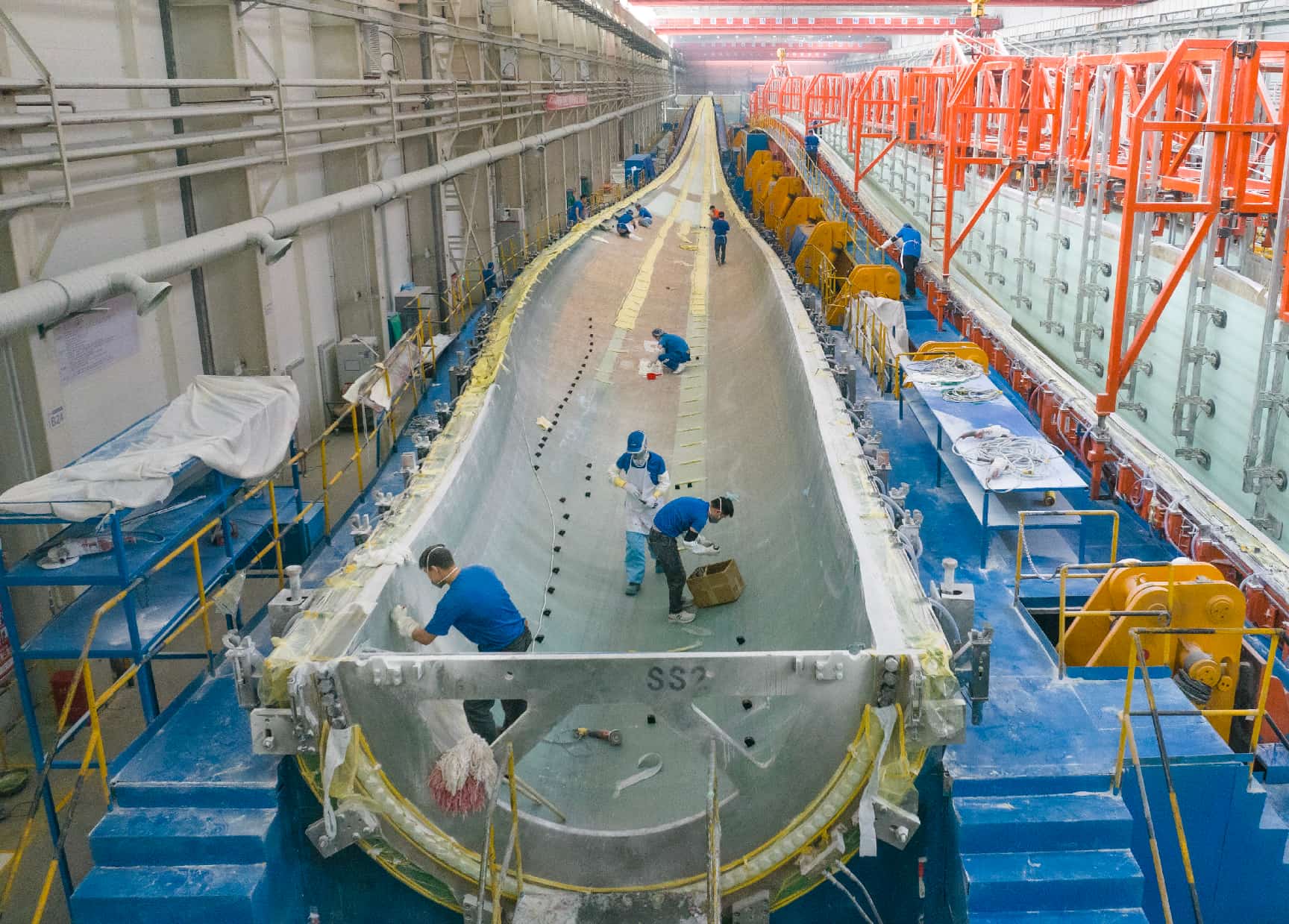
A wind turbine blade is manufactured in a workshop of a factory in Changji Hui autonomous prefecture in northwest China's Xinjiang Uygur autonomous region. (Photo/He Long)
Take climate governance as an example. Last year, China announced its nationally determined contribution targets for 2035 under the Paris Agreement. The outline of the 15th Five-Year Plan also clearly states that China will actively and prudently advance efforts to reach peak carbon emissions, setting out a clear roadmap. Such pragmatic and concrete policy design injects positive energy into global climate governance.
China's opening up provides another example. The new visions adopted in the first year of the 15th Five-Year Plan period have further enriched China's high-level opening up. China will continue to advance voluntary and unilateral opening up, stabilize the scale of foreign trade while optimizing its structure, expand two-way investment cooperation, and promote high-quality Belt and Road cooperation.
Through concrete actions that advance international openness and cooperation, China will inject stronger momentum into building an equal and orderly multipolar world and a universally beneficial and inclusive economic globalization.
Photos
Related Stories
- China's policy stability fosters innovation and a shared future
- NPC deputy helps transform crab breeding into a thriving industry in Gaochun, E China's Jiangsu
- NPC deputy brings people's long-held dream of a railway in SW China's Guizhou to 'two sessions'
- Two Sessions Explainer: How long will it take for robot "butlers" to enter our homes?
- China's two sessions highlight innovation, promote shared growth
- Two sessions, one number
- Two Sessions Explainer: What is China doing with retired electric car batteries?
- Interview: China's "two sessions" bring momentum to the global economy, says Cambodian legislator
- PD Explainer | Five-year plans: China's long game
- Global experts praise China's plan for shared progress
Copyright © 2026 People's Daily Online. All Rights Reserved.
