



Chinese smart technologies shine at 2026 Mobile World Congress
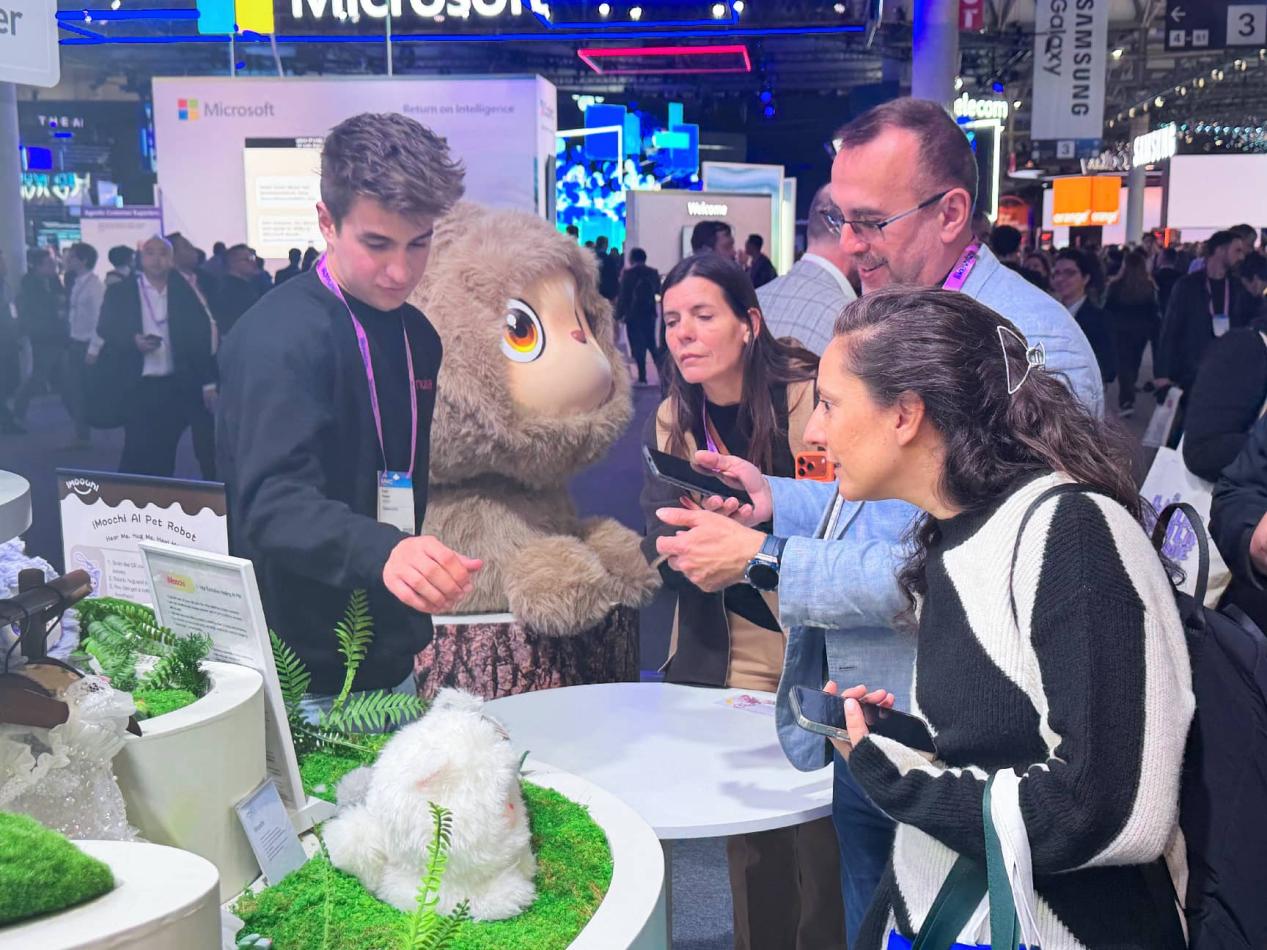
Smart toy Mashu is exhibited at the booth of ZTE during the 2026 Mobile World Congress in Barcelona, Spain. (People's Daily/Yan Huan)
The 2026 Mobile World Congress (MWC) was recently held in Barcelona, Spain. This year marks the 20th anniversary of the world's premier mobile communications industry event being held in Barcelona.
Under the theme "The IQ Era," MWC focused on intelligent infrastructure, AI connectivity and integration, enterprise-level AI applications, AI ecosystem collaboration, inclusive technology, and innovation-driven transformation.
The event brought together around 2,900 exhibitors from more than 200 countries and regions and featured over 100 national, regional and thematic technology pavilions. A China Pavilion was established for the first time this year.
Leading Chinese technology firms including China Mobile, China Telecom, China Unicom, Huawei, ZTE, Honor, and Xiaomi participated prominently, showcasing their latest technological achievements in mobile communications and AI.
Chinese exhibitors presented a variety of innovative products. At the booth of ZTE, a plush toy named Mashu drew crowds of visitors. With its round, adorable shape and big blinking eyes, the toy has a friendly appeal. Powered by advanced AI technology, Mashu can not only understand human speech and recognize emotions, but also learn continuously through daily interaction, gradually gaining insight into users' needs and preferences while providing emotional companionship.
Honor unveiled a "robot phone" equipped with a flexible gimbal camera capable of auto-rotation and precise subject tracking. Lenovo's YOGA concept device demonstrated rapid conversion of 2D images into 3D models, viewable on a glasses-free 3D display, aiding creators in visualizing depth and spatial relationships.
Alibaba's Qwen smart glasses integrated real-time translation and bone-conduction audio, highlighting the potential of AI in lightweight wearables. Xiaomi showcased its comprehensive "human-car-home" ecosystem, including a concept supercar, flagship smartphones, and smart home products.
"AI is expanding the boundaries of its applications in everyday life. It is no longer confined to optimizing device functions but has evolved into a key tool for enhancing user experience and coordinating services ," said Wang Xiang, chief strategy officer of ZTE.
In the AI-native smartphones launched by the company last year, AI functions as an "intelligent agent," directly connecting different applications and enabling cross-platform service orchestration. Users simply need to express their intention to travel, and the system can automatically generate a complete itinerary covering transportation, accommodation and dining.
This year's MWC also highlighted the ongoing evolution towards 6G technologies. As of January 2026, 374 operators worldwide had deployed 5G networks. Supported by extensive network coverage, 5G-Advanced applications are accelerating, with a global user base reaching 70 million.
At the event, numerous companies showcased their visions for future networks from multiple perspectives. Huawei launched a full lineup of indoor and outdoor products for the U6GHz spectrum -- the upper segment of the 6-GHz band. Offering ultra-large bandwidth, U6GHz demonstrates high capacity, enhanced user experience and low latency, delivering stable and reliable connectivity for AI applications. Huawei's U6GHz solutions fully support the transition toward 6G, helping telecom operators prepare early for next-generation infrastructure.
Humanoid robots were increasingly visible across exhibition booths, making "embodied intelligence" another buzzword. An official from the Arab Information and Communication Technologies Organization remarked: "Many of the products displayed by Chinese companies are truly impressive. China prioritizes the development of innovative technologies such as AI, and its vast market and supportive policies keep fueling technological progress."
"Chinese companies have brought many innovative technologies and products," said Vivek Badrinath, director general of the GSMA, the event's organizer. "Driven by the Chinese market scale, as well as the speed and determination with which these technologies are deployed among consumers and enterprises, technological development in China is reshaping how we connect with the world."
Badrinath added that the first China Pavilion at the congress for the first time underscored the global recognition and focus on China's scientific and technological innovation, .
Chinese technology companies are continuously raising the profile and expanding the reach of "Made in China" on the global stage through a combination of hardware innovation, AI empowerment and ecosystem integration.
Lara Dewar, chief marketing officer of the GSMA, noted that the communications industry has never stood still, and no company or country can progress in isolation. Only international cooperation can truly unlock its potential.
"China has already made important contributions in this regard," Dewar said. "At the MWC, we often discuss the possibilities of the future. In China, I see the future already taking shape."
Photos



Related Stories
- China to make breakthroughs in core technologies, achieve sci-tech self-reliance
- Understand China | Is China going to dominate everything?
- OpenHarmony builds digital foundation for multiple industries
- There is no need for Reuters to be anxious about China’s technological progress
- Intl media experience Shenzhen: Where futuristic tech meets endless fun
- Small private firm in E China achieves breakthroughs in new materials
- China unveils guideline to accelerate creation of scenarios for new tech, products
- More innovative technology financing being prioritized
- China advances to the forefront of global science and technology
- Foreign visitors snap up Chinese tech products
Copyright © 2026 People's Daily Online. All Rights Reserved.
