



China, Britain agree to develop long-term, consistent comprehensive strategic partnership in Xi-Starmer meeting
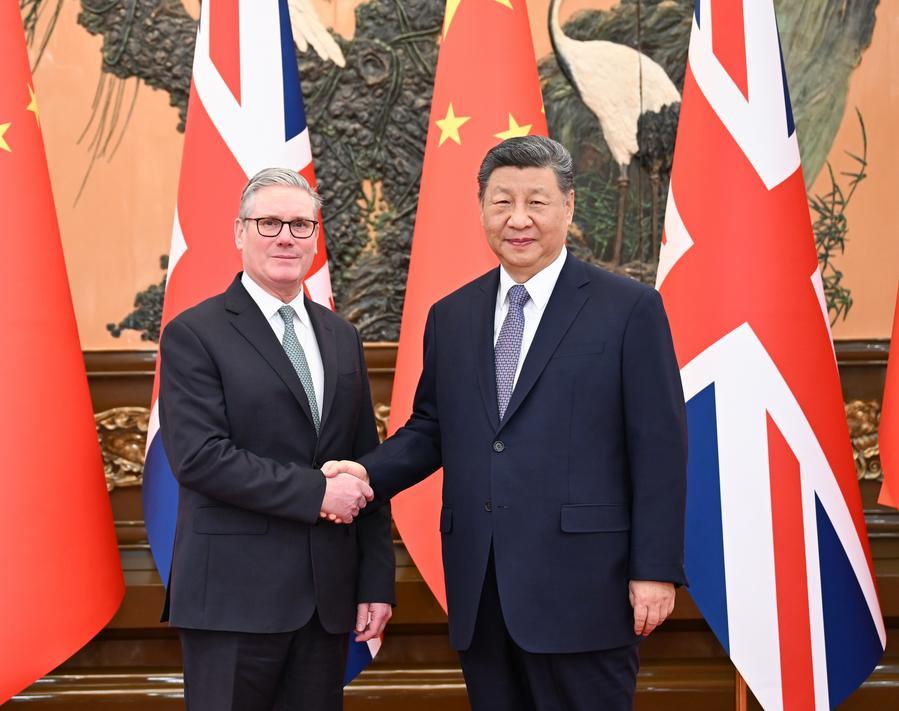
Chinese President Xi Jinping meets with British Prime Minister Keir Starmer, who is on an official visit to China, at the Great Hall of the People in Beijing, capital of China, on Jan. 29, 2026. (Xinhua/Li Xiang)
BEIJING, Jan. 29 (Xinhua) -- Chinese President Xi Jinping and visiting British Prime Minister Keir Starmer agreed on Thursday in Beijing that the two countries should develop a long-term and consistent comprehensive strategic partnership.
During their meeting, Xi said as the world today is undergoing both changes and turbulence, China and Britain, as permanent members of the United Nations Security Council and major economies, should enhance dialogue and cooperation in order to maintain world peace and stability, while promoting the economy and people's livelihoods of both countries.
Emphasizing the need to see history from a broader perspective, Xi called on the two countries to transcend differences and maintain mutual respect, so that they can translate the promising potential of cooperation into remarkable accomplishments, and open up new vistas for China-Britain relations and cooperation to better benefit both the two peoples and the world at large.
Stressing China's commitment to peaceful development, Xi said that China has never initiated a war, nor occupied an inch of foreign land.
China will never pose a threat to other countries no matter how it grows and develops, he told Starmer, who arrived in Beijing on Wednesday for a four-day official visit, the first by a British prime minister in eight years.
Xi said mutual benefit and win-win results constitute the essence of economic and trade cooperation between China and Britain, thus the two countries should expand mutually beneficial cooperation in education, health, finance and the service industry.
He also called on the two sides to carry out joint research and industrial application in the fields of artificial intelligence, bioscience, new energy and low-carbon technologies, among others, to achieve shared development and prosperity.
"It is hoped that the British side will provide an equal, fair and non-discriminatory business environment for Chinese enterprises," Xi said, adding that both sides should enhance people-to-people and cultural exchanges, and further facilitate travel.
He said members of the British government, parliament and various sectors of localities are welcome to visit China more frequently to foster a balanced, objective, and well-grounded perception of China.
China is actively considering granting unilateral visa waiver to British people, Xi said.
Noting that the international order has for some time suffered serious disruption, Xi said international law can only be truly effective when all countries, major countries in particular, abide by it. Otherwise, the world would risk regressing to the law of the jungle, he said.
China and Britain, as supporters of multilateralism and free trade, should jointly advocate and practice true multilateralism, and facilitate the establishment of a more just and equitable global governance system, so as to build an equal and orderly multipolar world and realize universally beneficial and inclusive globalization, Xi said.
Starmer conveyed King Charles III's greetings to President Xi, and said he was delighted to be the first British prime minister to visit China in eight years. This visit, with a delegation of around 60 important representatives from British business and cultural organizations, demonstrates the breadth of Britain-China cooperation and Britain's commitment to deepening and expanding ties with China, said Starmer.
He said as major economies and permanent members of the UN Security Council, it is vital for Britain and China to build a long-term and consistent comprehensive strategic partnership with mutual respect and trust, especially in a volatile and fragile world.
On Taiwan, Britain's position is long-standing, well-known, and unchanged, Starmer said, adding that Britain would like to maintain high-level engagement with China, enhance dialogue and exchange, and strengthen cooperation in trade, investment, finance and environment, among others, to support each other's growth and prosperity.
Britain will work with China to promote exchanges between their legislatures and other sectors, Starmer said.
Hong Kong's prosperity and stability serve the common interests of both countries, and Britain welcomes Hong Kong as a unique and important bridge between the two countries, said the prime minister.
China plays a vital role in international affairs, and Britain would like to strengthen cooperation with China on climate change and other global challenges and jointly uphold world peace and stability, Starmer said.
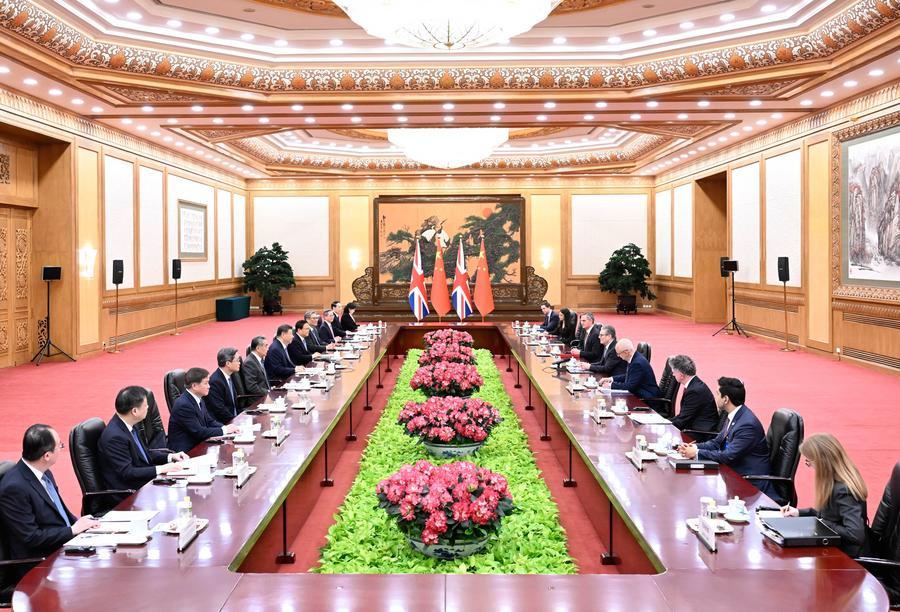
Chinese President Xi Jinping meets with British Prime Minister Keir Starmer, who is on an official visit to China, at the Great Hall of the People in Beijing, capital of China, on Jan. 29, 2026. (Xinhua/Shen Hong)
Feng Zhongping, director of the Institute of European Studies at the Chinese Academy of Social Sciences, said that for both sides to unleash their full cooperation potential, Britain needs to develop a more objective and rational view of China.
Chen Yang, director of the Institute of European Studies at the China Institutes of Contemporary International Relations, said artificial intelligence, bioscience, and new energy represent key development priorities in China's 15th Five-Year Plan, and deepening cooperation between the two sides on these fields will benefit the two peoples as well as the world.
He also suggested stepping up exchange and dialogue in such fields as education, culture, global governance, the international rule of law, and AI governance.
"Deeper and broader engagement at all levels is conducive to improve mutual understanding between the two peoples, which will contribute to the long-term and consistent development of China-Britain ties," Chen said.
On the same day, Chinese Premier Li Qiang also held talks with Starmer. Li said the Chinese government is committed to providing a favorable environment for enterprises from all countries, including Britain, to invest in China.
Following the talks, Li and Starmer witnessed the signing of multiple cooperation documents covering economy, trade, agriculture, food, media, education and market regulation.
As they both attended the closing ceremony of the meeting of 2026 UK-China Business Council, Li said the two sides can create a "new engine" for innovative development, taking the lead in and empowering each other in such fields as artificial intelligence, clean energy, biomedicine and high-end manufacturing.
"Both countries can begin by collaborating on a small scale in select fields, then broaden cooperation and build trust over time. Step by step, we can expect a fundamental improvement in China-Britain relations," Feng added.
Photos



Related Stories
- Xi calls on China, Britain to jointly advocate, practice true multilateralism
- Xi says China will never pose threat to other countries no matter how it grows
- Xi replies to veterans of Zimbabwe's national liberation war
- Shiguang Chronicle: Chinese modernization is the modernization of material and cultural-ethical advancement
- Xi welcomes Finnish enterprises to "take a swim in the vast ocean of the Chinese market"
- China and Europe are partners, not adversaries: Xi
Copyright © 2026 People's Daily Online. All Rights Reserved.
