



What is it like to work in a green office building?
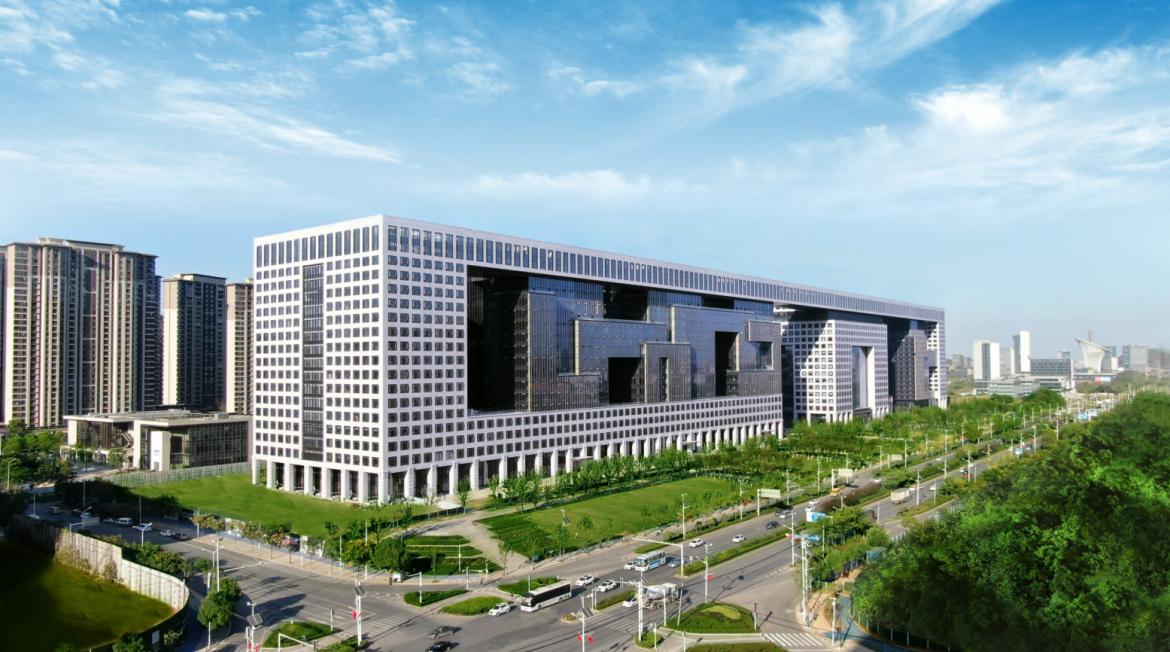
Photo shows the headquarters building of China Construction Third Engineering Bureau Group Co., Ltd.
Early in the morning, Cai Heng walked into the headquarters building of China Construction Third Engineering Bureau Group Co., Ltd.
As his footsteps echoed through the lobby, the lights above him gradually activated. Outside the glass curtain wall, sunlight was already illuminating the 14,000 square meters of monocrystalline silicon photovoltaic panels installed on the rooftop and skybridges.
This headquarters building is one of the landmark structures in East Lake High-tech Development Zone, also known as the "Optics Valley of China", in Wuhan, central China's Hubei province.
Cai has worked here for many years and knows the building well. Yet since last year, he has begun to notice subtle changes.
Stepping into the elevator lobby, Cai pressed the button for the 15th floor. "The elevator was a little jolty when starting and stopping. Now it runs much more smoothly," he said.
The improvement came from newly installed energy-regeneration devices. They not only make elevator operation smoother but also convert potential energy generated during operation into electricity that is fed back into the grid, significantly reducing energy consumption.
Back at his workstation, soft natural light poured through the glass curtain wall and spread across Cai's desk. In 2024, a special heat-insulating film was added to the building's glass facade. It preserves a clear view of the scenery outside while greatly improving thermal insulation.
Shi Fei, executive manager of the integrated energy division at City Investment and Operation Co., Ltd., a subsidiary of China Construction Third Engineering Bureau Group Co., Ltd., explained that the film keeps out 72 percent of heat. In summer, it blocks much of the outdoor heat, while in winter it reflects long-wave far-infrared radiation back indoors to retain warmth. This single measure saves an average of 252,000 kilowatt-hours of electricity annually and reduces carbon dioxide emissions by about 126 tons.
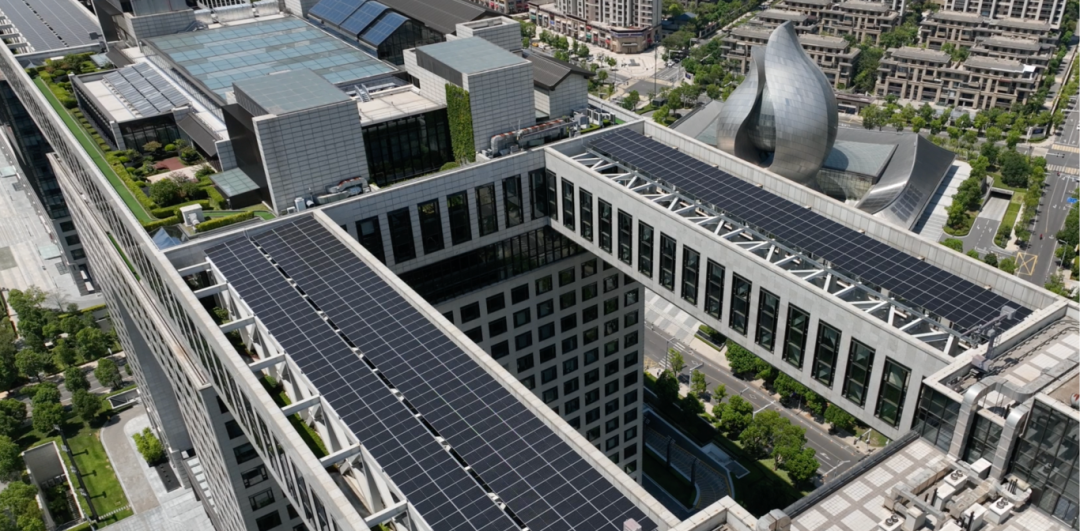
The rooftop of the headquarters building of China Construction Third Engineering Bureau Group Co., Ltd. is covered by photovoltaic panels.
At 10 a.m., Cai's department held a project coordination meeting. Although more than a dozen people were seated in the small conference room, the air felt fresh and comfortable.
"Today's buildings are smart -- they can 'think,'" Shi said. With a self-developed zero-carbon smart operation platform, more than 3,000 parameters from systems such as photovoltaics, charging piles, air conditioning, and lighting are integrated. Using the Internet of Things and artificial intelligence, the ventilation system monitors indoor carbon dioxide levels and occupancy in real time, adjusting airflow through variable-frequency fans. This alone cuts carbon emissions by about 87.6 tons per year.
At lunchtime, Cai headed to the cafeteria on the basement level. Passing through the skybridge and the ground-floor lobby, he felt a pleasant warmth in the corridors. "In winter, there used to be a chilling draft here," he recalled. With better heating now, does that mean higher energy consumption?
The answer is negative. Liu Li, a technical expert at a green and low-carbon technology research institute of China Construction Third Engineering Bureau Group Co., Ltd., explained the secret behind the lobby's "comfort upgrade."
The entrance route and management approach were redesigned, air curtains were installed to block outside air, and in winter the angles of the air-conditioning outlets were adjusted downward while radiant floor heating was activated. In the first winter after renovation, the lobby temperature rose by about 9 degrees Celsius, while heat retention improved and energy losses were reduced.
"Green buildings are not only about energy-saving indicators," Liu said. "They are also about how people inside them actually feel."
In the China Construction Technology Industrial Park, where the headquarters building is located, an underground integrated energy station was completed in June 2025.
"We use sewage-source heat pump technology, turning treated wastewater from a nearby wastewater treatment plant into a second energy source," said An Ming, head of the energy station.
During cold and damp winters, the wastewater temperature remains between 12 and 16 degrees Celsius, allowing the system to extract heat for space heating. In summer, the process is reversed, with heat released into the wastewater for cooling.
Previously discharged directly, the treated wastewater now replaces gas boilers and district steam heating, cutting an estimated 2,300 tons of carbon emissions annually.
Across the industrial park, photovoltaic panels with an installed capacity of 2.1 megawatts generate 2.156 million kilowatt-hours of electricity each year, equivalent to reducing carbon dioxide emissions by 1,078.2 tons.
Lighting systems automatically turn on when people arrive and off when they leave, cutting emissions by 67.5 tons each year. Newly added energy storage systems store electricity during off-peak hours and release it during peak demand, lowering overall energy costs by 23 percent.
After a series of upgrades, carbon emissions across the entire park have been reduced by 30 percent, while emissions from the headquarters building alone have dropped by 45 percent.
"Working in this building, you can feel every day that green lifestyles are all around you," Cai said.
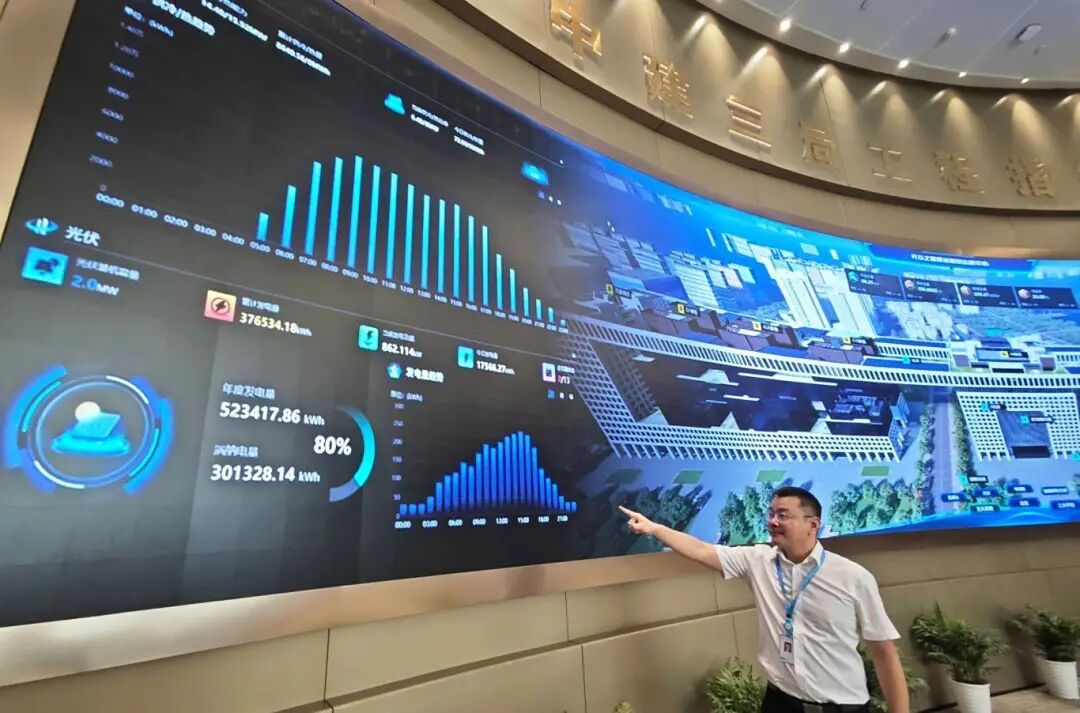
A self-developed zero-carbon smart operation platform independently developed by China Construction Third Engineering Bureau Group Co., Ltd. is employed for automated energy management of the company's headquarters building.
(Photos from the Dawuhan app)
Photos

Related Stories
- Foreign enterprises join China's zero-carbon industrial park development
- Young farmer in SW China cultivates carbon-neutral rice, contributing to China's green goals
- China's Ningxia sees first carbon credit transaction from vineyard
- China sees significant drop in carbon emission growth rate
- China aims to cover key industrial emitters in carbon market by 2027
- Full text: Carbon Peaking and Carbon Neutrality China's Plans and Solutions
- China vows to expand green trade to help achieve dual carbon goals
- Efforts to restrict non-CO2 emissions enhanced
- Scientists propose new model to sustain global carbon cycle simulation
- Guangdong carbon market remains unchanged
Copyright © 2026 People's Daily Online. All Rights Reserved.
