



AI cracks the code for faster, better crops
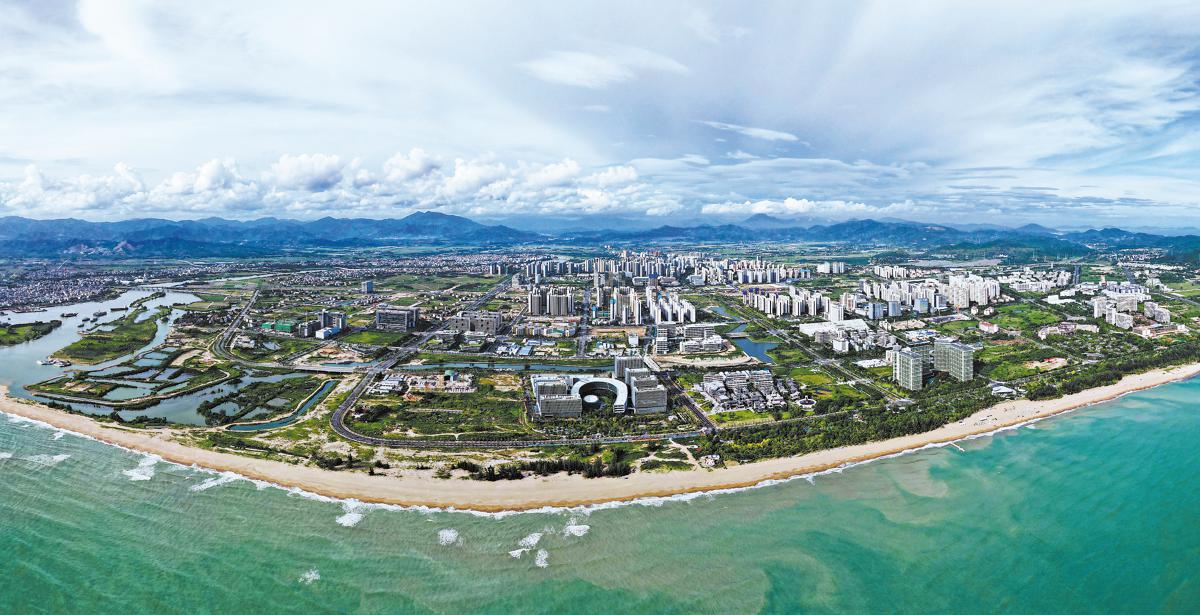
A drone captures an image of the Yazhou Bay Science and Technology City in Sanya, Hainan province, on July 29. YANG GUANYU/XINHUA
In the vast, sun-drenched fields of Yazhou Bay in Sanya, Hainan province, a quiet but monumental shift is taking place. Here, the practice of crop breeding is being rewritten not with a hoe, but with computer algorithms.
For generations, developing a superior seed variety was often an inexact science — a decade-long pursuit often relying heavily on a breeder's hunch. Now, a new initiative powered by artificial intelligence promises to slash that timeline in half, aiming to deliver resilient, high-yield crops in just three to four years.
Officially known as the Future Agriculture Nexus, or Fan, the project is a joint creation of the Yazhou Bay National Laboratory and Chinese tech company Huawei Technologies Co. The hub aims to transform breeding into a precise, predictive science — a critical move for a nation safeguarding its food security in an era of climate uncertainty.
The goal is in line with China's strategic needs, with seeds seen as the "chips" of global agriculture.
During an inspection of the Yazhou Bay laboratory in April 2022, President Xi Jinping stressed the importance of pursuing agricultural technological breakthroughs to achieve self-dependence in the seed sector. "We should rely on Chinese seeds to ensure China's food security," he said.
Yuan Xiaohui, a senior scientist at the Yazhou Bay National Laboratory, said that "as the only national-level laboratory in China's agricultural sector, our lab's mission is to develop major strategic crop varieties to meet real demand".
"We are fully aware that AI holds immense potential to empower agricultural science, but data remains the core bottleneck hindering its practical application," Yuan said.
"There is an urgent need for us to build a system capable of integrating global field and laboratory data while providing intelligent analytical capabilities."
Chen Fan, deputy director of the laboratory, outlined the fundamental shift required.
"Traditional breeding work relies heavily on experience. Moving from traditional to precision breeding requires analyzing correlations between massive amounts of data on crop traits and genotypes," Chen said.
Connecting data islands
For generations, breeders have operated like explorers in a vast, uncharted biological wilderness. The process of selecting parent plants, crossbreeding, and evaluating thousands of progeny over multiple growing seasons is painstakingly slow, with the success rate often below 1 percent, experts said.
This challenge, Chen added, is compounded by deeply entrenched "data silos".
"Data on genotype, phenotype, environment, and even soil are all kept separate. This fragmentation creates a critical bottleneck," he said.
Yuan said: "Researchers often know neither the source and quality of data, nor can they discern which data AI can understand. This causes AI to falter — or worse, produce erroneous results."
It is this precise problem that the Fan project is engineered to solve, acting as a "central nervous system" to connect disparate data islands — a full-chain AI technical system built on Huawei's AI data solution.
Yuan Yuan, vice-president of Huawei's data storage product line, said the Fan platform tackles the problem in three ways. First, it aggregates and standardizes multisource data on environment, traits, phenotype, and genotype from across the country.
Second, it utilizes specialized tools to enable the rapid construction of customized, industry-specific AI large language models, which can cut model development time from 15 days to five, Yuan said.
Finally, its core "breeding AI agent" can intelligently screen this unified data, automate complex analysis workflows, and validate models to identify optimal breeding pathways, he said.
"The impact is transformative," Yuan said.
"It can shorten the traditional 20-generation cultivation cycle for crops like rice, which usually takes eight to 10 years, to just five generations, or three to four years."
This represents a 50 percent reduction in the breeding cycle and can boost overall efficiency by an estimated 30 percent.
The project represents more than a technical advancement. It is also a statement of strategic intent aligned with a national blueprint. "This intelligent system currently does not exist globally," said Chen.
The goal is to rapidly advance the construction of the "Nanfan Silicon Valley" and establish a leading hub for future agriculture.
"Nanfan" refers to a unique breeding method using Hainan's warm winters as a natural way to accelerate the process. According to a national plan, the Nanfan breeding base, located in Hainan, is set to evolve into the "Silicon Valley" of China's seed industry by 2030, serving as a comprehensive hub for agricultural research, industry, and technology exchange.
This ambition mirrors high-level national directives. On Nov 13, 2025,China's Ministry of Agriculture and Rural Affairs convened a national conference to advance the seed industry revitalization action, charting the course for the 15th Five-Year Plan period (2026-30). The conference called for accelerating the realization of self-reliance and self-improvement in seed technology and securing a firm grip on seed sources.
At the industry level, the plan emphasizes upgrading the Nanfan Silicon Valley scientific base into a national seed innovation hub that integrates research, commercialization, and application.
"Digitalization and intelligence are undoubtedly the future directions for building the Nanfan Silicon Valley," Chen said. "We must use advanced technology to serve and transform both agricultural production and research."
This initiative is part of a broader push to harness AI for agricultural progress across the nation. In 2024,Yazhou Bay National Laboratory researchers, in collaboration with China Agricultural University and the Shanghai Artificial Intelligence Laboratory, developed China's first large language model for seed design, known as SeedLLM, or Fengdeng.
This AI platform provides expert insights on breeding, cultivation and industry trends — empowering farmers and researchers with practical knowledge.
In July 2025, Fengdeng was upgraded to an AI agent with three core research functions, said Yang Fan, a scientist at the laboratory.
The first function is knowledge summarization, which addresses key questions like "which traits are regulated by what type of genes". It does this by automatically integrating over 98 percent of relevant global crop research literature to build a gene-trait-environment association map.
The second is gene-trait association prediction, enabling autonomous genome-wide screening of key genes beyond traditional reasoning.
The third is experimental reasoning and design optimization, where it simulates expert logic to automate the entire research cycle from hypothesis generation and experimental design to result analysis, Yang said.
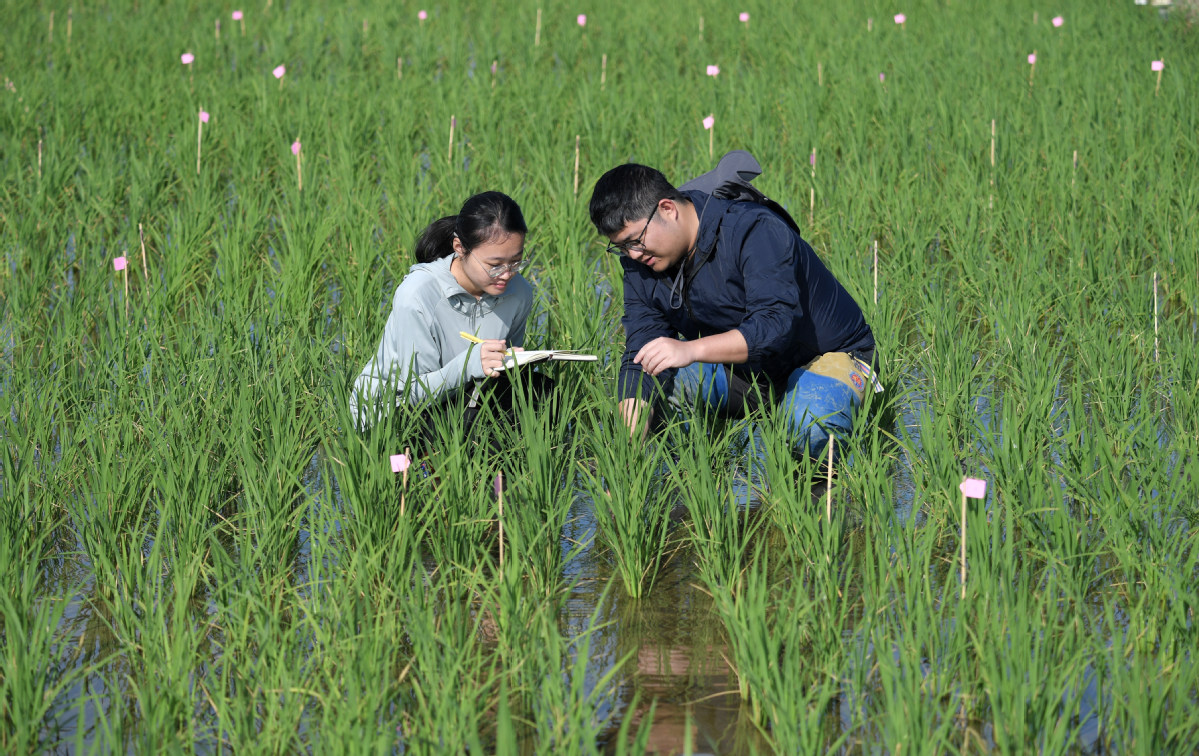
Agricultural researchers study agronomic traits of rice at Nanfan breeding base, Yazhou Bay, on Feb 10. ZHAO YINGQUAN/XINHUA
Nationwide effort
Agricultural innovation is also advancing at other Chinese institutions and research bodies.
At the China National Seed Group, researchers use an AI-powered, cloud-based system to remotely monitor fields and collect real-time data on crop health, enabling prompt intervention.
The Chinese Academy of Agricultural Sciences is also exploring the transition from experience-driven to data-driven breeding.
In the past, breeders tested thousands of combinations to find a single superior hybrid. Now, AI-powered genomic analysis predicts high-yield combinations before field trials begin, said Li Huihui, deputy director of the National Nanfan Research Institute of the Chinese Academy of Agricultural Sciences.
Li Jiayang, an academician at the Chinese Academy of Sciences, spoke highly of the concept of "intelligent creation of intelligent varieties", underscoring the potential of integrating AI, biotechnology and information technology to develop crops that autonomously adapt to environmental challenges.
Despite these advancements, challenges remain.
"Our country's total number of research papers in the seed field has surpassed that of the United States," said Wan Jianmin, an academician of the Chinese Academy of Engineering and former vice-president of the Chinese Academy of Agricultural Sciences.
"However, the connection between basic research and breeding application is not tight enough, and the innovation capacity in breeding theory and methodology is relatively weak," Wan said.
Wan also highlighted gaps in frontier biotechnology.
"Our R&D capability and level in biotechnology still lag noticeably behind the US. This is evident in core patents. While China's core patent quantity ranks second globally, the US holds far more high-value patents and controls the majority of core biotechnology patents," he added.
China's smart breeding sector also trails global seed giants in terms of data-sharing infrastructure and commercialization, said Qian Qian, another Chinese Academy of Sciences academician.
"Given the complexity of crop traits, understanding the relationship between genes and traits requires computational power and advanced algorithms," Qian said.
"Accelerating the development of high-yield, high-quality and climate-resilient 'super varieties' is crucial," Qian said, calling for interdisciplinary collaboration among breeding institutions, AI researchers and agribusinesses, to drive innovations in smart breeding.
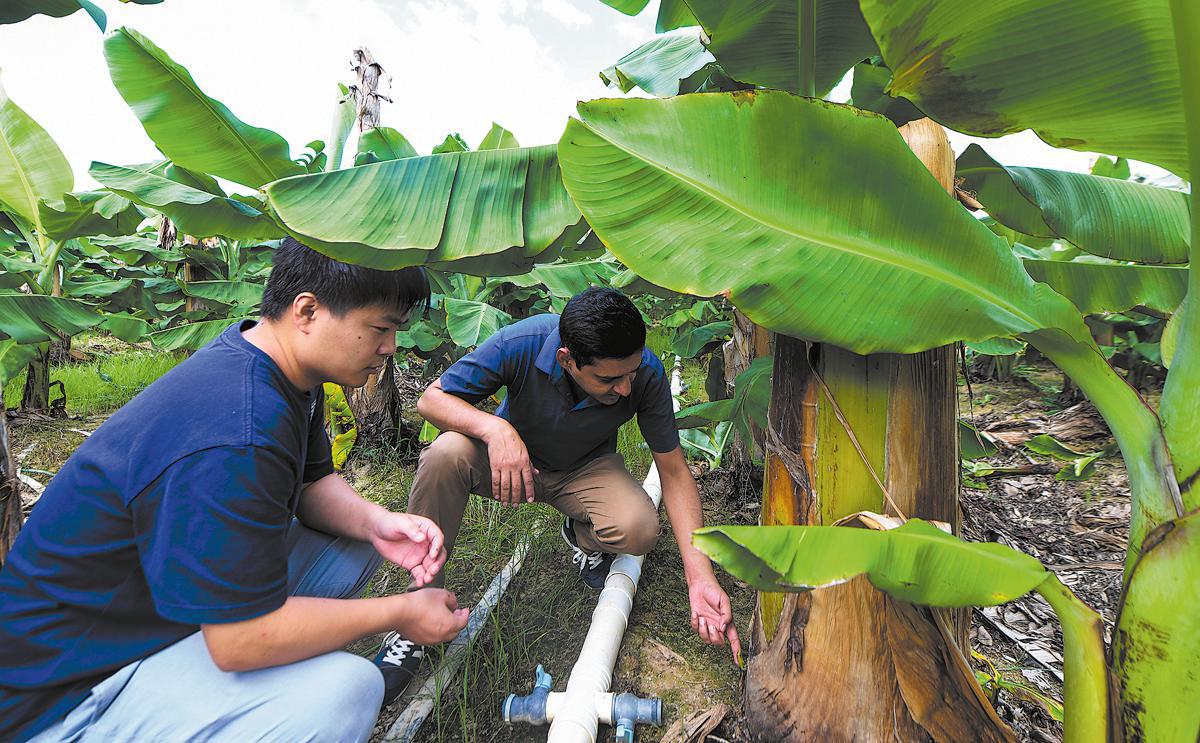
Experts examine bananas at a trial plantation in Yazhou Bay science and technology city in July. YANG GUANYU/XINHUA
Global quest
These endeavors have been built on a foundation of immense biological resources.
China hosts the world's largest and most structurally diverse repository of agricultural germplasm, according to the Ministry of Agriculture and Rural Affairs.
The latest national census of agricultural germplasm resources collected 139,000 new crop germplasm resources, providing a rich "source supply" for future breeding innovation.
The industry's scale is also expanding. The domestic seed market value surpassed 150 billion yuan ($21.51 billion) for the first time in 2023, while R&D spending reached 7.6 billion yuan, a 20 percent increase from 2021, according to People's Daily.
The use of AI in agriculture is not confined to China. Scientists and entrepreneurs worldwide are using algorithms to build a more resilient and productive food system.
In the US, the drive is spearheaded by a vibrant ecosystem of startups emerging from top research hubs.
Heritable Agriculture, a spin-off from Google X's moonshot factory, applies machine learning to analyze plant genomes, aiming to identify genetic combinations that enhance yield, reduce water use, and increase soil carbon storage — all without direct genetic modification.
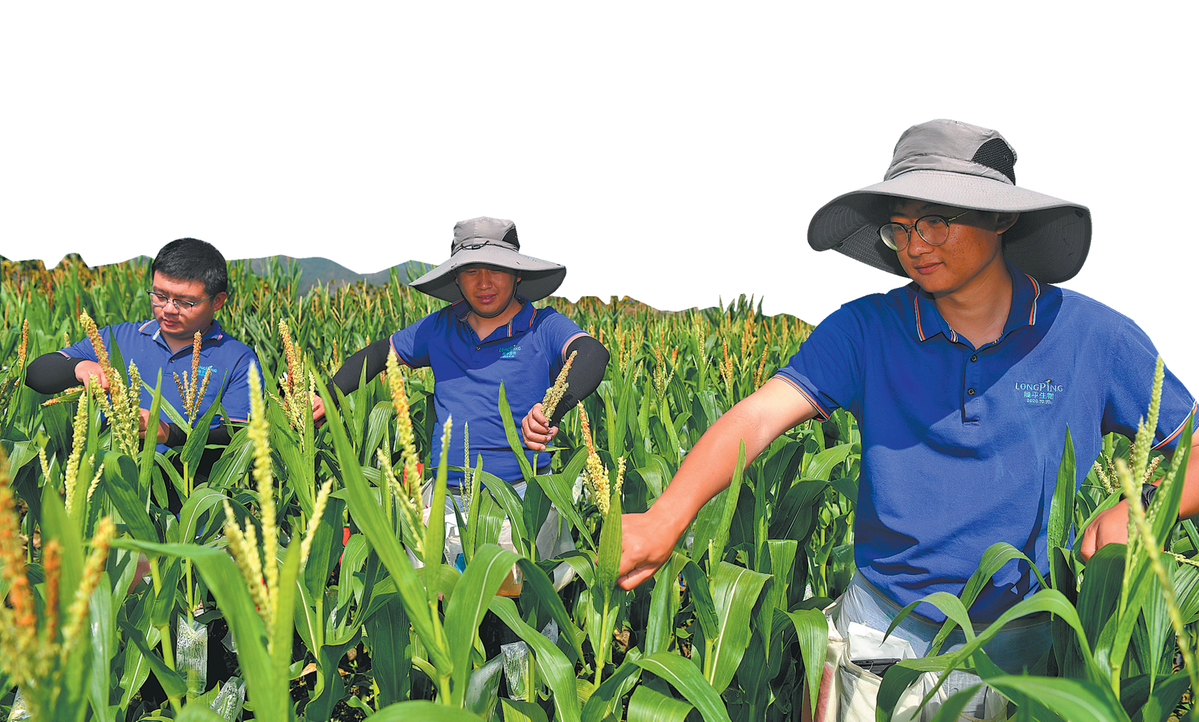
Researchers from Longping Biotechnology (Hainan) Co work on corn hybridization in Yazhou Bay science and technology city in February. ZHAO YINGQUAN/XINHUA
To share the technological progress it has made, the Yazhou Bay National Laboratory is also deepening international cooperation. In December, it signed a cooperation memorandum of understanding with agricultural research institutions from Colombia, Peru, Ecuador, and Chile.
"It is positive to strengthen Global South collaboration, integrating experience and knowledge from both sides to tackle food security and sustainability issues," said Agustin Zsogon, a professor at Brazil's Federal University of Vicosa.
Santiago Signorelli, a biochemistry professor at the University of the Republic in Uruguay, said China's advanced technologies hold great potential for contributing to scientific work in Uruguay.
From the experimental fields of Hainan to farms worldwide, a common narrative is emerging. The daunting challenges of climate change and resource scarcity are being met with the converging power of advanced biology and AI.
Huawei's Yuan said: "Our future collaboration prospects are very broad; this is just the beginning."
Photos


Related Stories
- Largest cargo port in Hainan FTP posts 65 percent surge in container traffic
- Island-wide special customs operations fuel Hainan's New Year holiday tourism boom
- New Year holiday duty-free sales surge 128.9 pct on China's resort island
- Expressway linking Dongcheng Town, Yangpu Port in south China's Hainan opens to traffic
- Hainan FTP becomes hot spot on policy breakthrough
Copyright © 2026 People's Daily Online. All Rights Reserved.
