



China shares AI-based early warning solutions to strengthen global climate resilience
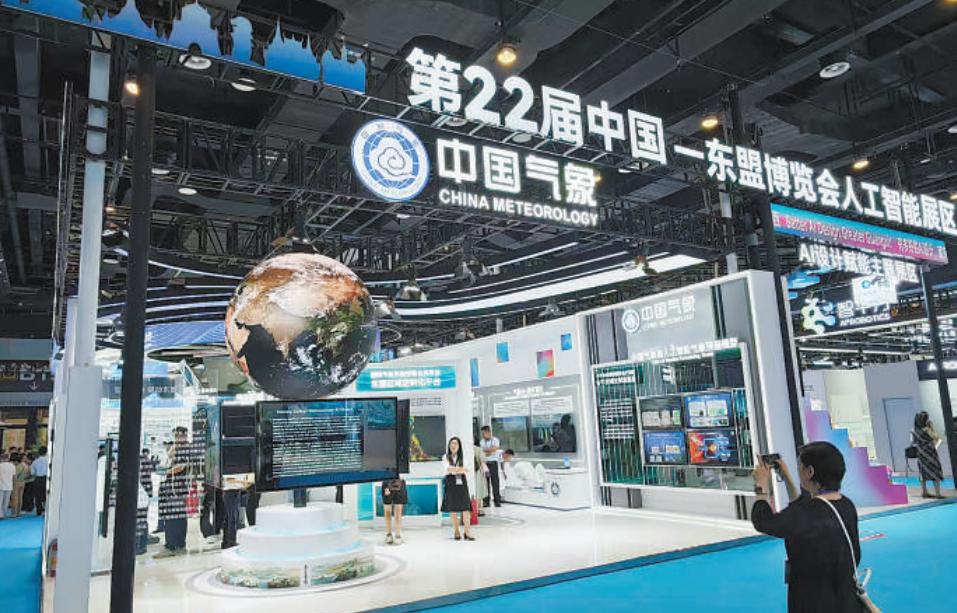
China's meteorological AI technology is exhibited at the 22nd China-ASEAN Expo.
Extreme weather events occur daily across the globe. In Afghanistan, severe convective weather may bring damaging hailstorms, while Uganda might experience convective storm systems with intense rainfall. These sudden, localized events remain challenging for forecasters worldwide.
China's AI technology now enables early detection of such threats in both nations. This capability facilitates timely evacuations and damage mitigation through the MAZU initiative -- a people-centered early warning system launched by the China Meteorological Administration (CMA) in response to UN priorities. M stands for Multi-hazard, A for Alert, Z for Zero-gap, and U for Universal.
The cloud-based MAZU platform deploys specialized AI "toolboxes" that provide end-to-end solutions for meteorological risk management: from monitoring and forecasting to warning dissemination and emergency response. Each toolbox is customized to national needs:
In Pakistan, a joint CMA-Pakistani system addresses glacial lake outburst floods, monsoon surges, and torrential rains occur frequently (operational since October 2025). Mongolia's system integrates FY-2H meteorological satellite snow data with localized alerts for blizzards, sandstorms, and dzud (winter disasters). "The workflow prompts generate practical guidance in our language," noted a Mongolian meteorological official.
Today, the platform's capabilities continue expanding. Two AI-based meteorological forecasting systems -- Fengqing and Fengshun -- released by CMA in June 2024, have now been fully integrated into the MAZU cloud platform.
Applications are also expanding, covering a wider range of meteorological hazards as well as risk scenarios in cities, agriculture, and other sectors.
"MAZU currently operates in five countries with 43 others testing across Asia, Africa and Oceania," said Zeng Qin, director of the Department of International Cooperation of CMA.
Alongside its global technological contributions, China is fostering "soft" cooperation through comprehensive capacity-building efforts. This includes targeted training programs, visiting scholar initiatives, and other measures designed to cultivate professional talent in partner countries.
Specifically, between 2025 and 2027, CMA is expected to provide more than 2,000 short-term training opportunities for developing countries in areas such as early warning, risk assessment, and climate change, along with scholarships for 100 master's and doctoral students and funding for 50 long-term visiting scholars.
The global appeal of the MAZU solution stems directly from China's accelerated modernization of its meteorological science and technology capabilities. Continuous progress has been made in meteorological satellites, weather radar, numerical forecasting, AI applications, and big data, with observation and forecasting systems advancing in a tightly integrated manner and overall capacity steadily strengthened.
Today, virtually every weather process on Earth—especially extreme events such as typhoons and torrential rains—can be observed, forecast, and serviced by China's meteorological system.
China's independently developed AI meteorological models are now recognized as being at the global forefront, alongside those developed in Europe and the United States.
Their performance speaks for itself. For example, generating a global forecast at a 10-kilometer grid resolution takes about two hours using traditional numerical models, while Fengqing delivers results in just half an hour, matching the performance of leading international meteorological models.
Severe convective events featuring strong winds, small hail, and short-duration heavy rainfall pose major challenges for conventional forecasting, yet Fenglei can detect warning signals an hour in advance. During the 2025 flood season outlook, Fengshun successfully identified the distribution patterns of China's major rain belts a full month ahead.
These advanced AI meteorological models are made open-source on MAZU's cloud-based technical platform, providing services to users worldwide.
By transforming cutting-edge technology into tangible, accessible disaster-risk reduction outcomes, China's meteorological AI is crossing mountains and seas. The Chinese solution is becoming a vital force in strengthening global early warning, helping countries around the world build safer and more resilient communities.
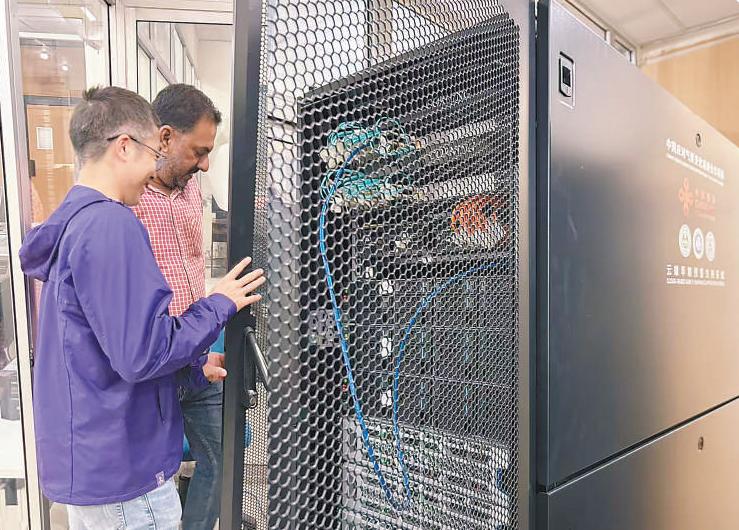
A Chinese and a Pakistani meteorologist communicate with each other over the deployment of meteorological AI systems.
(Photos provided by the China Meteorological Administration)
Photos


Related Stories
- China-developed AI technologies to be applied at FIFA World Cup 2026
- Chinese tech firms' CES displays reveal leap in manufacturers' innovation power
- China aims for secure, reliable supply of AI core tech by 2027
- Chinese tech firms draw crowds at CES as global AI rivalry heats up
- Beijing targets trillion-yuan AI industry within two years under new action plan
- 2025 Recap: Where People's Daily reporter goes
- 'Digital China' the priority for 2026
- China’s AI start-ups, humanoid robot firms set to dazzle CES 2026
- Chinese e-platform pushing AI education globally
- AI has finger on pulse of healthcare advances
Copyright © 2026 People's Daily Online. All Rights Reserved.
