



Embodied intelligence industry shows big leap forward in 2025
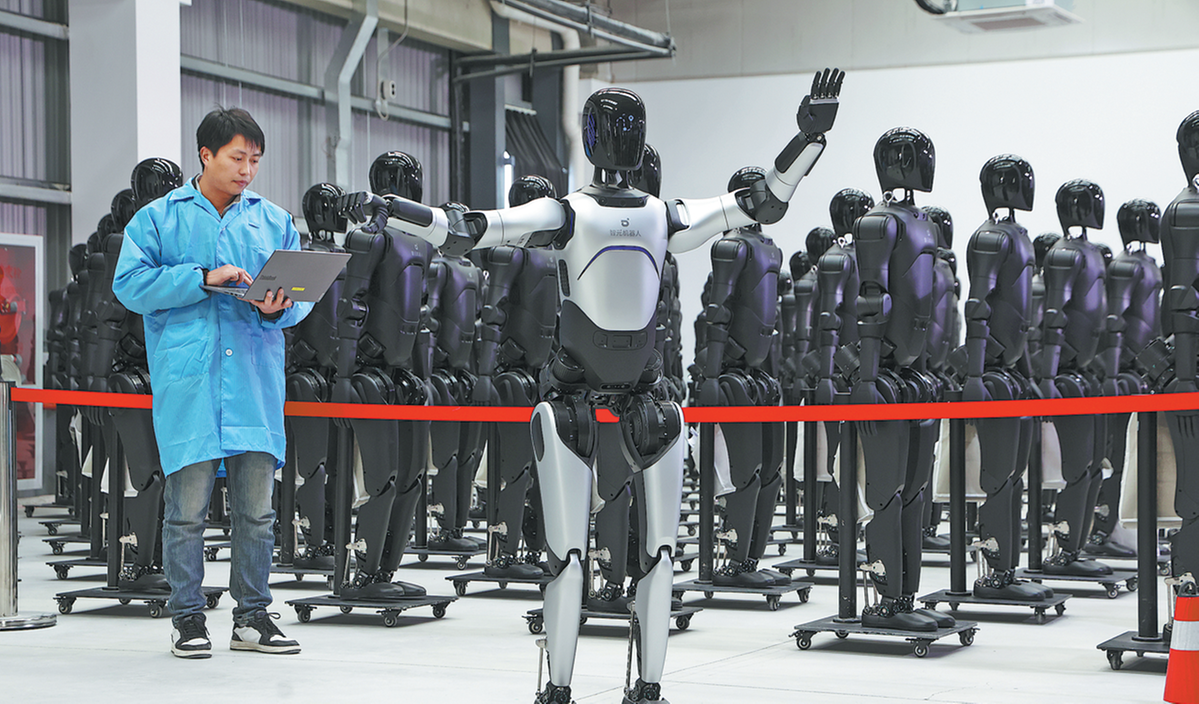
An engineer debugs robots from Shanghai AgiBot Innovation Technology Co Ltd at its mass production factory in Shanghai on Dec 8. TANG YANJUN/CHINA NEWS SERVICE
Embodied intelligence was one of the most widely discussed topics in China in 2025, starting from the 16 humanoid robots that took center stage at the annual Spring Festival Gala, to the world's first-ever competition to test robots' skills, which was held in Shanghai at the end of the year.
In early December, Chinese industry leader Shanghai AgiBot Innovation Technology Co Ltd announced that its 5,000th general-purpose embodied robot had officially rolled off the production line. According to the company's cofounder Peng Zhihui, this milestone has not only proven AgiBot's capability for large-scale delivery, but more importantly, demonstrated to the entire industry the feasibility of mass production of general-purpose embodied robots.
The National Development and Reform Commission, the country's top economic regulator, said in November that China's embodied intelligence industry is leaping forward, with its industrial value set to surge by 50 percent annually to reach 100 billion yuan ($14.2 billion) in 2030.
In the second half of 2025, the total value of orders claimed by Chinese humanoid robot companies exceeded 2 billion yuan.
Investments have also flowed into the sector.
Data from venture capital database ITjuzi showed that the total primary market financing for the robot industry amounted to over 38.6 billion yuan in the first eight months of 2025, which was 1.8 times the whole-year figure in 2024.
A number of industry leaders have filed their initial public offering applications or are making preparations for their stock market debut. Nearly 50 companies announced their IPO progress within 2025.
Unitree Robotics, the maker of the 16 robots that performed at the Spring Festival Gala, completed its pre-listing tutoring in November. The company's market value has already topped 12 billion yuan after it completed a Series C financing in May.
Yang Ming, a professor at Shanghai Jiao Tong University and an expert in robotics, said that IPOs are vital to leading robot companies when the scale of private equity can no longer meet their capital demands for technology upgrading and the expansion of production capacity.
Ever since early November, an increasing number of A-share companies have tapped into the robotics sector by setting up subsidiaries, equity financing and signing cooperation agreements, according to Yu Fenghui, a senior researcher at public policy think tank Pangoal Institution.
This trend takes place when the industry maturity seamlessly matches the market demand, he said. The localization of key parts and lowered costs have provided the best time window to enter this emerging sector. Listed companies' capital and industrialization strength will become important impetus for the development of the Chinese robot industry, he added.
Asset managers have also eyed this emerging sector.
According to market tracker Wind Info, mutual fund companies conducted more than 600 surveys in the fourth quarter of 2025, mostly focusing on artificial intelligence and robot companies. Sovereign wealth fund Abu Dhabi Investment Authority surveyed five A-share companies in the fourth quarter, four of which are robot-related.
Cheng Xin, global partner at consulting firm Bain &Co, explained that the capital market is directing more attention to component suppliers and humanoid robot makers at present. In the meantime, companies in these two sectors are actively looking for financing, including those specializing in model algorithm, chipmaking as well as the production of key components such as gear reducers and motors.
Investors eye several key indicators while looking for the right target. In the first place, investors should consider how extensively the technology or parts are used from a global perspective, rather than regionally. In other words, the technology or parts should have growth potential worldwide, said Cheng.
A competitive robot company should have enough capability in lowering costs. Its technology or product should be applicable in different industries, as relying on only one core technology may entail higher risks, he said.
"But it should be noted that the humanoid robot industry is at a turning point. With more technology breakthroughs and further reductions in cost, they will become the core production tool in industries, businesses and families. For investors, companies and clients aiming to use robots, this is the best time to make relative strategies so that they can take the upper hand in the upcoming competition," said Cheng.
Market research firm IDC estimates that China's expenditure on humanoid robots would exceed $1.4 billion in 2025 and the number will surge to $77 billion in 2030.
Driven by supportive government policies, an active capital market, and coordination within the robotics industry, China's humanoid robot sector is making a major step forward from technological breakthrough to real-world value realization, said Li Junlan, a research manager for IDC.
Photos



Related Stories
- Baby robot lion dancers light up Beijing
- Yearender: China's humanoid robots step from spectacle toward scalable industrial reality
- Unitree to open its first physical robot experience retail store in Beijing
- China’s robot rental orders surge at year-end
- 2025 First Global Humanoid Robot Street Dance Invitational to be held in Guangxi
Copyright © 2026 People's Daily Online. All Rights Reserved.
