



Enhancement of the automobile supply chain in the Greater Bay Area
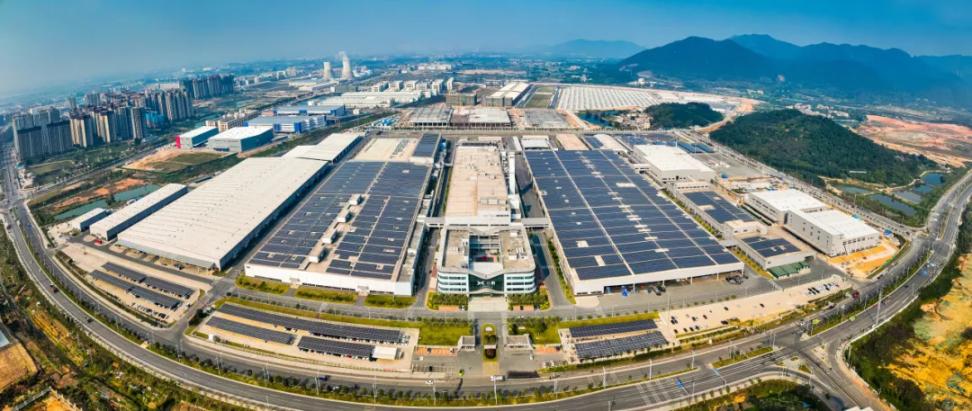
Photo shows Chinese automaker XPeng Motors' Zhaoqing plant in south China's Guangdong province. (Photo/Wang Zhenyu)
For automakers, the strength of local supporting industries is crucial to optimizing production efficiency. At the Zhaoqing facility of Chinese automaker XPeng Motors in south China's Guangdong province, the presence of a well-developed supply network is playing a significant role in accelerating the company's growth.
Bojun, a key supplier of automotive body components for XPeng, is situated less than two kilometers from the plant. In March 2023, when XPeng planned to launch production of a new model at the Zhaoqing plant, Bojun responded rapidly by investing in a nearby facility. According to Liu Yongjie, XPeng's vice president of supply chain, the facility achieved mass production and began stable deliveries within six months.
So far, Bojun has supplied more than 200,000 sets of body components for this model alone. "When production lines experience urgent demand, parts can be delivered within half an hour. Even deliveries to XPeng's manufacturing base in Guangzhou, capital of Guangdong province, take approximately 1.5 hours," Liu added.
The proximity to the factory also benefits other suppliers. "Being close to the factory allows us to respond to demand in real time, and deliveries are typically completed the same day," said Xin Yonghua, a representative of a headlamp supplier of XPeng.
Today, the Zhaoqing Hi-tech Industrial Development Zone, which houses XPeng's plant, is home to more than 100 new energy vehicle (NEV) and automotive parts companies. The zone is rapidly developing a diversified industrial landscape encompassing vehicle manufacturing, key components, automotive electronics, safety systems, lightweight materials, charging infrastructure, and after-sales services. An expansive NEV industrial cluster, with a projected output of 100 billion yuan ($14.23 billion), is beginning to take shape.
For the NEV sector, electrification represents the "first half" of development, while intelligent connectivity defines the "second half." As the industry transitions into the era of smart driving, supply chains are shifting focus from traditional hardware components toward software, artificial intelligence, and broader innovation ecosystems.
In August 2025, XPeng Tech Park officially opened in Tianhe Smart City, a central area in Guangzhou's technology district. The park brings together 59 companies involved in intelligent connected vehicles and NEVs, with supply-chain partners strategically located across various floors, forming an integrated and cohesive supply chain within the park itself.
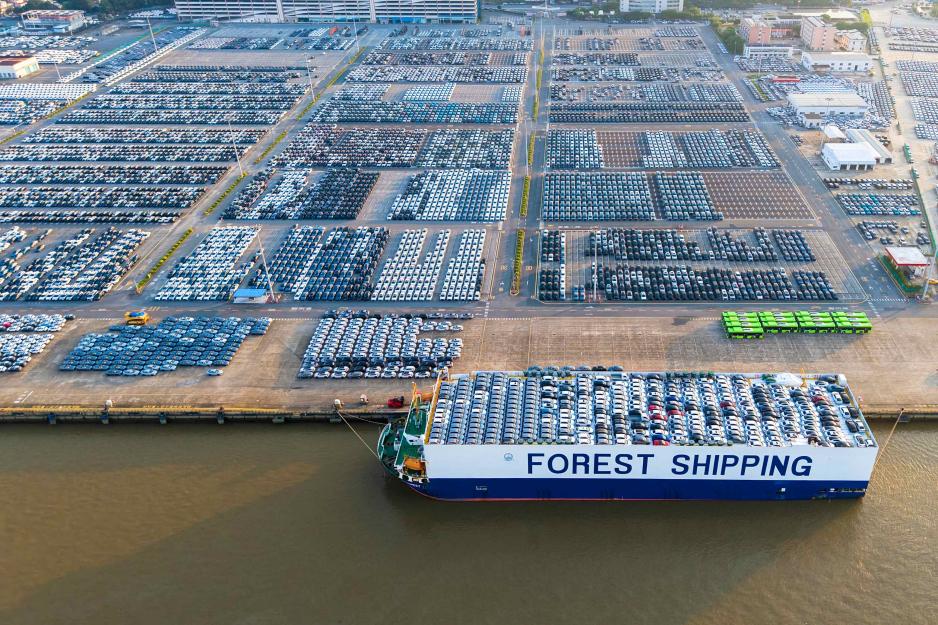
Automobiles are about to be shipped overseas at Nansha automobile terminal of Guangzhou Port in south China's Guangdong province. (Photo/Lyu Huadang)
"Following our relocation to Tianhe Smart City, our testing equipment and analytical software are now deeply integrated into the entire NEV research and development process," said Hu Jian, executive vice president of Guangzhou Zhiyuan Electronics Co., Ltd., a software supplier of XPeng. "This closer integration has facilitated stronger collaboration throughout the full development cycle."
The Guangdong-Hong Kong-Macao Greater Bay Area, with its robust industrial clustering, advanced charging infrastructure, and forward-looking policy support, has cultivated a highly competitive automotive ecosystem. As an international hub for finance, trade, and shipping, Hong Kong plays an important role in providing high-end services and advancing the industry's global integration.
According to an official with the Department of Industry and Information Technology of Guangdong Province, Guangdong is now home to not only leading automakers such as BYD, GAC, and XPeng, but also a growing number of key component and technology companies, including Huawei, CanSemi, and Inpai Battery. The province has developed strong capabilities in batteries, electric motors, electronic control systems, intelligent cabinets, and autonomous driving solutions.
A complete industrial chain, covering vehicle manufacturing, battery, motor, electronic control systems, intelligent driving, and charging infrastructure, is in place, with the province's capacity for independent and sustainable development continuing to strengthen, the official said.
Photos




Related Stories
- Where land, sea and air meet in South China
- Guangdong-Hong Kong-Macao Greater Bay Area accelerates growth in low-altitude economy
- GBA integration hits milestone with official launch of cross-boundary private car travel scheme
- Culinary adventure in the Greater Bay Area: An Italian Gen Z's first taste of Cantonese cuisine
- Greater Bay Area's intangible cultural heritage captivates Italian student
- American college student explores human-centered tech in China's Greater Bay Area
- Touching the Greater Bay Area: American college student meets China's humanoid robots
- Art meets tech: American college student explores Chinese innovation in the Greater Bay Area
- Expats glimpse the future in Shenzhen
- American college student dives into Greater Bay Area's vibrant sports culture
Copyright © 2026 People's Daily Online. All Rights Reserved.
