



Shandong develops integrated commercial space industry anchored in offshore launches

Photo shows the command center of the Oriental Aerospace Port. (Photo from the official account of the publicity department of Haiyang, Yantai on WeChat)
How long does it take to transport a rocket from the factory floor to its launch site? At the Haiyang Oriental Aerospace Port in Haiyang, Yantai, east China's Shandong province, the process now takes just two hours. This remarkable efficiency is the result of a carefully planned industrial framework supporting commercial space development.
As the global commercial space industry becomes a new frontier of global technological competition and industrial transformation, Shandong province, traditionally a manufacturing stronghold, is positioning itself as a rising force. Through coordinated regional development and integrated capabilities, the province is building a comprehensive, full-chain commercial space ecosystem.
The province entered the spotlight in June 2019, when China completed its first-ever offshore rocket launch in the Yellow Sea, with Haiyang Port serving as the mission's support harbor. Seizing the opportunity, Yantai launched the Haiyang Oriental Aerospace Port to establish a dedicated offshore launch base.
"Haiyang Port combines favorable natural conditions with a strong industrial base, making it well-suited for regular offshore launches," said Wang Xiaoming, assistant general manager of the Haiyang Oriental Aerospace Port Group. Located on the Yellow Sea, the area benefits from stable meteorological conditions and flexible launch windows, enabling a wide range of orbital missions, including low-inclination and sun-synchronous orbits. More importantly, Yantai's strong marine engineering and equipment manufacturing capabilities provide essential industrial support for aerospace operations.
To address key challenges in the aerospace industry, such as long production cycles, limited launch capacity, and high costs, the Haiyang Oriental Aerospace Port adopted a focused industrial attraction strategy early in its development. Efforts have centered on building reliable offshore launch infrastructure, attracting leading research and manufacturing enterprises, and establishing a supporting industrial ecosystem that spans rocket production, satellite development, and data applications.
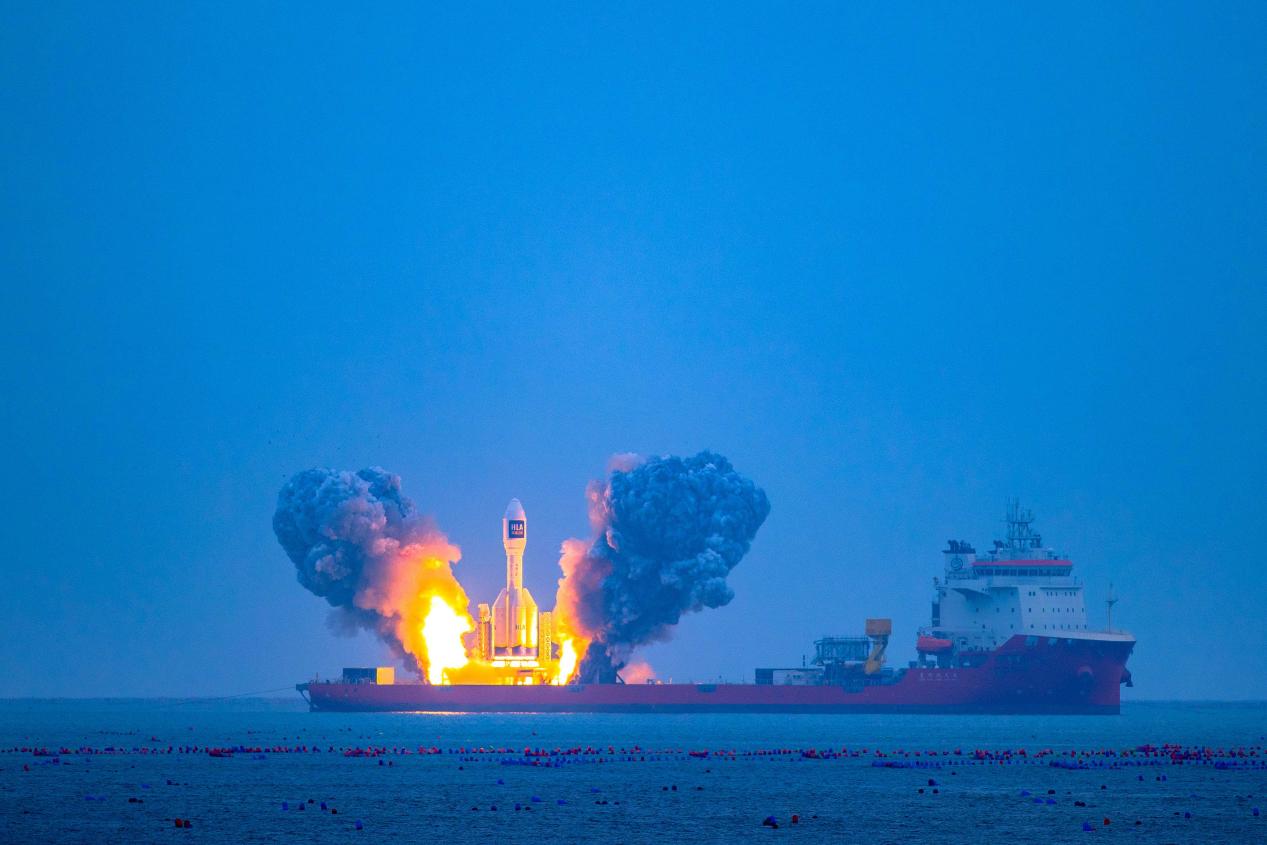
A Gravity-1 carrier rocket blasts off from waters off the coast of Haiyang, east China's Shandong province, Oct. 11, 2025. (Photo/Wang Yueguo)
"This 'point-to-area' approach has expanded our scope beyond launch services to encompass upstream R&D and manufacturing of rockets and satellites, as well as downstream aerospace information services," said Zhang Hua, deputy general manager of the Haiyang Oriental Aerospace Port Group. "Our ultimate objective is to establish a fully integrated commercial space ecosystem."
At the Haiyang Oriental Aerospace Port, a six-kilometer "Aerospace Avenue" stretches east to west, serving not only as a road but as the industrial backbone of the zone. It connects key facilities, including rocket assembly and testing centers, a satellite industrial park, a data application center, and the offshore launch wharf.
"Under an integrated model that co-locates port and manufacturing facilities, and combines production with launch operations, rockets can be transported from the final assembly building to a dedicated dock in just over ten minutes, where they are seamlessly loaded onto the launch vessel," said Teng Yao, chief engineer of the Haiyang Oriental Aerospace Port Group.
This model overturns the traditional approach, in which rockets are transported over long distances, disassembled and reassembled, significantly reducing both logistical risks and operational costs.
As China's first and currently only commercial offshore launch home port, the Haiyang Oriental Aerospace Port has completed more than 20 offshore launches, deploying over 130 satellites into orbit. This capability has helped catalyze the formation of a commercial space industry cluster centered on rocket manufacturing, satellite applications, and advanced supporting industries. To date, the port has attracted 30 aerospace-related projects with a combined investment exceeding 32 billion yuan ($4.55 billion).
In Jinan, the provincial capital, Shandong has established its first intelligent satellite manufacturing line at the Jinan satellite AIT (assembly, integration, and testing) industrial base. In this highly automated facility, guided vehicle transport satellite components to a six-axis robotic arm that assembles them with precision. Dubbed a "space embroiderer" for its accuracy, the system is capable of producing up to 100 satellites annually, each weighing 500 kilograms. The facility was developed by Jigang Group, which transitioned from steelmaking to high-end manufacturing after shutting down its steel operations eight years ago.
Jigang Group's transformation leverages its deep industrial manufacturing heritage. To overcome the shortage of specialized talent for satellite production, the local government worked closely with the company to implement targeted recruitment policies, providing a strong foundation for rapid development.
This transition exemplifies Shandong's coordinated approach to commercial space development. Anchored by offshore launch capabilities, the province is cultivating a differentiated yet industrial layout: Yantai focuses on offshore launches and rocket manufacturing; Jinan and Tai'an concentrate on liquid-fueled rocket development, testing, and satellite R&D and applications; while Qingdao specializes in measurement, tracking, and control systems, as well as marine remote sensing, supporting both national initiatives and commercial satellite constellations.
By 2027, Shandong is expected to have established a relatively complete commercial space industrial chain, with the capacity to produce 100 launch vehicles and 150 commercial satellites annually. The province's commercial space industry is projected to reach 50 billion yuan by then.
Photos



Related Stories
- Mouse astronaut selection vlog
- 'Cosmic snapshot' mirrors China's strength in innovation
- China awards medals to Shenzhou-19 astronauts
- China’s Ministry of State Security urges crackdown on space espionage
- Tianwen-2 probe operating smoothly in orbit: CNSA
- China launches Shenzhou-20 manned spaceship: a milestone in the country's space journey
- China unveils new cargo spacecraft
- Astronauts embark on six-month space trip
- 10th Space Day marked across China
- China's space partnerships: advancing technology for the betterment of humanity
Copyright © 2026 People's Daily Online. All Rights Reserved.
