
Tue,Dec 16,2014
 Bikini show in 2014 China Final of Miss Tourism World
 Close-up view of August Aerobatic Team
 Goddesses married in 2014
 Polar region photos raise worldwide awareness of global warming
 Get off at the last stop — Beijing Subway in vision
 Top 100 beauties in the world!
 Gallery: Who is the most beautiful one?
 If you like autumn, put your hands in the air!
 Fan Bingbing's "Queen style" in new play
 Lingerie show at 2014 Miss China
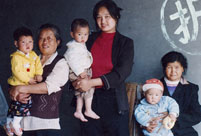
Experts are calling for an accelerated scrapping of the one-child policy as the nation's birthrate moves toward a dangerously low level.
The fertility rate in China is now 1.4 children per woman, almost touching the warning line of 1.3 that is recognized globally as the "low fertility trap", according to a report released by the Chinese Academy of Social Sciences on Monday.
Once a country falls into the low fertility trap, three self-reinforcing mechanisms-demographic, sociological and economic-work toward maintaining a downward spiral in fertility that is difficult to recover from, the report said.
Thanks to the one-child policy, China's birthrate has dropped from 4.77 births per woman in the 1970s to 1.64 in 2011, according to official statistics. However, the positive effects of slowing population growth have gradually disappeared since 2010.
"The low fertility rate will result in other problems such as a shortage in the labor force and the economic burden from an aging society," said Lu Yang, an associate researcher from the Institute of Population and Labor Economics at the Chinese Academy of Social Sciences.
She said scrapping the one-child policy nationwide will not have an effect on the population and the economy in the short term, but will contribute to an increase in the labor pool and economic stability in future.
In November last year, the national government eased some restrictions, allowing a couple to have a second child if either of them is an only child.
The policy has been implemented in many cities and provinces, but is not yet in place nationwide. The National Health and Family Planning Commission estimated that the second-child policy would add about 2 million births a year to China's current 15 million annual births.
However, the commission indicated that only 700,000 couples applied to had a second child by Nov 5.
"The expected baby boom didn't arrive. And people's willingness to have babies will decline with economic development. The earlier we promote a second-child policy, the sooner we will see the positive effects it brings," said Cai Fang, deputy director of the Chinese Academy of Social Sciences.
Cai said that the positive effects of increasing the fertility rate will emerge after 2030.
"Of course some negative results will also come with the new population policy, but they are very limited compared to the benefits the policy would bring," he said.
By 2050, one-third of the country will be aged 60 years or older, and there will be fewer workers supporting each retired person.
 Beautiful Chinese woman
 20 years on: Relocated Three Gorges residents through lens
 PLA HK Garrison veterans leave behind beautiful smiles
 Chestnut girl goes viral online
 Representative beauties
 Victoria's Secret Fashion Show
 Excellent photos of Zhuhai Air Show
 In photos: Bright and brave female soldier of PLA
 China's charming first lady
 Disrespecting memorial days crosses a line
 More efforts needed in ITA talks: experts
 China’s burgeoning pageant industry a mess
 South Korean educator brings positivity campaign to China’s Internet
Day|Week|Month